Junko Koeda
Bank of Japan
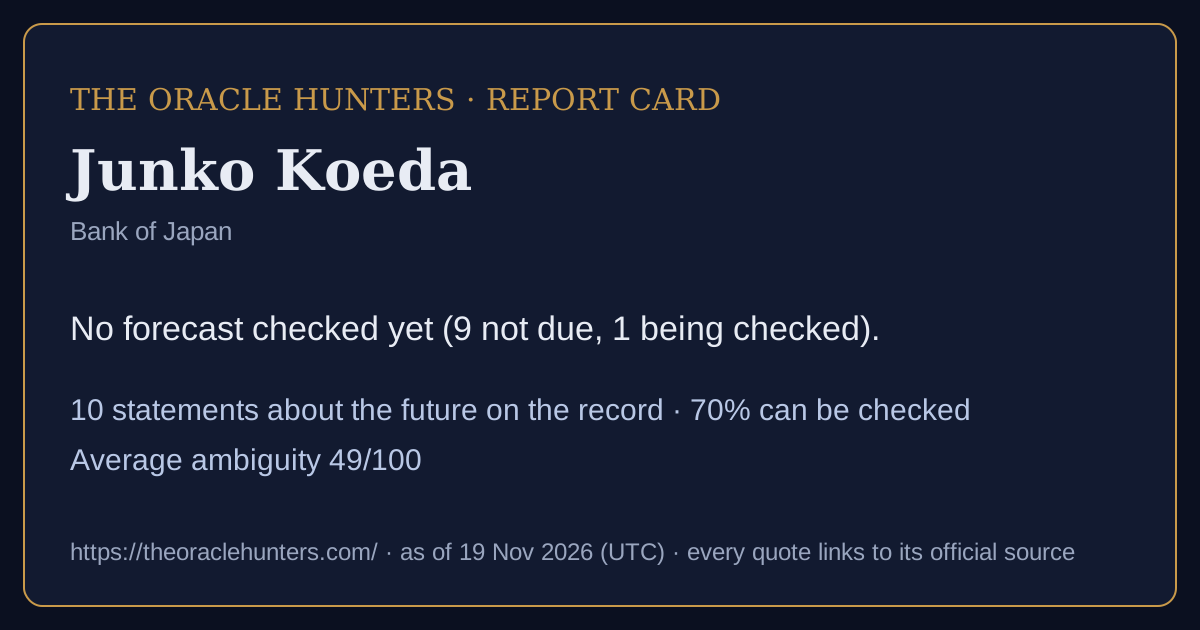
Track record: No forecast checked yet (9 not due, 1 being checked).
10forecasts & commitments on the record
70%can be checked as stated
49average ambiguity (0-100)
0goalpost moves recorded
0confirmed U-turns
Timeline
came true partly did not not due / being checked / too vague
Calibration score: shown after 10 checked forecasts with a stated likelihood (now 0).
How they speak about the future: educated guess 5, based on data 4, stated on authority 1.
Kinds of claim: forecast 5, scenario (if… then) 5. · Download this report card as a picture
In the nine words
πρόνοιαPreparing for the future5 · 50%πρόγνωσιςInference from evidence4 · 40%μαντείαInspired knowledge1 · 10%
How to read this
Each box is one sentence a public figure or institution said about the future, word for word, with a link to the official text. Can be checked means it names what will happen, by when, and how likely - so it can be compared with official figures later. Too vague to check means it does not. Ambiguity (0-100) is how many different ways the sentence can be read. When the date passes, the forecast is compared with official data and marked came true, partly or did not come true. Labels judge the sentence, never the person. Full guide and glossary.On the record (10)
If the potential growth rate remains stable, real interest rates could deviate further from the natural rate of interest in a negative direction when inflation or inflation expectations rise.
Conversely, if risk premiums affected by inflation can be contained, even if short-term interest rates rise, long-term interest rates will not necessarily follow suit.
Conversely, the likelihood of realizing the baseline scenario of the outlook could rise again, if risks surrounding economic activity and prices decline due to, for example, progress in ceasefire negotiations.
Given the situation in the Middle East, I see some possibility that underlying inflation may exceed 2 percent looking ahead.
If the profits of exporting firms and their fixed investment decline, this could also exert downward pressure on the economy.
If trade policy, among other factors, exerts downward pressure on overseas economies, Japan's external demand will likewise be undermined.
The Bank will conduct an interim assessment of the plan at the June 2026 MPM.
- Until January-March 2026 : about 400 billion yen (the reduction plan decided in July 2024 will be maintained)
The Bank will conduct an interim assessment of the reduction plan at the June 2026 MPM.
U.S. tariff policy launched this year may not have as significant an impact as previous major external shocks, but given the high degree of uncertainty, the need has arisen to ascertain the extent of the shock's impact.
Also said - not checkable as stated (2 newest)
Remarks about the future with no date, figure or likelihood that could be checked. They are kept on the record and shown here, but not scored.
Against this recent background, I believe the Bank of Japan needs to assess how long the present situation in the Middle East will last, what kind of impact it will have on the global economy, to what extent external demand will weaken, and, under these circumstances, how Japan's net exports will change in light of current exchange rate levels.
The Bank also needs to monitor how the rise in crude oil prices will affect Japan's economic activity and prices.