Juliette Enser
Competition and Markets Authority · GBR
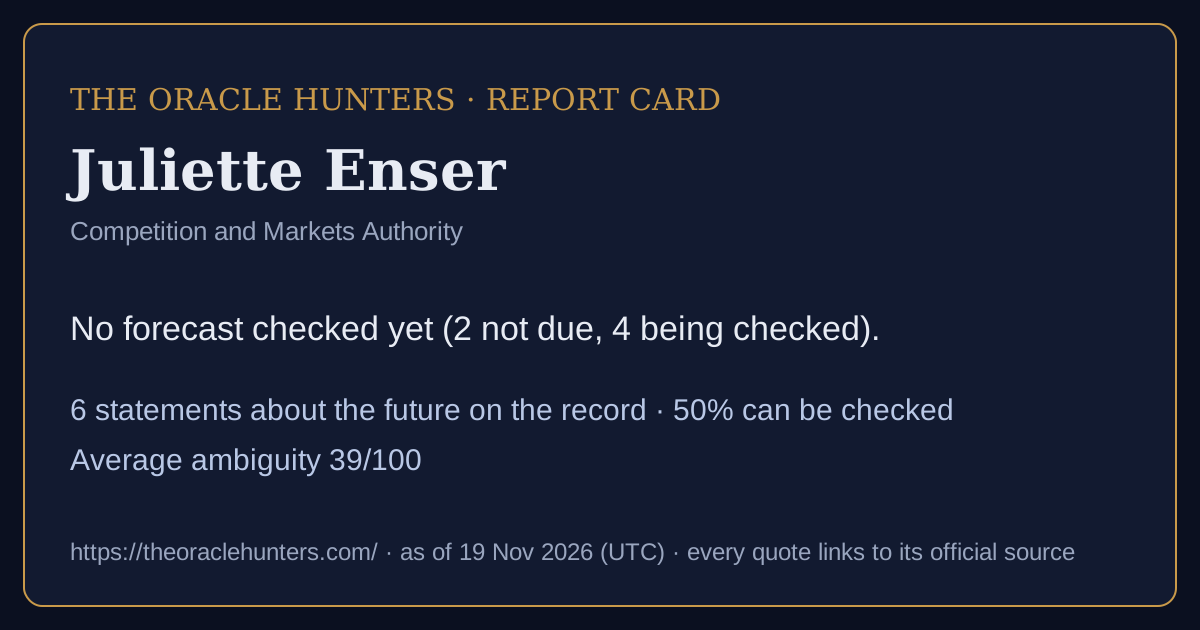
Track record: No forecast checked yet (2 not due, 4 being checked).
6forecasts & commitments on the record
50%can be checked as stated
39average ambiguity (0-100)
0goalpost moves recorded
0confirmed U-turns
Timeline
came true partly did not not due / being checked / too vague
Calibration score: shown after 10 checked forecasts with a stated likelihood (now 0).
How they speak about the future: stated on authority 3, based on data 3.
Kinds of claim: forecast 4, mixed claim 2. · Download this report card as a picture
In the nine words
How to read this
Each box is one sentence a public figure or institution said about the future, word for word, with a link to the official text. Can be checked means it names what will happen, by when, and how likely - so it can be compared with official figures later. Too vague to check means it does not. Ambiguity (0-100) is how many different ways the sentence can be read. When the date passes, the forecast is compared with official data and marked came true, partly or did not come true. Labels judge the sentence, never the person. Full guide and glossary.On the record (6)
To put an end to the investigation, the manufacturer has offered not only to put in place guarantees about how it will interact with healthcare providers going forward – including conducting a communications campaign designed to clarify the position in relation to the relative safety of the rival drug – but also to make a payment of £23 million directly …
The OECD estimates that, where present, bid-rigging may inflate prices by 20% or more.
The introduction of the DMCCA next year represents a significant development, ushering in a tailor-made regime, designed to unlock growth and opportunities in the tech sector in the UK.
This will supplement the legislation being prepared by government which we expect to be brought forward this year.
Those of you who have been involved with implementing IT solutions will know that this can be demanding work, but we have an experienced team working on the project and are comfortable that we are on track to accept notifications through an online system in March 2019, if we are called upon to do so.
We are therefore working to produce guidance, which we expect to publish early next year – this guidance will explain how we will conduct substantive assessments as well as how to notify us of a new aid measure or initiate a complaint.
Also said - not checkable as stated (12 newest)
Remarks about the future with no date, figure or likelihood that could be checked. They are kept on the record and shown here, but not scored.
We have also recently made changes to the guidance covering our procedures intended to help us work at pace, for example, by setting clear expectations about how we will go about identifying legally privileged documents among material acquired during inspections.
First, you should expect us only to open a formal investigation where we consider it is warranted by the expected impact should we conclude that an infringement has taken place – whether the direct impact that might result if we put an end to unlawful conduct and/or through the deterrent message that we would send, whether to a firm, sector …
In practical terms, this means you can also expect that in many cases we will aim to achieve a change in behaviour without carrying out a full (or indeed any) formal investigation.
Thirdly, where we can do so without undermining deterrence, we will seek to put an end to the matter by consensus, whether through our settlement or commitments procedures.
With that in mind, we intend to publish a ‘Complaints Charter’ that is intended to make our complaints process more accessible and predictable: for example, information about how to make a complaint, and what you can expect by way of response, including how quickly complainants should expect to hear back from us.
While I cannot say much about these investigations now because of the stage they are at, we anticipate that our current and future work in the area of labour should help bring home to businesses their obligations in this area, as well as ultimately helping reduce labour market frictions.
While we are clear in our intent to take action against illegal labour market cartels, consistent with what I’ve already said about not chilling beneficial outcomes, this obviously does not mean the CMA will or should step in to use our competition enforcement powers in every case involving labour relations.
For example, as we have already made clear, the CMA does not expect that we will stand in the way of genuine collective bargaining between self-employed workers (including through their representatives such as trade unions) and their employers.
Now of course this does not mean that we will be neglecting to tackle conduct with a more localised impact, and much of the conduct that I’ve talked about - in labour markets and in public procurement – is largely national or even local in nature.
Assuming that these negotiations are successful, the UK will remain within the EU’s state aid regime for the duration of the implementation period and the European Commission will continue to receive and assess notifications from UK aid grantors.
Our new role means we will need to examine notified aid, investigate complaints and, more generally, ensure compliance with the rules.
We anticipate that we will be dealing with 20 to 30 cases annually, spanning a wide range of industries.