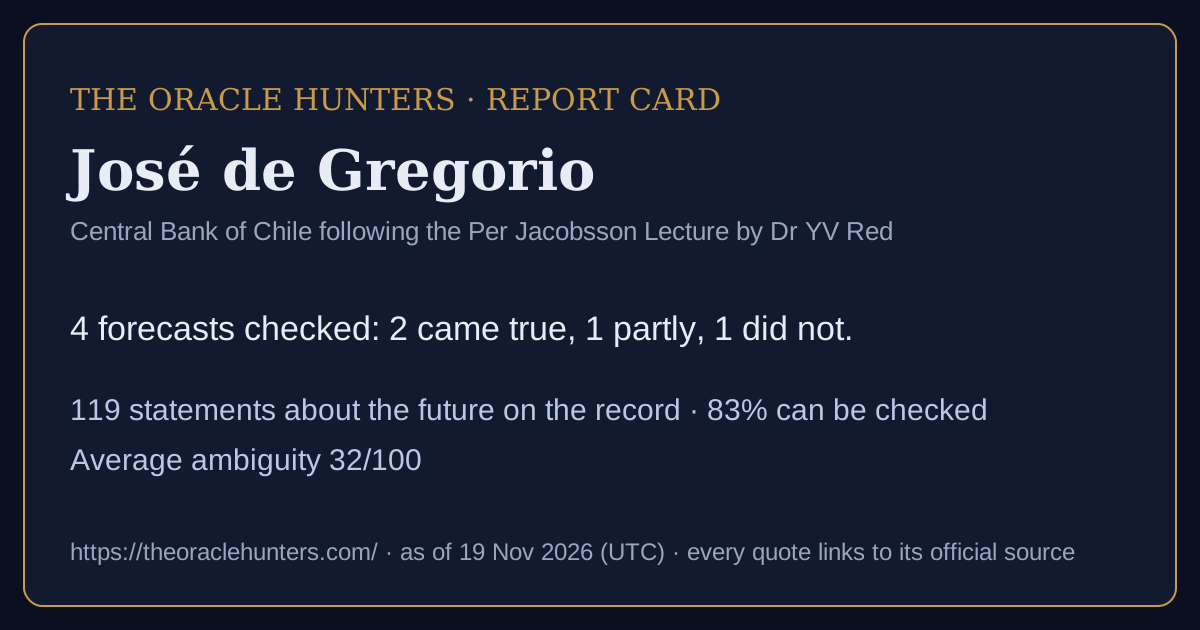
José de Gregorio
Central Bank of Chile following the Per Jacobsson Lecture by Dr YV Reddy
Track record: 4 forecasts checked: 2 came true, 1 partly, 1 did not.
119forecasts & commitments on the record
83%can be checked as stated
32average ambiguity (0-100)
0goalpost moves recorded
0confirmed U-turns
Timeline
came true partly did not not due / being checked / too vague
Calibration score: shown after 10 checked forecasts with a stated likelihood (now 4).
How they speak about the future: based on data 91, educated guess 17, stated on authority 11.
Kinds of claim: forecast 98, scenario (if… then) 10, mixed claim 10, commitment 1. · Download this report card as a picture
In the nine words
πρόγνωσιςInference from evidence88 · 74%πρόνοιαPreparing for the future10 · 8%μαντείαInspired knowledge10 · 8%εἰκασίαConjecture8 · 7%πρόβλεψιςSeeing the signs1 · 1%προαναγγελίαPublic pre-announcement1 · 1%φρόνησιςPractical wisdom1 · 1%
How to read this
Each box is one sentence a public figure or institution said about the future, word for word, with a link to the official text. Can be checked means it names what will happen, by when, and how likely - so it can be compared with official figures later. Too vague to check means it does not. Ambiguity (0-100) is how many different ways the sentence can be read. When the date passes, the forecast is compared with official data and marked came true, partly or did not come true. Labels judge the sentence, never the person. Full guide and glossary.Checked
In the baseline scenario, the cyclical situation of the Chilean economy plus the withdrawal of the macroeconomic stimulus will result in y-o-y CPIX1 inflation moving from its present level of around 0.5 percent to a little over 3 percent in the early part of 2012 (figure 8).
Came true. Said: inflation above 3% in 2012. Official figure for Chile: 3.0% (World Bank open data). On target. official data · checked 14 Nov 2026 · automatic check against official data (rules v3)
For the year 2011 GDP is expected to grow by 5.5%-6.5%.
Came true. Said: economic growth between 5.5% and 6.5% in 2011. Official figure for Chile: 6.2% (World Bank open data). On target. official data · checked 14 Nov 2026 · automatic check against official data (rules v3)
Taking all these aspects in consideration, the Board estimates that during this year GDP will grow between 5.0% and 5.5%.
Partly came true. Said: economic growth between 5% and 5.5% in 2010. Official figure for Chile: 5.9% (World Bank open data). Close: outside the margin, but within one more half point. Off by 0.3 points. official data · checked 14 Nov 2026 · automatic check against official data (rules v3)
Therefore, given a loss of 3 percent in the net capital stock, the Board estimates that during this year the level of trend GDP will fall 1.0% to 1.5% because of the catastrophe.
Did not come true. Said: economic growth between 1% and 1.5% in 2010. Official figure for Chile: 5.9% (World Bank open data). Missed. Off by 4.3 points. official data · checked 14 Nov 2026 · automatic check against official data (rules v3)
On the record (119)
But even if it were possible to identify a bubble from a fundamental-driven asset price increase, controlling asset price growth may require substantial increases in the interest rate, which will reduce credit supply and the prices of other assets that may or may not be part of the bubble, having negative consequences on output and inflation.
While in mid-year we expected inflation to be around 4% for much of the second half, the data have shown inflation hovering around 3%.
The Bank makes decisions aiming at expected inflation standing at 3% over a two-year policy horizon.
Assessing these resource needs is critical to evaluate whether, for instance, the New Arrangements to Borrow will have to remain active, even if the quota increase is fully implemented by next year.
In the baseline scenario, the increase in y-o-y CPI inflation towards the end of the year will be less than forecast in June, mainly responding to the lower price of fuels.
The biggest impact of the change in external conditions will be visible in GDP growth of 2012.
In this scenario of reduced external impulse, the Chilean economy is forecast to grow in the range of 6.25% to 6.75% this year, in line with June's projections.
In light of these developments, output figures for the second quarter and advanced indicators for the third - which are still weak in developed economies - , the baseline scenario revises downward by 0.2 percentage points the world growth estimate for 2011, and by half a percentage point the one for next year (table 1).
In Chile, in early January, we announced a program of reserves accumulation of 12 billion dollars, which will be completed over the course of this year.
However, as we said when we announced the intervention program, the level of international reserves we will reach by the end of the year is close to the limits that can be absorbed by our equity position.
Overall, the expected expansion of consumption will have a significant incidence on domestic demand growth, which will increase 8.5 percent in the year.
The baseline scenario assumes that GDP will grow this year between 6 percent and 7 percent.
(f) Dots indicate average prices forecast for 2011 and 2012 in June 2011's Monetary Policy Report.
The baseline scenario assumes that commodity prices will remain fairly constant over the next two years.
Consistently, the Board acted preventively and raised the monetary policy interest rate (MPR) by 150 basis points between March and May this year, taking it above levels forecast by the market.
World GDP will grow slightly more than 4% in the two-year period 2011-2012, with a milder expansion of the United States and Japan, which will be offset by somewhat faster growth in emerging economies (table 2).
This year to date, a 200 basis point increase has already accumulated in the MPR and we believe further increases will be needed.
This will allow trend inflation, today in bounded levels, to converge and remain around the 3% target in the coming quarters.
This is a major adjustment if we consider that in 2008 the country posted a primary deficit of 4.5% of GDP, all this under the assumption that it will pay an interest rate between 6 and 7%, and the interest rate is today around 16%.
According to the forecasts contained in the third review of Greece's stand-by agreement with the IMF, from now to 2020 Greece must generate a primary fiscal surplus of 6% of GDP per year.
The baseline scenario assumes that the oil price will average somewhat more than 100 dollars per WTI barrel in the two-year period 2011-2012.
In the baseline scenario, the cyclical situation of the Chilean economy plus the withdrawal of the macroeconomic stimulus will result in y-o-y CPIX1 inflation moving from its present level of around 0.5 percent to a little over 3 percent in the early part of 2012 (figure 8).
Came true. Said: inflation above 3% in 2012. Official figure for Chile: 3.0% (World Bank open data). On target. official data · checked 14 Nov 2026 · automatic check against official data (rules v3)
The baseline scenario assumes that during this year the external inflation relevant to Chile will exceed December's forecast.
Thus, the Board foresees that annual CPI variation will return to the tolerance range during the second quarter of 2012 and will stay at 3 percent until the end of the year.
Accordingly, annual CPI inflation will stand above 4 percent for the entire second half of this year and into 2012.
Worth noting is the case of emerging Asia, where by mid-2010 the market consensus expected inflation to average 3.8 percent annually this year, and revised it upward to 4.8 percent last March (figure 4).
The Central Bank will fulfill its purpose and will continue to use its policies with flexibility, as proven in the recent intervention announcement, so that projected inflation stands at 3% over the policy horizon.
This program will take the Central Bank's international liquidity position to the equivalent of 17% of GDP, which is comparable with those of other economies similar to Chile (figure 7).
The baseline scenario of our December Monetary Policy Report assumes that the Chilean economy grew 5.2% in 2010 and that GDP growth will stand between 5.5 and 6.5% during 2011.
In January the Monetary Policy Rate was kept unchanged, but the Board has stated that it will be necessary to continue to reduce the monetary policy stimulus in the coming months.
Thus, GDP will grow in the 5.5%-6.5% range in 2011, with a smaller contribution of supplyside sectors - i.e., fishing, mining and hydroelectric generation - than foreseen in the latest IPoM, while the other sectors will converge to trend growth as the monetary and external impulses are normalized (table 2).
Accordingly, the investment rate will rise next year, to more than 30% of GDP in real terms.
In addition, next year will see a stronger impact of public and private reconstruction works, which should be visible mainly in infrastructure investment, in line with a dynamic construction sector.
In 2011, domestic demand will continue to drive GDP growth, with a y-o-y increase of 6.6%.
We expect an average growth rate of 4.2% for the world economy over the next two years, fairly high by historic standards, but around 0.3 percentage points below the market consensus forecast.
Also, prospects for 2011 are favorable, with projected growth in the range of 5.5 to 6.5%.
The real issue here is that the recovery of the developed world will not hold if it happens at the expense of repeating the current account deficits of the pre-crisis years.
Considers actual data through second quarter 2010 and estimates for second half 2010, based on the share in net capital flows to Latin America in 2009 and forecast for 2010 from WEO, October 2010.
The main projections of the world economy foresee that this disparity between emerging and advanced economies will go on for the next two years.
The plan of gradual reduction of the structural fiscal deficit announced by the government will contribute to moderate demand and remove some pressure from the real exchange rate, although its effects will become apparent gradually over time.
These operations require authorization by the SBIF which may also impose conditions to such authorizations. 6 For example, the SBIF may require that the effective net worth of the bank or banks involved be more than 8 and up to 14% of their risk-weighted assets; or demand that the limit of the loans granted by a bank to another financial …
Hence, the Great Recession did not affect significantly this growth differential, and prospects for the near term also indicate that growth in emerging economies will outpace growth in developed economies, but at a rate (4-4.5%) not that different from the average between 2003 and 2005.
The discussion about exit strategies has morphed into further balance-sheet stimulus, and markets are pricing-in that monetary accommodation will continue well into 2011.
At the same time the economy has been showing a rapid expansion: despite the earthquake we suffered this year growth is expected to be between 5 and 5.5% this year and between 5.5 and 6.5% next year.
After considering all the elements described, the Board believes that the balance of risks for inflation and output is unbiased, and we reiterate that we will continue to use our policies with flexibility so that projected inflation stands at 3% in the policy horizon.
This short-term trajectory is influenced by one-time effects, which will eventually revert, permitting inflation to hover around 3% throughout 2011 and to the end of the relevant projection horizon, this time the third quarter of 2012.
Summarizing, for the rest of this year, annual CPI inflation is expected to return to figures around 3% to then move to the upper limit of the tolerance range for some months.
The behavior of output and demand will determine a current account deficit of -1.1% of GDP this year increasing in 2011.
For the year 2011 GDP is expected to grow by 5.5%-6.5%.
Came true. Said: economic growth between 5.5% and 6.5% in 2011. Official figure for Chile: 6.2% (World Bank open data). On target. official data · checked 14 Nov 2026 · automatic check against official data (rules v3)
Taking all these aspects in consideration, the Board estimates that during this year GDP will grow between 5.0% and 5.5%.
Partly came true. Said: economic growth between 5% and 5.5% in 2010. Official figure for Chile: 5.9% (World Bank open data). Close: outside the margin, but within one more half point. Off by 0.3 points. official data · checked 14 Nov 2026 · automatic check against official data (rules v3)
Showing the newest 50 - the ledger has all 119.
Also said - not checkable as stated (12 newest)
Remarks about the future with no date, figure or likelihood that could be checked. They are kept on the record and shown here, but not scored.
This could be specially damaging in the financial system and therefore every effort should be made to make the institutions safeguarding financial consumers autonomous and technical.
Today we have the opportunity to tackle this task, but we also have to avoid shortcuts that may end up rebuilding a weaker financial system.
If this ceiling is set low enough, it may end up generating exclusion rather than lower financial costs for households, who may end up paying much higher interest rates in informal credit markets.
Some research has shown that in Latin America public banks are less procyclical than private banks (Micco and Panizza, 2006), but this could be for good or bad reasons.
If public banks are prudent and avoid jumping on the bandwagon of optimism during the upturn this is good - they may even soften credit constraints during the downturn.
However, public banks may also be an instrument to pay back supporters of politicians, and certainly this is unfair and inefficient.
In the second part of this talk, I will refer to the context of international capital flows and policy responses in a small open economy with inflation targeting, and the relation that monetary policy has to have with macroprudential policies in that context.
However, the central bank's mandate for preserving financial stability is less explicitly defined; probably in part because there is less agreement on what is financial stability and what should be considered an indicator of it.
In addition regulation that could have systemic implications should be discussed in these instances.
It is not the purpose of my talk to narrow the definition of financial stability, so I will use the term in a broad sense.
There is also the key distinction between micro and macro financial stability, and in most of what follows I will be focusing on the systemic aspects of financial stability, unless noticed otherwise.
2 In order to avoid indeterminacy or multiple equilibria, the forecast must be the central bank's forecast and not that of the market (Bernanke and Woodford, 1997).