Joseph Yam
Hong Kong Monetary Authority
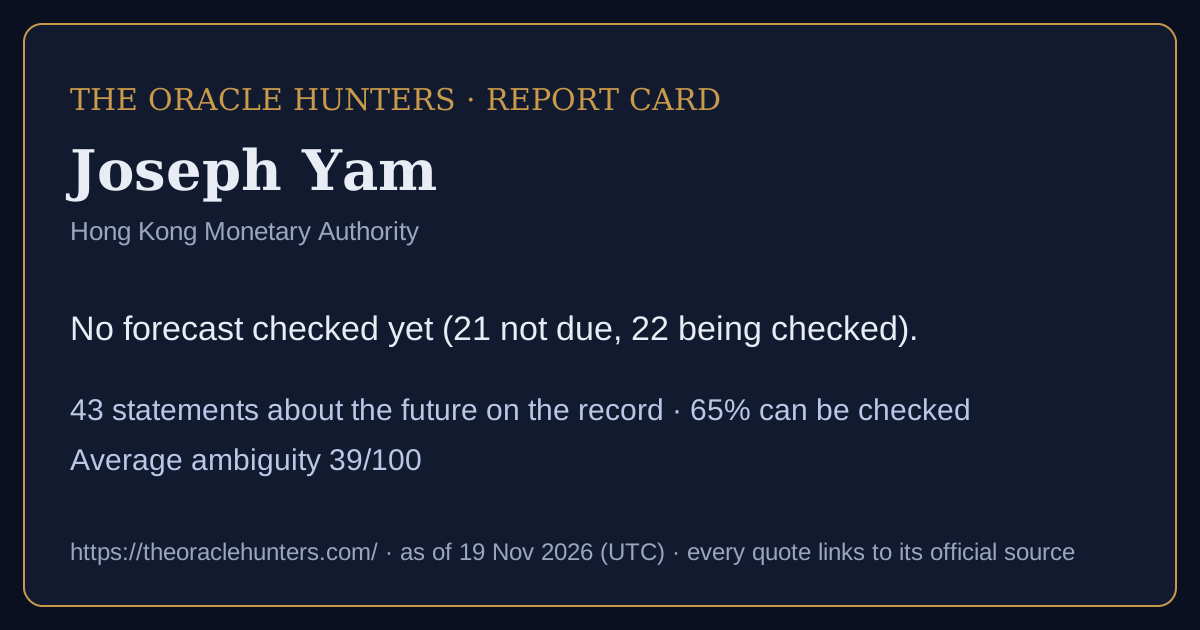
Track record: No forecast checked yet (21 not due, 22 being checked).
43forecasts & commitments on the record
65%can be checked as stated
39average ambiguity (0-100)
0goalpost moves recorded
0confirmed U-turns
Timeline
came true partly did not not due / being checked / too vague
Calibration score: shown after 10 checked forecasts with a stated likelihood (now 0).
How they speak about the future: based on data 32, stated on authority 9, educated guess 2.
Kinds of claim: forecast 37, mixed claim 3, scenario (if… then) 3. · Download this report card as a picture
In the nine words
πρόγνωσιςInference from evidence31 · 72%μαντείαInspired knowledge9 · 21%πρόνοιαPreparing for the future3 · 7%
How to read this
Each box is one sentence a public figure or institution said about the future, word for word, with a link to the official text. Can be checked means it names what will happen, by when, and how likely - so it can be compared with official figures later. Too vague to check means it does not. Ambiguity (0-100) is how many different ways the sentence can be read. When the date passes, the forecast is compared with official data and marked came true, partly or did not come true. Labels judge the sentence, never the person. Full guide and glossary.On the record (43)
But interest rate adjustments when the exchange rate hits the strong side of the band are bounded by the floor of 0%, while they might be a lot more dramatic at the weak side, and the sensitivity of stock prices to these different adjustments differs.
You may think that this is not high; but if you put this along with similar comparisons for population, which is only 0.5%, or gross domestic product, which is 8%, you can appreciate the significance of the banking system of Hong Kong in the context of the country as a whole.
This is shown by the listing of the large state-owned banks this year, including what is expected to be the largest IPO ever in the world - the listing of the Industrial and Commercial Bank of China.
Momentum is expected to pick up further with the planned acquisition of between HK$16 billion and HK$20 billion of mortgage portfolios before the end of 2004.
That percentage is expected to double to 15% by 2030: in Hong Kong, we have already reached 11.5%.
If they do not take these forces into account, individual banks not only face growing risks, but they could be in danger of losing their competitiveness.
If there continue to be capital inflows on the back of sustained growth and confidence in Hong Kong's prospects, the current account surplus and continuing talks about a possible revaluation of the renminbi, the risk of overheating in the economy and in asset markets will increase.
As some of you may be aware, the Aggregate Balance has already increased to HK$52 billion from its traditional level of less than HK$1 billion necessary as engine oil in the very efficient real time inter-bank clearing system.
Like the 70% guideline, the Link is maintained over the longer term for the greater economic well-being of our community, even though it might seem tempting from time to time to try to use monetary policy for short-term tactical gains.
This was around HK$62 bn, or 4.9% of GDP in the last fiscal year, and, according to the Government's latest estimates, may exceed that figure for the current fiscal year.
We expect to see all these features implemented by the second quarter of 2003.
- Thirdly, public consultation by the Privacy Commission will soon commence on broad proposals for the sharing of positive consumer credit data - a facility which, when and if it is introduced, will help in addressing an issue of concern to banking stability: the dramatic rise in consumer defaults and personal bankruptcies.
Consultations on the technical details are continuing, and we expect to be able to introduce the necessary legislation in late 2002.
It seems inevitable that exports, and in turn GDP, will be affected by the decline in consumer spending in the US, which accounts for around 20% of China's export market: the latest figures already suggest this.
Growth this year is likely to be in negative territory again, and price deflation is expected to persist.
As a result of accession, China's trade flows are projected to double between now and 2005.
For the medium and longer terms, dynamic and far-reaching economic transformations will be set in motion by China's accession later this year to the World Trade Organisation.
Perhaps the single most important measure to remove barriers to competition will be the abolition early next month of the last remaining Interest Rate Rules, which involves removing the interest rate cap on savings accounts and ending the prohibition on interest on current accounts.
We also plan to review whether the three-tier system of authorisation might be reduced to two tiers, although we do not plan to visit this issue until next year - i.e. 2002 - and have quite an open mind on this.
This rapid growth in the Mainland's share of world trade, coupled with a projected growth in trade volume at the rate of 7% per annum, is likely to mean yet more Mainland-related business for Hong Kong, just as it will undoubtedly also mean a great deal more business for Shanghai and other Mainland cities as well.
It is still not clear when exactly this event will take place, although the latest predictions seem to put it at some time during the second quarter of next year.
Given also that about 40% of the mainland's trade is routed through Hong Kong, Hong Kong's banks will have an unrivalled advantage over other banks in capturing the increased demand for trade and related financing services.
The World Bank projections on the effects of WTO entry - a doubling in the space of five years of China's share in international trade (which is itself projected to grow at the rate of about 6% per annum) - suggests that the business 'creation effect' stimulated by WTO accession will far outweigh the 'diversion effect'.
China's share in world imports is expected to rise marginally faster than its share in exports: from the present 3.4% to 7.2% in five years' time.
For general trade our estimates within the HKMA suggest that, although our domestic exports to the mainland will be largely unaffected by the WTO terms, our re-export trade, involving the movement of goods to and from the mainland through Hong Kong, will be considerably boosted, and should raise our annual GDP growth rate by somewhere between 0.5% to 1%.
Yet, in this moribund state, we are still managing to struggle along with GDP growth - projected for this year - of 8.5% and export growth at double-digit rates in recent quarters.
China's share in world exports will double in the space of five years: from the present 3.7% to around 7.3% by 2005.
The reality is that it has survived, and the Hong Kong economy has now rebounded strongly, with the year-on-year growth rate of GDP for the fourth quarter of last year recording 8.7% and the forecast for the year 2000 now put at 5%.
You may also wish to be aware of the fact that the internal deliberation within the Government, after the threemonth public consultation period earlier this year, is drawing to a close, and an announcement on the Government's decision on the recommendations will likely be made shortly.
Of course, nothing of the kind has happened, a may well be lessons here to apply to some of the more lurid scenarios that are being for the first of January 2000.
Nominal wages are likely to sho any, growth this year, compared with increases of 7-8% in the period leading up to Price inflation has also dropped markedly, and has turned negative in recent mont reductions inevitably cause short-run dislocations.
A number of continuing issues, and new ones on the horizon, will provide the HKMA with a heavy workload in the remainder of this year.
- The rest of this year will continue to be somewhat difficult for the banking sector - but it as a whole in excellent shape to cope with the pressures ahead.
It is therefore hardl that we should have experienced some considerable stress as a result of the Asian crisi last year we have seen a roughly 50% decline in the value of property and stocks, unemployment, and a forecast contraction of 4% in our GDP for 1998.
Economic growth in 1998, forecasted to be 8% in real terms, is only a shade below the growth rate of 8.8% achieved in 1997.
Furthermore, inflation is expected to be below 3%.
Indeed, inflation this year will slow down further to 5% from 5.8% in 1997, with the unemployment rate staying low and the current account remaining broadly in balance.
The IMF forecast for Hong Kong's growth rate next year is 4.25%, only a shade below our trend growth rate of 5%, representing a healthy consolidation in the circumstances.
To the extent that the free market is demanding higher interest rates because there is a reverse flow of capital from Asia to the OECD markets, we will all have to bear the pain and adjust accordingly.
The World Bank has estimated that for East Asia alone, projected infrastructure investments amount to US$1.5 trillion between 1995-2004.
Indeed, on the World Bank's projections, the share of bank borrowing is expected to decline commensurately from 40% to 30% over the same period.
The share of bonds in financing these needs is projected to grow from only 9% to 26% by 2004.
The World Bank has estimated that private gross domestic fixed investment will amount to a total of US$ 5 trillion over the ten years to the year 2004, a large part of it associated with infrastructural development 1 .
Also said - not checkable as stated (12 newest)
Remarks about the future with no date, figure or likelihood that could be checked. They are kept on the record and shown here, but not scored.
We must expect this trend to continue, and it will be necessary for the banking industry and the regulator to take more and more account of wider public opinion, and to tackle areas of concern.
Therefore, we might conclude that we do not need to consider them for Hong Kong.
There should be no doubt that the renminbi will become an international currency one day.
I shall therefore simply offer a few reflections that I hope will be relevant to the banking profession in Hong Kong.
We have not experienced a collapse of our financial system, or a nationalisation of our major banks, or other forms of government intervention that will burden taxpayers for many years to come.
We might therefore observe, in the light of this and of our experience over the past year, that Hong Kong has got it broadly right in the relationship between the supervisor and the banking system.
But many of the important elements of the financial infrastructure are public goods, the provision of which, in a form that serves the public interest best, may not be financially viable for the private sector.
Some of you may, for example, be wondering how you could use the RMB for trade settlement, something that is being promoted by the Mainland authorities.
Although it provides employment for quite a number of people, including us, and profits for a lot of capital, the financial system does not and should not have a life of its own.
I believe therefore that those responsible for the maintenance of monetary and financial stability should have the necessary emergency powers to do what is required independently and promptly.
I should like to thank those newspapers who have faithfully reproduced these articles, week after week, even when the content may not always have been as newsworthy as they may have hoped.
The many colleagues in the media play an extremely important part in the development of financial markets, and I should like to pay tribute to their professionalism.