Jose Luis Escrivá
Bank of Spain
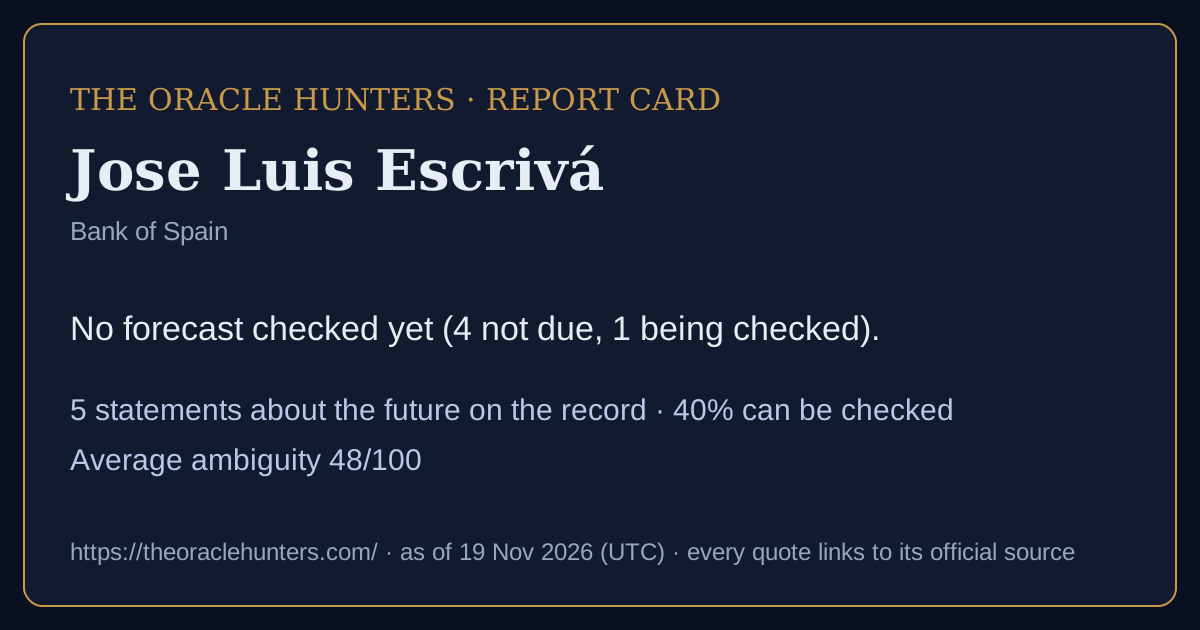
Track record: No forecast checked yet (4 not due, 1 being checked).
5forecasts & commitments on the record
40%can be checked as stated
48average ambiguity (0-100)
0goalpost moves recorded
0confirmed U-turns
Timeline
came true partly did not not due / being checked / too vague
Calibration score: shown after 10 checked forecasts with a stated likelihood (now 0).
How they speak about the future: based on data 3, stated on authority 2.
Kinds of claim: forecast 4, commitment 1. · Download this report card as a picture
In the nine words
πρόγνωσιςInference from evidence3 · 60%μαντείαInspired knowledge1 · 20%προαναγγελίαPublic pre-announcement1 · 20%
How to read this
Each box is one sentence a public figure or institution said about the future, word for word, with a link to the official text. Can be checked means it names what will happen, by when, and how likely - so it can be compared with official figures later. Too vague to check means it does not. Ambiguity (0-100) is how many different ways the sentence can be read. When the date passes, the forecast is compared with official data and marked came true, partly or did not come true. Labels judge the sentence, never the person. Full guide and glossary.On the record (5)
This year's theme, "Harnessing Innovation and Integration for Sustainable and Inclusive Development in the Mediterranean Region," could not be more timely.
Against this backdrop, talking about the future of the European financial system is more than a theoretical exercise: it's a discussion about how we are going to finance and sustain growth, innovation and social cohesion in Europe in the coming decades.
The Congressional Budget Office projects, in the absence of new fiscal policies, persistent deficits of over 5% of GDP for the next decade and a debtto-GDP ratio rising from 100% to 150%.
Euro area inflation was thus swiftly brought down and is now close to the medium-term target of 2%.
At present, bank loans account for 92% of European firms' total indebtedness, which means that mobilising bank lending will be essential to bridge the private investment gap.
Also said - not checkable as stated (12 newest)
Remarks about the future with no date, figure or likelihood that could be checked. They are kept on the record and shown here, but not scored.
Over these two days, we have the opportunity not only to reflect on what household finance surveys have taught us, but also to discuss how they should evolve in the years ahead.
I have been thinking about what examples could I provide about the importance of the EFF for our analysis, and there are certainly many, but if there is one I think I would like to single out is debt.
We tend to talk about inflation, monetary policy, monetary analysis, but without the data on the distribution of debt we could not assess the vulnerabilities in the system.
Also, AI giving us opportunities in terms of analysis that were not available before: now we may have the possibility of capturing non-linearities and patterns that with our traditional techniques are very difficult to detect.
But again, these new tools highlight the importance of good data: when you talk to AI people, what they tell you is the main constraint to generate significant advances over time is going to be data, not computing power.
Any progress in this area must therefore be carefully designed, avoiding abrupt solutions that could disrupt sovereign debt markets or adversely affect government financing.
Strengthening the banking union must go hand in hand with further deepening of the savings and investments union, because only a more integrated financial system will make it possible to channel European savings more effectively towards the investment needs generated by innovation, the energy transition, digitalisation and the EU's open strategic autonomy.
At the same time, we should be pragmatic about how to achieve it: a phased-in implementation, with verifiable milestones and well-defined transitional arrangements, may be a reasonable way to build consensus among Member States.
We will continue to closely monitor these indicators going forward.
A more competitive Europe will not emerge from a single decision or an isolated reform, but from our ability to move forward, coherently and with a sense of purpose, in several directions at once: innovating without eroding trust; integrating markets without compromising stability; and simplifying the regulatory and supervisory framework without lowering prudential standards.
European banks will not be fully competitive while they continue to operate, in practice, in banking markets that remain too national.
Speech by Mr José Luis Escrivá, Governor of the Bank of Spain, at the Spain LatAm Economic Forum, Roda de Bará, 9 May 2026.