Jorgovanka Tabaković
National Bank of Serbia
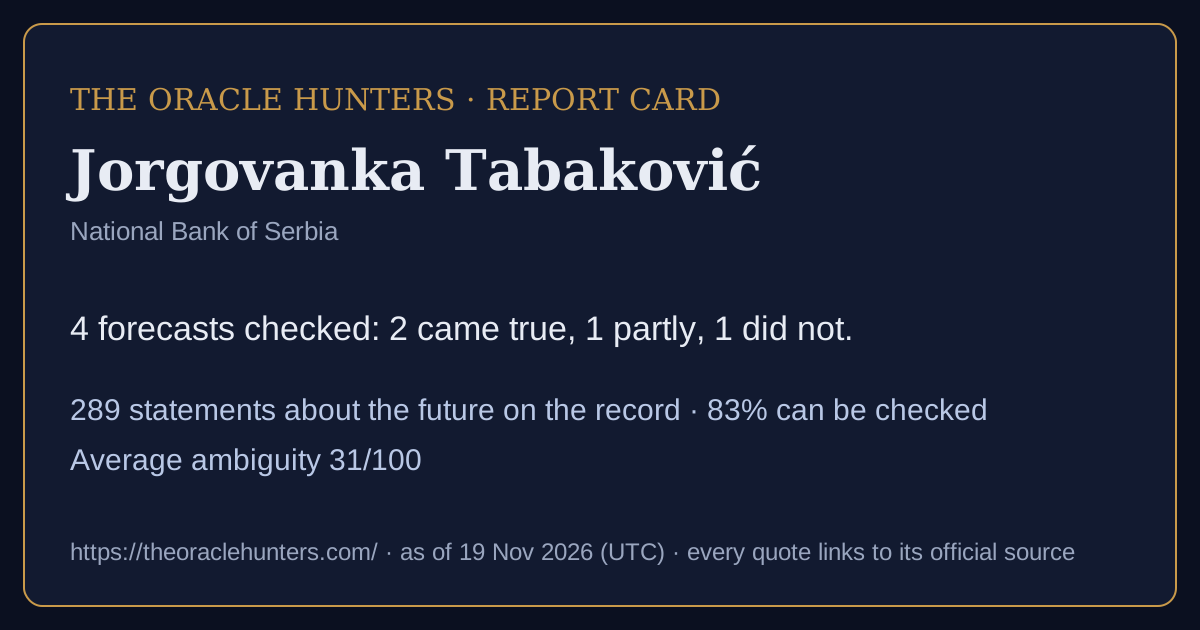
Track record: 4 forecasts checked: 2 came true, 1 partly, 1 did not.
289forecasts & commitments on the record
83%can be checked as stated
31average ambiguity (0-100)
0goalpost moves recorded
0confirmed U-turns
Timeline
came true partly did not not due / being checked / too vague
Calibration score: shown after 10 checked forecasts with a stated likelihood (now 4).
How they speak about the future: based on data 248, stated on authority 40, educated guess 1.
Kinds of claim: forecast 257, mixed claim 19, commitment 12, scenario (if… then) 1. · Download this report card as a picture
In the nine words
πρόγνωσιςInference from evidence240 · 83%μαντείαInspired knowledge30 · 10%προαναγγελίαPublic pre-announcement12 · 4%πρόβλεψιςSeeing the signs4 · 1%φρόνησιςPractical wisdom2 · 1%πρόνοιαPreparing for the future1 · 0%
How to read this
Each box is one sentence a public figure or institution said about the future, word for word, with a link to the official text. Can be checked means it names what will happen, by when, and how likely - so it can be compared with official figures later. Too vague to check means it does not. Ambiguity (0-100) is how many different ways the sentence can be read. When the date passes, the forecast is compared with official data and marked came true, partly or did not come true. Labels judge the sentence, never the person. Full guide and glossary.Checked
- Cumulatively speaking, Serbia's economic growth outturn will be among the best in Europe, with a minimal decrease recorded last year and real growth of around 7% this year.
Partly came true. Said: economic growth around 7% in 2021. Official figure for Serbia: 7.9% (World Bank open data). Close: outside the margin, but within one more half point. Off by 0.9 points. official data · checked 14 Nov 2026 · automatic check against official data (rules v3)
Our new projection also confirms that in 2018 and 2019 GDP growth will accelerate to around 3.5%.
Did not come true. Said: economic growth around 3.5% in 2019. Official figure for Serbia: 4.8% (World Bank open data). Missed. Off by 1.2 points. official data · checked 14 Nov 2026 · automatic check against official data (rules v3)
This year we expect GDP growth to step up to around 3% and then further up to 3.5% the following year, supported by continued favourable movements in the labour market.
Came true. Said: economic growth below 3% in 2017. Official figure for Serbia: 2.4% (World Bank open data). On target. official data · checked 14 Nov 2026 · automatic check against official data (rules v3)
In 2017, GDP growth is expected to step up to 3%.
Came true. Said: economic growth below 3% in 2017. Official figure for Serbia: 2.4% (World Bank open data). On target. official data · checked 14 Nov 2026 · automatic check against official data (rules v3)
On the record (289)
In accordance with the Law on the NBS, out of the operating profit worth RSD 48.1 bn, 70% or RSD 33.7 bn will be transferred to the budget of the Republic of Serbia, 10% will be allocated to core capital and 20% to special reserves.
Since 5 May this year, SEPA payments have been operational.
The share of NPLs declined to a new historical low of 2.1% at end-2025 and remained at that level at end-May this year.
For 2026 as a whole, we project real GDP growth of 3.0%, while in 2027 it is expected to step up to 4.5%, propped up by the investment cycle and the hosting of "Expo".
- In May - the first month of processing transactions through the SEPA payment scheme, approximately 40% of all relevant cross-border euro transactions were executed through SEPA channels.
In such circumstances, seven days ago the ECB downgraded its euro area growth projections for 2026 and 2027 and upgraded its inflation projections.
- Consistent with supervisory expectations regarding more favourable financing terms for lower-income households, more than 395 thousand loans worth over RSD 320 bn in total were approved until end-May 2026.
- With projected real GDP growth of 3.0% this year and an expected acceleration to 4.5% in 2027, Serbia will rank among the fastest-growing economies in Europe.
- We have also secured record-high FX reserves of EUR 29.9 bn at the end of May this year, covering seven months' worth of imports of goods and services.
In March, the ECB revised its projections, forecasting average inflation growth in the baseline scenario at 2.6% this year, up from levels around the 2.0% target in the December projection round.
Assuming there is no significant deepening of the energy crisis, we do not expect the fiscal deficit to exceed the planned level this year, nor do we expect to see any major increase in the public debt share to GDP (42% in March).
Due to a sharp rise in global energy prices, the current account deficit share in GDP is projected at around 6% this year, with a decline to around 4% in 2027, as a result of the Expo rollout and the rise in tourist and business services.
Y-o-y inflation remained below the target midpoint of 3% during the first quarter of this year, which was lower than expected in our previous Report .
Had the war in the Middle East not broken out, the IMF indicated that it would most likely have revised up its global growth projections in the April report, but under the current circumstances it was compelled to revise them down, to 3.1% for this year under the reference scenario.
In line with the new circumstances and heightened risks, in April the IMF projected higher global inflation, now expected at 4.4% this year, while in the event of a more prolonged and intense shock it could increase further -to above 5% or even 6%.
For those who may not know, the NBS ranks first in the world in terms of gender equality among 178 central banks as more than 57% of key managerial positions here are held by women.
that these reforms could increase productivity in the EU by around 20%, and over time GDP per capita could rise by around 35%.
- In January, the good news for Serbia was that the IMF slightly revised upward, compared to October, its growth forecast for the euro area for this year.
While the IMF warns that, without structural reforms, fiscal consolidation and sustainable growth, Europe faces the risk of rising public debt that could, on average, approach 130% of GDP by 2040, Serbia stands out as an example of a country whose public debt level is below 45% of GDP, far below the value set by the Maastricht criteria.
- In 2027 we also expect growth to pick up on account of the increased services export, owing to the Expo exhibition, and our Minister of Finance Mr Mali will speak about that.
- Investment growth will be propped by the realisation of infrastructure projects planned within the "Leap into the Future - Serbia 2027" programme.
- Given the geopolitical risks and the growing fragmentation in the global market, which could reflect on the prices of primary commodities, value chains and capital flows, we will continue to carefully monitor and assess all movements.
Next year we expect it to drop below 4% of GDP thanks to greater services export and activation of additional export capacities.
As for our country's external position, this year we expect the share of current account deficit in GDP to be below 5.5%, based on increased realisation of infrastructure projects and further growth in disposable income.
In terms of economic activity, we expect GDP growth to accelerate to 3.5% this year and to 5% in 2027.
- -Inflation is moving within the NBS target band (3±1.5%) and will remain, according to our projections, within this range in the medium term.
We project GDP growth of around 5% in 2027, with the acceleration relative to 2026 driven by higher exports of services as a result of hosting the specialised international exhibition 'Expo'.
Consumption growth will be supported by higher disposable income resulting from wage and pension increases, as well as more favourable lending conditions, while the implementation of infrastructure projects planned under the 'Leap into the Future -Serbia Expo 2027' programme will prop up investment growth.
Taking this into account, we expect GDP growth to accelerate to 3.5% this year.
In 2027, we expect demand to rise further due to the hosting of 'Expo' and we therefore project average inflation at 3.8%.
Our new inflation projection is similar to that in November -we expect y-o-y inflation to remain around the target midpoint until September this year, and then, owing to the low base effect, primarily in food prices, to amount to around 4% at the end of this year.
Despite somewhat weaker economic growth prospects this year than initially expected, both the fiscal and external positions have been preserved.
In 2027, we project GDP growth to measure around 5%, with the acceleration in its momentum compared to 2026 being driven by increased service exports due to the hosting of the specialised international exhibition 'Expo 2027.'
Meanwhile, the implementation of infrastructure projects planned under the 'Leap into the Future Serbia Expo 2027' programme will contribute to investment growth.
Consequently, our GDP projection for 2026 is now 3.5%.
According to our new central projection, while the Decree is in force, i.e. until end-2025 and in early 2026, y-o-y inflation will move below or around the central midpoint.
Although the medium-term fiscal framework projected a fiscal deficit of 3% of GDP by end-2027, we believe this will not disrupt the declining trajectory of the public debt-to-GDP ratio, which fell to 43.4% at the end of September.
- In that sense, the IMF's analysis is important, as it shows that reducing internal trade barriers by 1.25 percentage points or external trade barriers by 3.5 percentage points could fully offset the effect of US tariffs on European Union exports.
Likewise, one of the results of the IMF's analyses indicates that, without structural reforms, fiscal consolidation and sustainable growth, Europe faces a rising public debt which could, on average, approach 130% of GDP by 2040, and in some countries even significantly exceed that level.
However, owing to the specialised international exhibition Expo 2027, in 2027, we expect a growth rate closer to the upper bound of the projected band, as a more notable rise in contribution is likely from services, on the production side, and from net exports, on the expenditure side.
GDP growth projection for the next two years is still in the 4-5% range.
Nonetheless, we still expect economic activity to accelerate in the second half of the year, supported by the continued growth in automobile production and exports, as well as the implementation of infrastructure projects planned under the 'Leap into the Future - Serbia Expo 2027' programme.
Accordingly, the new GDP growth projection for this year has been revised down to 2.75%.
Subsequently, in 2027, due to higher export of services, the current account deficit is expected to fall to around 4% of GDP and to be fully covered by net FDI inflows.
Taking all of the above into account, we project that the current account deficit as a share of GDP will range between 5.0% and 5.5% this year and the next, and that it will be largely covered by net FDI inflows, which are projected at around 4.5% of GDP.
- According to our May projection, inflation will continue to slow down and by the end of the year approach the target midpoint of 3% - the level around which it will hover until the end of the projection horizon.
Although it goes without saying, I will reiterate that Serbia will do everything necessary to ensure that our citizens and businesses truly experience the real benefits of joining SEPA starting from May next year - namely, cheaper and faster international payments and easier access to the EU market.
According to the European Payments Council calendar, payment service providers from Serbia will be able to submit documentation for joining the SEPA payment schemes starting from November this year, while May 2026 is set as the earliest operational readiness date, i.e. date from which payments within these schemes can begin to be executed.
Let me share the figure, which will be publicly released on 12 June: inflation is now at 3.8%, but even more importantly, core inflation fell from 5% to 4.6%, and we expect this downward trend to continue.
Let me remind you that 22 May this year is a significant date not only for the National Bank of Serbia and the financial institutions of our country, but also for all our citizens and economic entities.
Showing the newest 50 - the ledger has all 289.
Also said - not checkable as stated (12 newest)
Remarks about the future with no date, figure or likelihood that could be checked. They are kept on the record and shown here, but not scored.
The third message is that we will continue to base our decisions on data and on what is in the interest of Serbia.
We will not delay action when a response is needed, but neither will we squander the country's trust and reserves to create a short-lived illusion that risks do not exist.
Namely, we must not allow those who would continue to use the assets of closed-down banks - and I hope that will not happen to any bank that has had its license revoked, because that would be my and your responsibility - the right to be forgotten, as Marina called it when speaking about the history of the Credit Bureau.
I believe Ralph is someone who knows how to read and anticipate events, or to recognise those who have anticipated them, and to say at the right moment that it is time for us to be a "brave old world." I interpret this in my own way: the old world does not mean demographically old, but rather that we should …
Although we will be speaking about demography and its impact today on production, survival, and progress in society, we must in fact speak not only about numbers, but about the kind of people we are shaping and the values we instil in them.
That may be more valuable than all the figures, migration flows, and demographic processes, as well as the well-known saying: "We all want to live long, but no one wants to grow old," which is yet another paradox of our time.
The fact is that in the years ahead, growth will depend less on the quantity of labour and more on its quality, adaptability and productivity.
First, regarding the impact on economic growth and stability, I will single out three areas, underlining that people are not statistics:
Given that European countries are Serbia's key economic partners, the assessments you will present today are of particular importance for us.
The ECB also published its latest macroeconomic projections on Thursday, along with two additional scenarios indicating that an increase in oil prices could have significant macroeconomic effects, both in terms of inflation and economic growth.
The continuation of a cautious monetary policy and a resilient financial sector will remain an important anchor in a period of heightened uncertainty".
In addition to the lecture by our colleague from Armenia, at the end of the second day we will also have the opportunity to hear a panel whose participants will share their experiences and views on corporate governance in banks.