Jonathan Neilson
Microsoft · USA
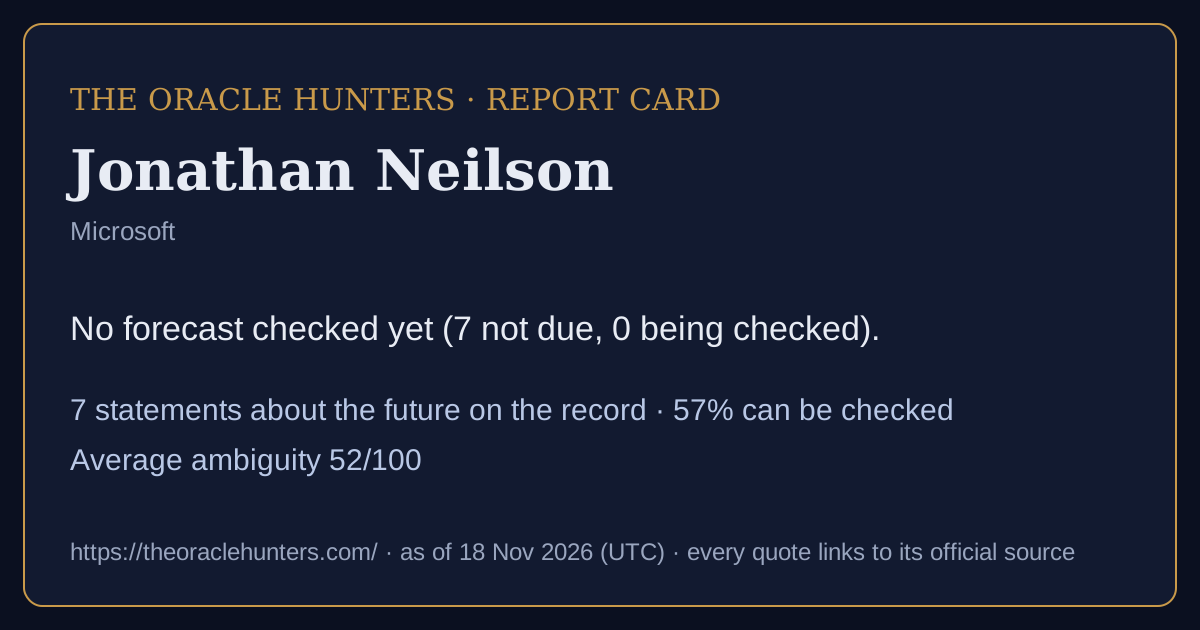
Track record: No forecast checked yet (7 not due, 0 being checked).
7forecasts & commitments on the record
57%can be checked as stated
52average ambiguity (0-100)
0goalpost moves recorded
0confirmed U-turns
Timeline
came true partly did not not due / being checked / too vague
Calibration score: shown after 10 checked forecasts with a stated likelihood (now 0).
How they speak about the future: stated on authority 3, educated guess 2, based on data 2.
Kinds of claim: mixed claim 2, commitment 2, scenario (if… then) 1, speculation 1, forecast 1. · Download this report card as a picture
In the nine words
πρόγνωσιςInference from evidence2 · 29%προαναγγελίαPublic pre-announcement2 · 29%μαντείαInspired knowledge1 · 14%εἰκασίαConjecture1 · 14%πρόνοιαPreparing for the future1 · 14%
How to read this
Each box is one sentence a public figure or institution said about the future, word for word, with a link to the official text. Can be checked means it names what will happen, by when, and how likely - so it can be compared with official figures later. Too vague to check means it does not. Ambiguity (0-100) is how many different ways the sentence can be read. When the date passes, the forecast is compared with official data and marked came true, partly or did not come true. Labels judge the sentence, never the person. Full guide and glossary.On the record (7)
Amy and Satya, I’m wondering if you could unpack what I thought was one of the key metrics from this call, and that is the guidance for Azure growth of 49 to 50% constant currency in December.
Where growth rates are the same in constant currency, we will refer to the growth rate only.
We will also provide growth rates in constant currency, when available, as a framework for assessing how our underlying businesses performed, excluding the effect of foreign currency rate fluctuations.
First, how material do you think traction could be for open and custom models over the next year or two, knowing that many enterprises might be initially reticent to use open models?
And if I’m looking at Microsoft, this is two quarters in a row, we’re really seeing results that are well ahead of anybody’s expectations when we were thinking about this company a year ago or five years ago. 111% commercial bookings growth was not on anybody’s bingo card, if you will.
Satya, when we think about AGI, or we think about how application and computing architectures are changing, is there anything that you see on the horizon, whether it’s AGI or something else, that could potentially change what appears to be a really strong positioning for Microsoft in the marketplace today, where that strength will perhaps weaken on a go-forward basis?
Satya, on your comment about accelerating demand for cloud migrations, I’m curious if you could dig in and extrapolate a little more what you’re seeing there.
Also said - not checkable as stated (11 newest)
Remarks about the future with no date, figure or likelihood that could be checked. They are kept on the record and shown here, but not scored.
We will post our prepared remarks to our website immediately following the call until the complete transcript is available.
(Audio break) alongside lower expected CapEx and those better cloud growth margins sequentially.
Can I ask, as incremental AI capacity comes online, what do you see as likely to be the more important driver of returns over the next few years, improving utilization and unit cost within Azure, or your ability to monetize more layers of each workload across Fabric, Foundry, and Copilot?
Can you give some color about how the timing works out, or how much needs to be spent on replacement of equipment or first party in order to build that confidence that, as we look for the towards this strong spending on CapEx, that the core business will continue to be very, very healthy, and that the margins will be …
One of the big push backs we all get is that AI is going to be really expensive.
I was hoping you guys could help us fill in some of the blanks a little bit in terms of how should we think about capacity expansion and what that can yield in terms of Azure growth, going forward.
We will post our prepared remarks to our website.
But how should we think about the shape of the curve of capex vis a vis Azure growth rate in the years ahead, particularly as you listen to Satya comments on the AI stack consuming more and more infrastructure.
Are we at a point where we’re going to have to continue to do this, and we magically wait for inference and applications to kick in and therefore, create a richer gross margin mix?
What do you think is the best way that software companies are going to be able to monetize AI for SaaS?
You’ve said in the past that that you can attain better and better capital efficiency with the Cloud business, and probably Cloud and AI business.