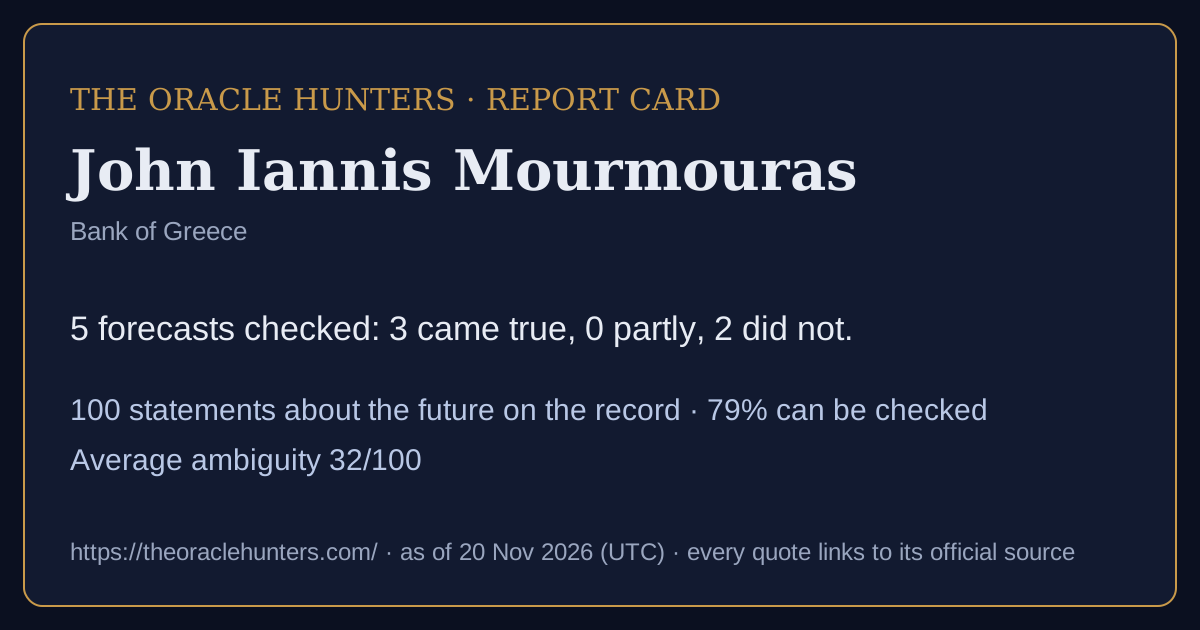
John Iannis Mourmouras
Bank of Greece
Track record: 5 forecasts checked: 3 came true, 0 partly, 2 did not.
100forecasts & commitments on the record
79%can be checked as stated
32average ambiguity (0-100)
0goalpost moves recorded
0confirmed U-turns
Timeline
came true partly did not not due / being checked / too vague
Calibration score: shown after 10 checked forecasts with a stated likelihood (now 5).
How they speak about the future: based on data 92, stated on authority 7, educated guess 1.
Kinds of claim: forecast 94, mixed claim 5, scenario (if… then) 1. · Download this report card as a picture
In the nine words
πρόγνωσιςInference from evidence90 · 90%μαντείαInspired knowledge7 · 7%φρόνησιςPractical wisdom1 · 1%πρόνοιαPreparing for the future1 · 1%πρόβλεψιςSeeing the signs1 · 1%
How to read this
Each box is one sentence a public figure or institution said about the future, word for word, with a link to the official text. Can be checked means it names what will happen, by when, and how likely - so it can be compared with official figures later. Too vague to check means it does not. Ambiguity (0-100) is how many different ways the sentence can be read. When the date passes, the forecast is compared with official data and marked came true, partly or did not come true. Labels judge the sentence, never the person. Full guide and glossary.Checked
Euro area GDP is expected to grow at 2.4% in 2018 and 2% in 2019 and to slow down to 1.6% in 2020 and this is worrying of course for the dynamics of output growth in the eurozone.
Came true. Said: economic growth around 2% in 2019. Official figure for Euro area: 1.6% (World Bank open data). On target. Off by 0.4 points. official data · checked 14 Nov 2026 · automatic check against official data (rules v3)
In Japan, real GDP growth is projected to decelerate to 1.0% in 2018 from 1.5% in 2017.
Came true. Said: economic growth around 1% in 2018. Official figure for Japan: 0.8% (World Bank open data). On target. Off by 0.2 points. official data · checked 14 Nov 2026 · automatic check against official data (rules v3)
Output growth is projected to rise to 2.3% in 2017 and 2.5% in 2018.
Came true. Said: economic growth around 2.5% in 2018. Official figure for Greece: 2.1% (World Bank open data). On target. Off by 0.4 points. official data · checked 14 Nov 2026 · automatic check against official data (rules v3)
Inflation is now projected to be 0.1% in 2015 and 1.5% in 2016.
Did not come true. Said: inflation around 1.5% in 2016. Official figure for Greece: -0.8% (World Bank open data). Missed. Off by 2.3 points. official data · checked 14 Nov 2026 · automatic check against official data (rules v3)
However, inflation rates are projected to rise consistently over the short- and medium-term and reach 1.5% by next year.
Did not come true. Said: inflation around 1.5% in 2016. Official figure for Greece: -0.8% (World Bank open data). Missed. Off by 2.3 points. official data · checked 14 Nov 2026 · automatic check against official data (rules v3)
On the record (100)
The latest forecasts with regards to the Greek economic outlook this year is for a recession around 7-8% and for next year a recovery of around 3-4%, namely not a V-recovery, similar to the rest of the Eurozone.
According to my personal opinion, the main challenge for Greece is to maintain sustainable growth rates beyond 2% in the next decade.
As we enter the euro's third decade, and after this week's European elections, I - myself a well-known pro-European - could predict that the serious challenges facing Europe won't go away, even by the 2024 European election!
In 2018, RegTech investment reached the amount of US $2 billion and is forecasted to exceed $ 76 billion by 2022.
Worldwide, the total value of transactions through alternative lending platforms climbed to an amount of US $196 billion, expected to grow by an annual rate of 10.7% in the period between 2019-2023, resulting in a total amount of $363 billion (Statista, 2018).
- On the fiscal front, the 2018 general government primary surplus target of 3.5% was outperformed by a strong margin (4%) and according to the 2019 budget, it is projected to reach 3.6% of GDP.
In contrast, activity in the euro area has been somewhat weaker than previously expected near 1.7%, owing to slowing net exports.
Some other notable parliamentary elections in Member States are in Belgium in May 2019, Denmark in June 2019, Estonia in March 2019, Finland in April 2019, Portugal in October 2019 and also in my own country, Greece by October 2019 (see Table 1).
Starting with the Fed: After the dovish speech by the Fed Chair Jerome Powell earlier this month at the Economic Club of Washington D.C., which set the record for a data-dependent monetary policy, following the Fed's projection for a GDP growth rate of 2.3% in 2019, the market participants no longer price in any hike in the Fed Funds rate …
Today, my focus is on the main risks for the financial markets this year, which could result in heightened uncertainty across the global economy, prompting certain Cassandras to foretell a global economic downturn and even a recession.
A further moderate slowdown in Chinese growth is expected this year (at 6.2%), as increased trade tensions could offset the positive effects of the stimulus package.
All in all, global growth is projected to moderate from 3.7% in 2018 to 3.5% in 2019, before picking up slightly to 3.6% in 2020, as economic slack dissipates, monetary policy accommodation in advanced economies is removed, and global trade gradually slows.
It is too big to ignore, as the eurozone's third largest economy and the world's third largest, after the US and Japan, sovereign debt market with total public debt of more than €2.3 trillion, of which more than 36% is held by foreigners, and the political uncertainty could generate severe spillover effects to the global sovereign markets.
It is estimated that the APP purchases will rise near 23% of euro area's GDP in December 2018 [this compares to the quantitative easing programmes of the US Fed: $4.2 trillion or 21% of GDP , of the Bank of Japan: $5 trillion or 97% of GDP , and of the Bank of England: $575 billion or 22% of GDP].
With the ECB conducting only reinvestments, its gross asset purchases will fall from €465 billion in 2018 to €165 billion in 2019.
At the Governing Council in Frankfurt two weeks ago, the ECB continued its enhanced forward guidance towards normalisation of its monetary policy and confirmed that it will reduce the monthly pace of its net asset purchases to €15 billion starting next month and until December 2018, and then end them.
The euro area is expected to grow at a modest rate of 2.1% this year (down from 2.4% in 2017) and to moderate to 1.9% in 2019.
Headline inflation is forecast to an average of 1.7% over both 2018 and 2019.
b) Also due to political developments in Greece as next year will be the year of European elections and also national and regional elections.
Finally, it seems that austerity will stay with us at least for another 4 years as primary surpluses of 3.5% are required until 2022.
This trend continued in the first four months of 2018, which supports the outlook for an unemployment rate of around 19% and 18% in 2018 and 2019 respectively.
This positive outcome creates a strong carryover effect of +0.5% for GDP growth in 2018, which supports the outlook for a GDP growth rate of around 2% and 2.5% in 2018 and 2019, respectively.
It is expected to be at the bottom of the euro area's growth league this year.
This drop in taxes could be financed by the fiscal space achieved through a decrease in primary surpluses, say, to 2.5% from 2020 onwards, bringing effectively forward a year or two the agreed-with-our-lenders lower primary surpluses, or from a persistent overshooting of agreed surplus targets of 3.5% of GDP until 2022.
This positive outcome creates a strong carryover effect of 0.5 percentage point for GDP growth in the current year, which supports the outlook for a growth rate of around 2% and 2.5% in 2018 and 2019 respectively.
The aim is for the new budget to be approved by spring 2019, but the proposal has several contentious parts and difficult and longdrawn negotiations are expected between the Member States especially given the large budget gap to be left by the UK's exit from the EU which may be addressed through additional funding from the EU-27, on which there …
A reflection paper by the European Commission on deepening the Economic and Monetary Union proposed concrete steps that could be taken by the time of the European Parliament elections in 2019, but progress has fallen short of the European Commission's ambitions.
As far as the ECB's QE programme is concerned, ECB holdings amount to €1.96 trillion under the Public Sector Purchase Programme (PSPP), while total purchases under the Asset Purchase Programme (APP) amount to €2.39 trillion, and the APP is expected by the majority of economists to come to a close by year-end.
The third section will be focused on the countries of Central and Eastern Europe (CEE) as candidates for euro area accession and also present the benefits of EU membership, taking a look into the EU funds received under the current EU budget and how EU financing will evolve under the European Commission's new proposals on the new budget for 2021-2027.
Euro area GDP is expected to grow at 2.4% in 2018 and 2% in 2019 and to slow down to 1.6% in 2020 and this is worrying of course for the dynamics of output growth in the eurozone.
Came true. Said: economic growth around 2% in 2019. Official figure for Euro area: 1.6% (World Bank open data). On target. Off by 0.4 points. official data · checked 14 Nov 2026 · automatic check against official data (rules v3)
imminent, US stock prices could fall further, hurting the US economy, even if President Trump ultimately doesn't follow through with his plans.
At a time when the level of savings is very low, the prospective deterioration in the US current account deficit of around US$150 billion a year (due to the spending bill signed into law last month) will almost inevitably reduce the overall level of savings.
US moves have already provoked retaliatory measures by China, which announced it will impose retaliatory tariffs targeting a limited number of American goods, which would cover an estimated $49.8 billion of US exports to China (see Figure 18b).
President Trump has introduced tax cuts that will increase the budget deficit by US$1.5 trillion over the next decade and approved a congressional bill that will increase public spending by US$300 billion over the next two years, according to the Congressional Budget Office (CBO).
At the moment, the proposed tariffs will apply to less than 7% of total US imports and, according to calculations by Fitch, their impact on China's economy will knock a mere 0.3% off China's GDP growth rate (China's GDP growth target this year is 6.5%).
Finally, with Brazil and Russia exiting recession and China stabilising at growth rates above 6%, emerging economies real GDP is projected to be expanding roughly near to 4.6% in 2017 from 4.3% in 2016 and to 4.9% in 2018.
As far as inflation is concerned (as you know Japan is an outlier in terms of persistently low inflation despite its full employment), core inflation is projected to stand at 0.8% for 2017 and 1.4% for 2018 and that is why the Bank of Japan, among all other central banks from developed countries, is likely to maintain its quantitative easing …
In Japan, real GDP growth is projected to decelerate to 1.0% in 2018 from 1.5% in 2017.
Came true. Said: economic growth around 1% in 2018. Official figure for Japan: 0.8% (World Bank open data). On target. Off by 0.2 points. official data · checked 14 Nov 2026 · automatic check against official data (rules v3)
UK growth is expected to stand around 1.5% in 2017 from 1.8% in 2016 and 1.7% in 2018 with downside risks on the back of the slow progress in Brexit negotiations.
Output growth is projected to reach 2.4% in 2017 and 2.1% in 2018 (1.6% in 2016), much lower than the Trump administration's plan to get the economy growing at 3%, while CPI inflation is projected by the Federal Reserve (Fed) at 1.6% in 2017 before increasing to 1.9% in 2018.
According to the IMF's latest forecasts, global GDP growth is expected to accelerate to 3.6% in 2017, and reach 3.7% in 2018, while global inflation will reach 3.1% this year and 3.3% in 2018.
Countries such as Germany are now well above their pre-crisis GDP levels, but for other countries such as Italy, GDP is only expected to return to its pre-crisis level in the mid-2020s (last quarter GDP 1.5% on a yearly basis).
Today, Europe is no longer the world's largest economy, it has been overtaken by China and, by 2025, the IMF predicts that China's share will reach 16.5%, while the EU's share will be almost halved.
In the case of failing banks, the Single Resolution Board may decide on resolution, to be covered by funds drawn from a Single Resolution Fund (€55 billion by 2023) that banks themselves pay into.
There are two different issues here: one is a tentative return which may take place within this year, for instance, the recycling of the three-year bond issue of September 2014 or the reopening of the existing five-year bond issue which matures in 2019.
In terms of timing, when could all this happen, given that the QE programme officially ends in December this year?
The crucial parameter here is 'tapering', which means that for the first six months or perhaps more in 2018, the ECB will keep buying government bonds, but at a diminishing rate (from €60, to €50, to €40 billion, etc.) and during this period, it could - provided that the above preconditions are met - include GGBs.
With regard to the Japanese economy, IMF has also revised upwards its real GDP forecasts to 0.8% for this year and to a relatively stable pace of around 1% in the years to come.
Growth of real earnings is forecast at around, or below, zero in the second half of 2017.
Moreover, the December 2016 Eurosystem staff projections foresee the euro area HICP inflation at 0.2% in 2016, and 1.3% in 2017, while real GDP growth is foreseen at 1.7% in both 2016 and 2017 and at 1.6% in both 2018 and 2019, broadly unchanged from previous estimates.
Showing the newest 50 - the ledger has all 100.
Also said - not checkable as stated (12 newest)
Remarks about the future with no date, figure or likelihood that could be checked. They are kept on the record and shown here, but not scored.
I wish to all of you to be healthy and stay safe and next year we all get together in Athens at the IMN's real event, and not like this year's virtual event.
Looking ahead, the economy will benefit in the coming years mainly from two drivers: a) the catching up effect, which will be bigger as a result of a combination of the MoU and pandemic years and b) from the government's reforms agenda and FDI.
It goes without saying, that the country should continue with structural reform policies, speed up privatisations, make efficient use of our large public property, and submit integrated investment plans for the full absorption of funds from the above programmes, as well as from the new MultiAnnual Financial Framework 2021-2027.
In all the above issues and many more, the Bank of Greece soon will have all the answers given Governor Stournaras's strong commitment for quick results.
May I wish you a productive discussion on such an important issue for the Greek banking sector and the Greek Economy more general.
Speech by Professor John Iannis Mourmouras, Senior Deputy Governor of the Bank of Greece, at the reception of the All-Parliamentary Party Group for Greece in the Houses of Parliament, Westminster, London, 20 May 2019.
Cassandras claim that the UK will face a recession as a result of Brexit - I'm not sure about that!
First of all, migration: divisions between EU Member States over migration and asylum policy will persist.
Finally, the third challenge lies in the continuing divergence between the North and the South with regard to real wages and productivity and if Europe heads to a recession, this will complicate matters even more.
This year, we are expecting more FinTech consolidation driven both by FinTech companies looking to buy in order to achieve greater scale and by conventional banks looking to buy FinTech in order to drive their own strategic objectives.
We must first see whether there is a fundamental economic case for regulating specific products/functions (which, in some cases, might ultimately be proven useless) and then regulate in a coordinated manner.
One final comment, with my professorial hat: More generally and in more philosophical terms, as new technologies evolve and become more accessible, naturally more ethical issues will arise, but I believe the foundation on which everything must be built is quite simple: putting humans and their needs first.