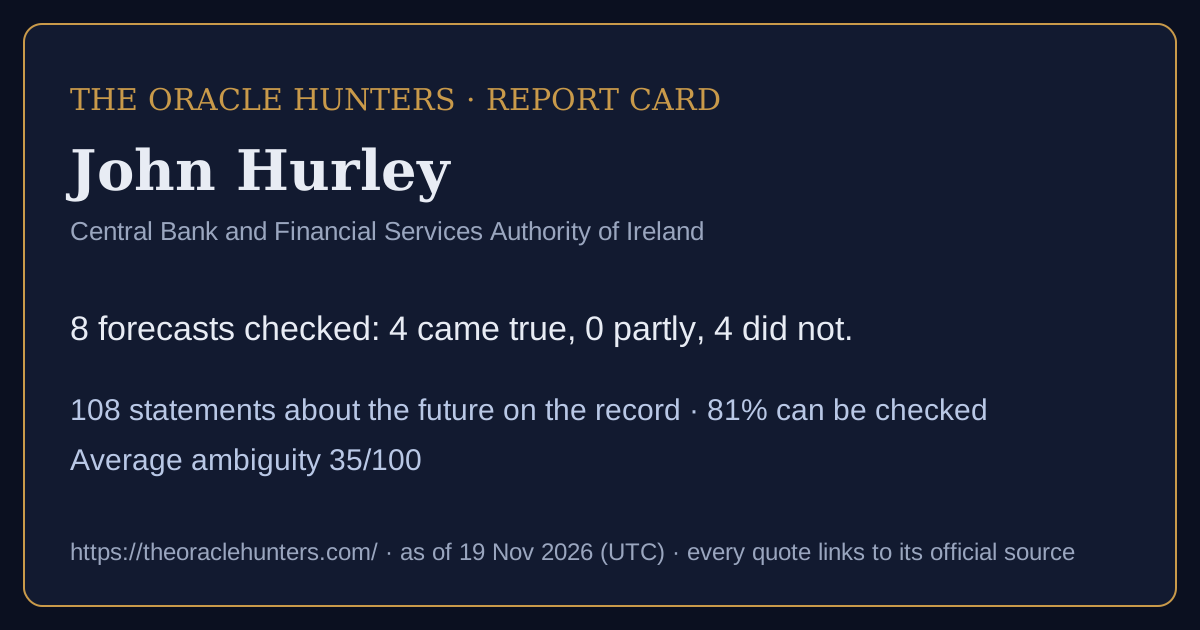
John Hurley
Central Bank and Financial Services Authority of Ireland
Track record: 8 forecasts checked: 4 came true, 0 partly, 4 did not.
108forecasts & commitments on the record
81%can be checked as stated
35average ambiguity (0-100)
0goalpost moves recorded
0confirmed U-turns
Timeline
came true partly did not not due / being checked / too vague
Calibration score: shown after 10 checked forecasts with a stated likelihood (now 7).
How they speak about the future: based on data 86, stated on authority 15, educated guess 7.
Kinds of claim: forecast 92, mixed claim 10, scenario (if… then) 4, commitment 2. · Download this report card as a picture
In the nine words
πρόγνωσιςInference from evidence83 · 77%μαντείαInspired knowledge14 · 13%πρόνοιαPreparing for the future4 · 4%εἰκασίαConjecture3 · 3%προαναγγελίαPublic pre-announcement2 · 2%πρόβλεψιςSeeing the signs2 · 2%
How to read this
Each box is one sentence a public figure or institution said about the future, word for word, with a link to the official text. Can be checked means it names what will happen, by when, and how likely - so it can be compared with official figures later. Too vague to check means it does not. Ambiguity (0-100) is how many different ways the sentence can be read. When the date passes, the forecast is compared with official data and marked came true, partly or did not come true. Labels judge the sentence, never the person. Full guide and glossary.Checked
Reflecting this, unemployment is forecast to average around 13 per cent this year and 15 per cent in 2010.
Came true. Said: unemployment around 15% in 2010. Official figure for Ireland: 14.5% (World Bank open data). On target. Off by 0.5 points. official data · checked 14 Nov 2026 · automatic check against official data (rules v3)
Based on what is currently known, our latest unpublished estimates suggest that GDP will fall by over 6 per cent this year, with a broadly similar fall likely in the level of employment.
Did not come true. Said: economic growth above 6% in 2009. Official figure for Ireland: -5.1% (World Bank open data). Missed. Off by 11.1 points. official data · checked 14 Nov 2026 · automatic check against official data (rules v3)
We expect the economy to grow next year by some 3 per cent. or so, and this in a situation where the rebalancing of economic activity will continue.
Did not come true. Said: economic growth around 3% in 2008. Official figure for Ireland: -4.5% (World Bank open data). Missed. Off by 7.5 points. official data · checked 14 Nov 2026 · automatic check against official data (rules v3)
Unemployment is likely to rise modestly, probably to about 5¼ per cent next year from an average of about 4¾ per cent this year.
Did not come true. Said: unemployment around 5.25% in 2008. Official figure for Ireland: 6.8% (World Bank open data). Missed. Off by 1.5 points. official data · checked 14 Nov 2026 · automatic check against official data (rules v3)
Inflation is likely to ease, however, with an average HICP rate of 2.8 per cent this year falling to about 2¼ per cent next year, effectively eliminating the inflation differential with the euro area.
Did not come true. Said: inflation around 2.25% in 2008. Official figure for Euro area: 4.2% (World Bank open data). Missed. Off by 1.9 points. official data · checked 14 Nov 2026 · automatic check against official data (rules v3)
The economy is expected to grow by about 5 per cent this year - a broadly similar rate to that in recent years.
Came true. Said: economic growth around 5% in 2006. Official figure for Ireland: 5.0% (World Bank open data). On target. Off by 0.0 points. official data · checked 14 Nov 2026 · automatic check against official data (rules v3)
The current inflation forecast for this year is 2¼ per cent for both measures of inflation - the CPI and the HICP.
Came true. Said: inflation around 2.25% in 2004. Official figure for Ireland: 2.2% (World Bank open data). On target. Off by 0.1 points. official data · checked 14 Nov 2026 · automatic check against official data (rules v3)
This year, the Bank forecasts inflation to be about 2 per cent.
Came true. Said: inflation around 2% in 2004. Official figure for Ireland: 2.2% (World Bank open data). On target. Off by 0.2 points. official data · checked 14 Nov 2026 · automatic check against official data (rules v3)
On the record (108)
In addition, this month the Eurosystem has started a programme that will see it purchase up to €60 billion of covered bonds issued by banks in the euro area; this will help an important market sector, and again will be of benefit to banks in Ireland and support credit provision here.
The fact that some recovery may be in prospect over the next year or so primarily reflects the unprecedented response of policy-makers to the crisis.
Next year the level of contraction is likely to be around 3 per cent for the year as a whole with some gradual recovery emerging later in the year but unlikely to take hold until 2011.
The consumer price index is forecast to fall by around 4 per cent this year and to be broadly flat next year (the HICP index, which does not include mortgage interest payments, is projected to fall by close to 1½ per cent this year with a further modest fall in 2010).
Reflecting this, unemployment is forecast to average around 13 per cent this year and 15 per cent in 2010.
Came true. Said: unemployment around 15% in 2010. Official figure for Ireland: 14.5% (World Bank open data). On target. Off by 0.5 points. official data · checked 14 Nov 2026 · automatic check against official data (rules v3)
Following a contraction of around 1½ per cent this year, the IMF now expects global growth of 2½ per cent in 2010, somewhat higher than their previous projection of just under 2 per cent.
At its last meeting, the Governing Council announced the details of a programme to purchase around €60 billion of euro-denominated covered bonds issued in the euro area, which will help an important market, and again will be of benefit to banks and support credit provision.
As regards prices, euro area inflation is expected to turn temporarily negative for a period this year but to return to positive territory again thereafter.
There has also been a cumulative reduction of 300 basis points in the key policy rate and, while the Governing Council is never pre-committed, I cannot exclude the possibility that the Council may - in a very measured way - further reduce the main policy rate.
Reflecting these developments, headline inflation could turn negative in a number of advanced economies this year.
While the Fund has forecast very modest positive growth at the global level for next year, the recovery may be rather gradual.
In October, the global growth projection was revised down to 3 per cent, in November to 2.2 per cent and most recently, in January, to 0.5 per cent.
For example, in July last year, the IMF was expecting global growth of 3.9 per cent in 2009, a development that they described as 'a pronounced slowdown'.
Based on what is currently known, our latest unpublished estimates suggest that GDP will fall by over 6 per cent this year, with a broadly similar fall likely in the level of employment.
Did not come true. Said: economic growth above 6% in 2009. Official figure for Ireland: -5.1% (World Bank open data). Missed. Off by 11.1 points. official data · checked 14 Nov 2026 · automatic check against official data (rules v3)
The situation in advanced economies is actually worse as, within these global growth projections, the significant downward revisions to growth in the advanced economies, which are expected to contract this year by 2 per cent, are balanced by relatively better performance in emerging markets.
Economic activity has remained stronger in the euro area, although an easing in the growth rate is expected in the short-term before a recovery towards its potential growth rate of about 2 per cent.
While the emergence of a slowdown in the economy was not unanticipated, the loss of momentum has been greater than expected this year.
The significant weakening in the housing sector is going to detract considerably from growth this year.
our forecasts, but a ballpark estimate, at this point in time, would be around 0.5 per cent growth this year and about 2 per cent in 2009.
Growth should pick up somewhat next year as the fall in domestic housing output levels off.
Our current forecasts are that both GNP and GDP growth will remain positive this year, albeit significantly less than 1 per cent.
On the basis of current trends, it will be a major challenge to remain within the terms of the Stability and Growth Pact next year.
Growth prospects for the next 18 months or so are now significantly less favourable and we will be revising our forecasts to reflect this.
Growth should pick up next year on the basis of a bottoming out in domestic housing output and some improvement in the external environment.
The downturn in the housing market and the consequent reduced employment in that sector will contribute to a sharp slowdown in the overall rate of job creation and a rise in the unemployment rate to about 6 per cent on average this year.
Although some improvement is in prospect, growth is likely to remain below potential in 2009 at about 2 per cent.
Overall, it seems likely that both GNP and GDP growth will remain positive this year, albeit significantly less than 1 per cent.
As a result, real GDP is projected to increase by 2.4 per cent while real GNP is forecast to increase by 1.9 per cent in 2008.
While the growth rate of the economy is expected to slow this year, it will still represent a good performance by international standards, and growth is expected to recover in 2009 and subsequent years.
Some pick up in economic growth is likely in 2009 on the basis that house-building activity will stabilise or contract only modestly, and there will be some recovery in the global economy.
The expected slowdown in the economy this year, however, will have implications for the performance of the labour market.
While growth is expected to moderate somewhat from its 2007 rate, euro area economic activity is still expected to continue to expand this year.
At this stage, growth in Irish GDP and GNP are forecast to recover to 3.6 per cent and 3.2 per cent, respectively, in 2009.
If we try to compensate ourselves for terms of trade losses, such as those caused by oil price increases, then the results will be damaging.
The Bank projects GDP growth of around 3 per cent this year, with GNP growth expected to be somewhat lower at about 2.6 per cent.
The average HICP inflation rate is expected to fall to around 2½ per cent this year, and perhaps further to about 2 per cent next year, bringing inflation in Ireland broadly into line with the euro area average.
Assuming no adverse external developments and a broad levelling off in housing output, growth should recover in 2009, approaching its medium-term potential.
Direct debit payments will be covered by the SEPA Direct Debit Scheme, but will not be available until November 2009, when the EU Commission's Payment Services Directive is transposed into national law throughout the EU.
beginning to happen and, if this continues, it is difficult to see how overall economic activity in the US will remain unaffected.
To try and further calm this segment of the money market, in recent weeks, the ECB signalled that it will rollover the two outstanding supplementary long-term refinancing operations and, last Friday, stated that, at least until after the end of the year, it will reinforce its policy of allocating more liquidity than the benchmark amount in the main refinancing operations.
While the intensity of the problems across various markets has ebbed and flowed since August, it is clear that this process is still very much ongoing and is likely to persist, at least into the early part of 2008.
We expect the economy to grow next year by some 3 per cent. or so, and this in a situation where the rebalancing of economic activity will continue.
Did not come true. Said: economic growth around 3% in 2008. Official figure for Ireland: -4.5% (World Bank open data). Missed. Off by 7.5 points. official data · checked 14 Nov 2026 · automatic check against official data (rules v3)
I will now refer briefly to the macroeconomic risks that could pose problems for economic growth if they were to materialise.
While the outlook is for some deceleration in 2008, growth projections remain reasonably strong by international standards.
Frank Browne, Head of Financial Stability, will make a brief presentation to pick up on some of these points, after which we will be happy to take questions.
Unemployment is likely to rise modestly, probably to about 5¼ per cent next year from an average of about 4¾ per cent this year.
Did not come true. Said: unemployment around 5.25% in 2008. Official figure for Ireland: 6.8% (World Bank open data). Missed. Off by 1.5 points. official data · checked 14 Nov 2026 · automatic check against official data (rules v3)
GNP is likely to expand by about 4¾ per cent this year but the growth rate will probably drop to about 3¼ per cent next year.
Inflation is likely to ease, however, with an average HICP rate of 2.8 per cent this year falling to about 2¼ per cent next year, effectively eliminating the inflation differential with the euro area.
Did not come true. Said: inflation around 2.25% in 2008. Official figure for Euro area: 4.2% (World Bank open data). Missed. Off by 1.9 points. official data · checked 14 Nov 2026 · automatic check against official data (rules v3)
The data for the early part of this year suggest that growth was probably in excess of these levels but there are two factors that will act to reduce growth somewhat as the year progresses and into next year.
Turning now to the outlook for the economy generally for this year and 2008, the Bank's current projections are that output growth will moderate, though still remaining strong.
Showing the newest 50 - the ledger has all 108.
Also said - not checkable as stated (12 newest)
Remarks about the future with no date, figure or likelihood that could be checked. They are kept on the record and shown here, but not scored.
A final necessary stage must address the optimum shape and structure of the domestic banking sector that will be required to meet the needs of the economy in the years ahead.
As a result, monetary policy will have to remain accommodative for as long as is required and will only be adjusted when there are definite signs of a significant improvement.
More generally, it is vital that we act credibly and quickly to confront the very significant challenges that we face and chart a path that will in time ensure a sustainable recovery in economic growth.
While it remains unclear when the crisis will end and what its ultimate effects will be, recent signs of recovery remind us that we need to look at the type of financial system that we want to see emerge when the crisis is over.
This is a development that is likely to last for a number of months in the case of the euro area, before there is a return to moderate rates of positive inflation.
We have seen a small improvement in some economic indicators internationally in recent weeks, but I have to say that, at this stage, these remain more consistent with further contractions in output albeit at a slower pace - rather than actual growth.
I will refer to the international debate concerning how central banks and financial supervisors can work better together to reduce the chances of events like these happening again.
This is likely to result in an unemployment rate averaging over 11 per cent for the year.
More importantly, debating the whys and wherefores will have its place, but at this juncture we need to act decisively with conviction, in unison, and move forward.
With reference to financial stability issues more generally, I will comment on the actions taken by the authorities here to secure the stability of our domestic financial system, particularly since the Lehman's bankruptcy last September.
At that time, we were experiencing a greater-than-expected slowdown in domestic growth in conjunction with a generalised disruption in international money markets.
An international debate has now begun on how authorities might directly change the behaviour of financial market participants to mitigate the risks identified in Financial Stability Reports.