John Glen
Department for Digital, Culture, Media & Sport (2017 to 2023) · GBR
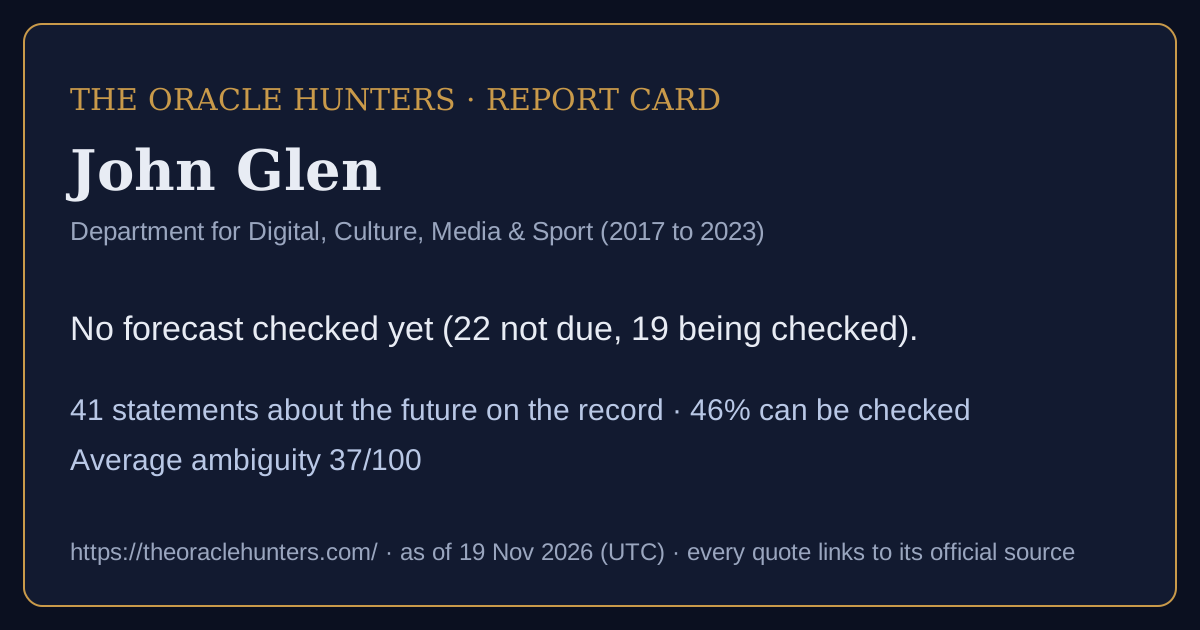
Track record: No forecast checked yet (22 not due, 19 being checked).
41forecasts & commitments on the record
46%can be checked as stated
37average ambiguity (0-100)
0goalpost moves recorded
0confirmed U-turns
Timeline
came true partly did not not due / being checked / too vague
Calibration score: shown after 10 checked forecasts with a stated likelihood (now 0).
How they speak about the future: stated on authority 22, based on data 17, educated guess 2.
Kinds of claim: forecast 25, commitment 11, mixed claim 5. · Download this report card as a picture
In the nine words
πρόγνωσιςInference from evidence17 · 41%μαντείαInspired knowledge12 · 29%προαναγγελίαPublic pre-announcement11 · 27%εἰκασίαConjecture1 · 2%
How to read this
Each box is one sentence a public figure or institution said about the future, word for word, with a link to the official text. Can be checked means it names what will happen, by when, and how likely - so it can be compared with official figures later. Too vague to check means it does not. Ambiguity (0-100) is how many different ways the sentence can be read. When the date passes, the forecast is compared with official data and marked came true, partly or did not come true. Labels judge the sentence, never the person. Full guide and glossary.On the record (41)
Today, I can announce the final instalment of nearly £1m of funding for five additional projects which will help us understand what works in tackling crime, Net Zero, and recruitment.
It could have been written yesterday, but actually next month that report celebrates its 170th anniversary.
It provided essential support throughout the pandemic rapidly, and will save £650m per year by 2027.
And I’m delighted to say that, next year, the IPA will launch a new benchmarking service to improve decision making, which I hope will lead to stronger business cases and greater confidence in cost and schedules - all powered by innovative practices.
Public infrastructure plays a vital role in economic growth, and, indeed, it is a growth industry in itself, and we’ll need over a million new workers until 2025 to deliver the projects currently scheduled.
The TNFD is on track to publish its final nature risk management and disclosure framework later this year, which will support businesses and financial institutions to assess, manage and disclose their risks, impacts and dependencies on nature and take action.
As part of the strategy, which will launch later this year, we will have a new policy framework for nature markets.
And at the 2021 Spending Review, the Government confirmed it will provide £5 million of seed funding for the creation of a new industry-led Centre for Finance, Innovation and Technology to tackle barriers to growth and accelerate the UK fintech sector.
We will be introducing new secondary objectives for the PRA and FCA to ensure a greater focus on growth and competitiveness.
I expect the pilot to reach full-scale rollout in a number of pilot sites across the UK at the start of 2023.
The government will continue to stand by credit unions in your mission to provide access to affordable credit and increase financial resilience.… just as we did in the pandemic… to ensure the sector can deliver for its members now and into the future.
We will continue to strengthen affordable credit initiatives, which will both expand the provision of affordable credit and increase usage.
By collectively targeting elites and oligarchs, cutting off transport and finance links and starving Moscow of technology and know-how… we will make sure Putin pays the price while simultaneously degrading Russia’s ability to perpetuate this course of action.
We are developing opportunities to use distributed ledger technology for Customs and International Trade, to ease the import of goods, and we will continue to support further opportunities to deploy that technology.
The FCA have announced today that they will be organising the first of a series of ‘crypto-sprints’ next month, involving scores of industry experts.
Today, we’re publishing our response… as part of which I can confirm that we will be legislating to bring certain stablecoins into our payments framework… creating the conditions for stablecoin issuers and service providers to operate and grow in the UK.
And we will not hesitate to take further action as it is needed, including by strengthening the Treasury’s powers to enforce financial sanctions,
Thirdly, we will introduce a significant increase in flexibility to allow more investment in long-term assets such as infrastructure, the hardware which makes economic growth possible.
When I saw The City UK dinner was going to be held in Leicester Square this year, I couldn’t help but take a moment to reflect on this place’s history.
This will allow us next year, to tailor our future approach to enable market access to investment funds from other countries.
This means UK firms will be able to reclaim input VAT on financial services exports to the EU – support worth £800 million per year.
So, to make sure UK financial services exports to the EU remain competitive, we will treat them the same as exports to other countries.
We will cut down bureaucracy so it’s easier for businesses to hire the people they need, with no cap on skilled migration.
The government will monitor progress and publish an interim report by the end of 2020, which will inform our next steps.
You probably don’t need me to remind you that the financial services sector contributed £75 billion in taxes during the last financial year.
But this will only be possible if our immigration system enables the City to access the global talent it needs to innovate and grow.
We expect the Fund to raise up to £500 million of international investment through the City of London to support sustainable energy initiatives on the sub-continent.
PwC predict that by 2050, the ‘E7’ countries will have a 46% share of global banking assets, whilst the G7’s share will shrink to just 30%.
And a £1.5 trillion economy which is expected to double between now and 2025.
And next month, here in London, we will use the tenth annual Economic and Financial Dialogue between our two countries to deepen that relationship further still.
Later this year, we will publish our Green Finance Strategy to put flesh on the bones of this growing ambition.
(PWC) predict that by 2030, (AI) could boost our national (GDP) by 10%.
The second Women in Finance Charter Annual Review will be published in March this year, where signatories to the Charter will provide updates on their progress.
McKinsey, the management consultant, has released research showing that closing the UK’s gender gap could create an additional £150 billion on top of business-as-usual GDP forecasts for 2025.
And this will not change after March next year.
I will be hosting a roundtable with industry this year to discuss exactly this…
The Government Equalities Office has published research which shows that equalising women’s productivity and employment to the same levels as men could add £600 billion to the UK economy.
And equalising work participation rates could add 10% to the size of the UK economy by 2030.
…I think we will continue to see a growth in product offering.
By the end of this year, we expect this number to have risen substantially, along with increased allocations of investments dedicated to fighting climate change.
In 2021 another city will benefit from being UK City of Culture.
Also said - not checkable as stated (12 newest)
Remarks about the future with no date, figure or likelihood that could be checked. They are kept on the record and shown here, but not scored.
I’m pleased to say that good progress is being made and should conclude next month.
As a first step, we will pilot this with our most senior grades, and I hope that this will prove to be a first step in moving towards a wider system of performance related pay.
By autumn, we will have a better understanding of how these tools are being used, we will then act accordingly and if required, make radical changes ahead of the next performance year.
Creating a more flexible and agile workforce matters greatly if we are going to instil technical innovation that we need in the civil service, where we really need ground-breaking leadership to bring the public sector in line with the tech sector.
That’s why I am announcing today - as part of the Senior Civil Service Strategy - that we will be developing a recruitment pathway specifically for experienced specialist talent to join the Civil Service.
Doing so will allow us to reallocate resources to our most pressing priorities, like national security.
The College of Policing will be evaluating ‘Operation Divan’, convincing young people not to carry knives or weapons, again an incredibly complicated issue, but we need to underpin interventions with rigorous analysis.
We will also deliver more efficient public services and target spending where it can be most effective, which I’m sure is the common thread that motivates us all to be involved in this work.
It really is critical work, we need to get this right, make it the norm across Whitehall and use it to drive more efficient and confident allocations in spending reviews of which there will be another one very soon.
The Department for Energy Security and Net Zero will evaluate the Energy efficiency scheme and how our sustainable projects are appraised.
Transforming Access and Student Outcomes in Higher Education will be analysing how they can improve student wellbeing and mental health.
That is why we will be setting out the line management standards we want across the Civil Service and providing the support to managers they need to achieve these.