John C Williams
Federal Reserve Bank of New York
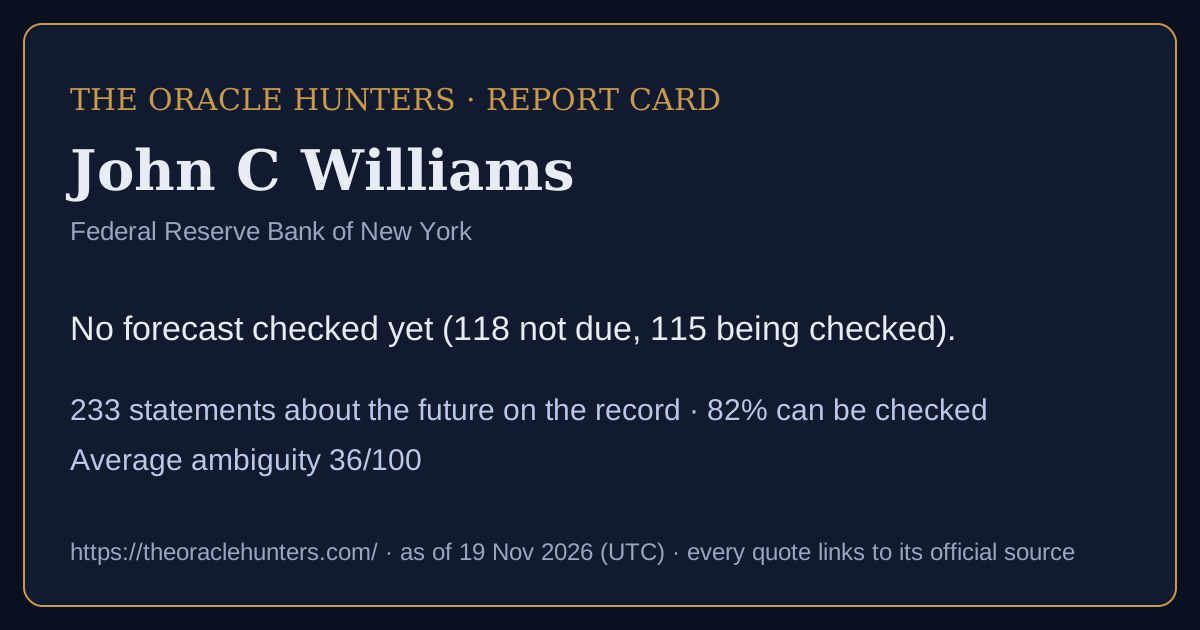
Track record: No forecast checked yet (118 not due, 115 being checked).
233forecasts & commitments on the record
82%can be checked as stated
36average ambiguity (0-100)
0goalpost moves recorded
0confirmed U-turns
Timeline
came true partly did not not due / being checked / too vague
Calibration score: shown after 10 checked forecasts with a stated likelihood (now 0).
How they speak about the future: based on data 194, stated on authority 35, educated guess 4.
Kinds of claim: forecast 203, mixed claim 19, scenario (if… then) 7, commitment 4. · Download this report card as a picture
In the nine words
πρόγνωσιςInference from evidence182 · 78%μαντείαInspired knowledge32 · 14%πρόνοιαPreparing for the future7 · 3%φρόνησιςPractical wisdom4 · 2%πρόβλεψιςSeeing the signs4 · 2%προαναγγελίαPublic pre-announcement4 · 2%
How to read this
Each box is one sentence a public figure or institution said about the future, word for word, with a link to the official text. Can be checked means it names what will happen, by when, and how likely - so it can be compared with official figures later. Too vague to check means it does not. Ambiguity (0-100) is how many different ways the sentence can be read. When the date passes, the forecast is compared with official data and marked came true, partly or did not come true. Labels judge the sentence, never the person. Full guide and glossary.On the record (233)
Third, based on oil prices today and futures market pricing into next year, it appears that prices for energy and related goods have likely peaked and will come down closer to levels seen before the initial closure of the Strait of Hormuz.
For the reasons I outlined a moment ago, I expect overall inflation to decline to around 3-1/4 percent by year-end, then continue on a glide path toward our 2 percent goal in 2027 and land on target in 2028.
With growth running modestly above my estimate of its potential rate of 2 percent, I expect the unemployment rate to edge down very gradually to 4 percent in 2028.
Looking ahead, I expect real GDP growth to be around 2 to 2-1/4 percent this year and over the next two years.
Consequently, with growth around its trend pace, I expect the unemployment rate will remain in its recent range of 4-1/4 to 4-1/2 percent.
I expect inflation to remain elevated and above the FOMC's longerrun 2 percent goal for the next few quarters, largely due to those two factors.
However, I also expect there will be a new round of tariffs in the coming months, which would put additional upward pressure on import prices.
I anticipate real GDP growth to be between 2 and 2-1/4 percent this year and next.
With growth running close to trend, I anticipate the unemployment rate will remain in its recent range of 4-1/4 to 4-1/2 percent.
We can see this pattern in perceptions of jobs availability published by the Conference Board and job-finding expectations reported in the New York Fed's Survey of Consumer Expectations, both of which have continued to trend downward. 2 In particular, the New York Fed's survey measure may foreshadow a further decline in job-finding rates in coming months.
And I expect overall inflation to come in between 2-3/4 and 3 percent this year-reflecting the effects of energy price increases-and then reach our 2 percent longer-run target in 2027 as the effects of tariffs and energy prices fade.
But given what we know now, I expect real GDP growth to be between 2 and 2-1/2 percent this year.
At its most recent meeting, the FOMC decided to maintain the target range for the federal funds rate at 3-1/2 to 3-3/4 percent. 3 And, it stated that, "In considering the extent and timing of additional adjustments to the target range for the federal funds rate, the Committee will carefully assess incoming data, the evolving outlook, and the balance of …
With growth running above potential, I expect the unemployment rate to edge down over this year and next.
Perceptions of jobs availability published by the Conference Board and job finding expectations reported in the New York Fed's Survey of Consumer Expectations (SCE) both have been trending downward. 2 The SCE measure, in particular, may foreshadow a further decline in job-finding rates in coming months.
And with various short-term factors affecting prices, I expect overall inflation to come in at around 2-3/4 percent this year, before reaching our longer-run 2 percent target in 2027.
Given what we know today, I expect real GDP growth to be close to 2-1/2 percent this year, reflecting tailwinds from fiscal policy, favorable financial conditions, and investment in AI.
In addition, the significant increase in energy prices resulting from developments in the Middle East will likely boost overall inflation in coming months, but these effects should partially reverse later this year, assuming oil prices come down after hostilities cease.
With real GDP poised for continued solid growth, I expect the unemployment rate to edge down over the course of this year and next year.
Therefore, I anticipate inflation to start coming back down later this year when the peak effect of tariffs on the inflation rate is behind us.
And with the effects of tariffs on inflation waning later in the year, I expect overall inflation to come in at around 2-1/2 percent in 2026, then fall to 2 percent in 2027.
In terms of my outlook, I expect real GDP to grow about 2-1/2 percent this year, supported by stimulus from fiscal policy, favorable financial conditions, and robust investments in artificial intelligence.
Taking all of that into account, I expect we will see some additional pass-through of tariffs into consumer prices during the first half of this year.
Looking ahead, I expect tariffs will have a largely one-off price level effect that will be fully realized in 2026.
The accompanying FOMC statement said that "in considering the extent and timing of additional adjustments to the target range for the federal funds rate, the Committee will carefully assess incoming data, the evolving outlook, and the balance of risks." 3 With these actions, monetary policy is well positioned as we head into 2026.
So, after a year of uncertainty, we will be starting 2026 from a place of resilience.
And I expect the unemployment rate to rise to around 4-1/2 percent at the end of this year, reflecting some additional effects from the government shutdown.
I expect real GDP growth to be about 2-1/4 percent in 2026, well above my forecast for this year's pace of around 1-1/2 percent.
I anticipate inflation to decline to just under 2-1/2 percent next year before reaching the FOMC's longer-run 2 percent goal in 2027.
And I expect PCE inflation to come in between 3 and 3-1/4 percent this year, before declining to around 2-1/2 percent next year, and reaching 2 percent in 2027.
With this slowdown in growth, I expect the unemployment rate to gradually rise to about 4-1/2 percent next year.
As a result, I expect GDP growth this year to be between 1-1/4 and 1-1/2 percent.
All in all, I expect tariffs will boost overall prices by a total of between 1 and 1-1/2 percent, with these effects continuing through the first half of next year.
All in all, although we are only seeing relatively modest effects of tariffs in the hard aggregate data so far, I expect those effects to increase in coming months.
Specifically, for are items that are more exposed to higher tariffs-household appliances, musical instruments, luggage, tableware-price increases so far this year have been well above what one would expect based on past trends.
I anticipate inflation will come in between 3 and 3-1/2 percent in 2025, and then fall back to about 2-1/2 percent next year before reaching 2 percent in 2027.
With this slowdown in growth, I expect the unemployment rate to rise to around 4-1/2 percent by the end of this year.
As a result, I expect real GDP growth this year to be about 1 percent.
Overall, I expect tariffs to boost inflation by about 1 percentage point over the second half of this year and the first part of next year.
I anticipate the tariffs enacted this year will boost inflation to around 3 percent in 2025, and then for inflation to gradually decline to 2 percent over the next two years as the tariff effects fade.
With this deceleration of real GDP, I expect the unemployment rate to rise to around 4-1 /2 percent by the end of this year.
As a result, I expect real GDP growth this year will slow considerably from last year's pace, to just over 1 percent.
Given the combination of the slowdown in labor force growth due to reduced immigration and the combined effects of uncertainty and tariffs, I now expect real GDP growth will slow considerably from last year's pace, likely to somewhat below 1 percent.
A key question is the extent to which this year's higher inflation spills over into subsequent years and how that may affect expectations.
I expect increased tariffs to boost inflation this year to somewhere between 3-1/2 and 4 percent.
With this downshift in the pace of growth, I expect the unemployment rate to rise from its current level of 4.2 percent to between 4-1/2 and 5 percent over the next year.
The Committee reaffirmed its strong commitment to supporting maximum employment and returning inflation to its 2 percent objective, and its policy decisions will be based on a careful assessment of the incoming data, the evolving outlook, and the balance of risks. 10
In the Summary of Economic Projections that the FOMC released this week, the central tendency of projections for GDP growth this year was between about 1-1/2 and 2 percent, and for inflation, between about 2-1/2 and 3 percent.
Turning to the U.S. economic outlook, I expect GDP growth this year to step down from last year's pace in part because of a slowdown in labor force growth due to lower immigration rates.
And inflation is on a path to reach our 2 percent longer-run goal over the next few years.
Showing the newest 50 - the ledger has all 233.
Also said - not checkable as stated (12 newest)
Remarks about the future with no date, figure or likelihood that could be checked. They are kept on the record and shown here, but not scored.
But there are encouraging reasons to expect that inflation has peaked and should edge down in coming quarters.
I am confident that these investments will support strong productivity growth in coming years.
To give you a bit of a spoiler, my answer to the question of the effects of a shift in trend productivity growth on the economy and monetary policy is, unsurprisingly,"it depends."In particular,it depends on the nature and expected duration of the shift in question.
As we try to answer this question, I will point out something I'd call"the recognition problem."This means that while shifts in trend productivity growth may appear crystal clear in hindsight, it often takes years to distinguish them from the normal ups and downs in the data.This gradual recognition of shifts in productivity growth has profound implications for how economies respond.
Finally, I should emphasize that this correspondence between the model's predictions and the views of experts isn't mere curvefitting; rather, it's evidence that a simple, disciplined framework captures how forecasters process productivity information in real time.
I'll close with a note on robust policy, which is related to what I discussed at last year's conference here in Reykjavik.11 Historyinformed by economic theory and evidence-teaches usthat the macroeconomic effects of a shift in productivity growth depend on the nature and expected duration of the shift.Although each historical episode is unique, they also share regularities.
gradually to changes in underlying productivity growth.As a result, in the initial stages following a shift, the economy is likely to behavemorelike a temporaryincreasein productivitygrowth than apermanent one.
Williams. 2oo4."Learning and Shifts in Long-Run Productivity Growth,"Federal Reserve Bank of San Francisco Working Paper 2oo4-04.Relatedly,one can imagine scenarios where the increase in productivity growth is expected to occur in the future once the new technologies are fully developed, as analyzed by Barsky, Robert B.and Eric R.
I anticipate the pass-through of current tariffs to prices to be mostly completed in the next few months and therefore their effects on the inflation rate to fade.
Remarks by Mr John C Williams, President and Chief Executive Officer of the Federal Reserve Bank of New York, at the Cynosure Group Spring Symposium, New York City, 4 May 2026.
Over the next few quarters, the effects of tariffs on the inflation rate should begin to wane, creating some downward momentum in core inflation.
Assuming energy supply disruptions ease reasonably soon, energy prices should come down, and these effects should partially reverse later this year.