Johannes Hahn
European Commission · EU
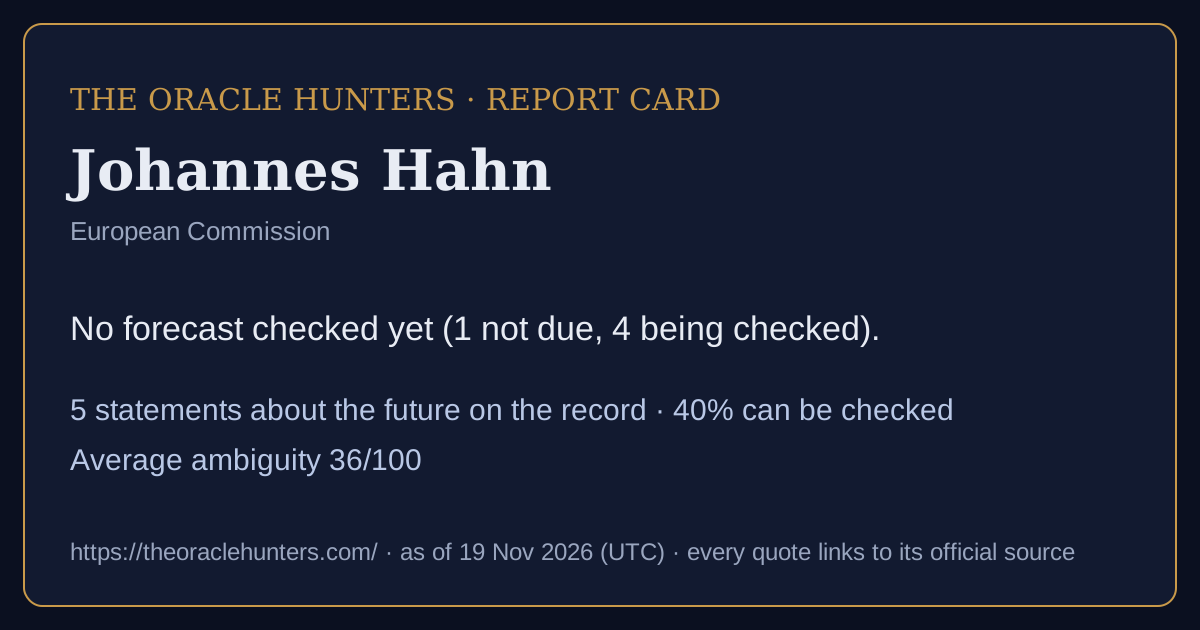
Track record: No forecast checked yet (1 not due, 4 being checked).
5forecasts & commitments on the record
40%can be checked as stated
36average ambiguity (0-100)
0goalpost moves recorded
0confirmed U-turns
Timeline
came true partly did not not due / being checked / too vague
Calibration score: shown after 10 checked forecasts with a stated likelihood (now 0).
How they speak about the future: based on data 3, stated on authority 2.
Kinds of claim: forecast 4, mixed claim 1. · Download this report card as a picture
In the nine words
How to read this
Each box is one sentence a public figure or institution said about the future, word for word, with a link to the official text. Can be checked means it names what will happen, by when, and how likely - so it can be compared with official figures later. Too vague to check means it does not. Ambiguity (0-100) is how many different ways the sentence can be read. When the date passes, the forecast is compared with official data and marked came true, partly or did not come true. Labels judge the sentence, never the person. Full guide and glossary.On the record (5)
We're putting in place measures to help Ukrainian businesses get ready, with the funds that will leverage around 1 billion Euros worth of support for Ukraine over time.
As you all know, from 1st January 2016, a new Deep and Comprehensive Free Trade Area will open up between Ukraine and the EU.
I can announce that Ukraine will receive substantial extra help this year – over 70 million Euros more - because of the reforms that have already been launched.
We are supporting you in developing better administration in your new amalgamated communes, and I hope that next year we will be able to support a reform of public administration throughout Ukraine.
Soon, the Commission will adopt this year's enlargement package.
Also said - not checkable as stated (12 newest)
Remarks about the future with no date, figure or likelihood that could be checked. They are kept on the record and shown here, but not scored.
Therefore, we will also have to ask tough questions: How can Europe explore the full potential of new technologies while containing the democratic and privacy challenges which come, for example, with Artificial Intelligence?
Together, we will thus explore the best “realistic visions” for how Europe can face up to its challenges and its standing in the world.
In this context, my colleague the European Commissioner for Economy, Paolo Gentiloni, will explain why and how Europe needs to be the frontrunner of the green and digital transition – and how we can finance this.
But it is worth the effort: Every solar panel, every wind turbine and every energy-efficient building will contribute to Europeans having access to cheaper, safer, and cleaner energy.
I could witness this when I visited Ukraine and met the Ukrainian Deputy Prime Minister Mykhailo Fedorov, who is also minister for digitalisation and committed to turning Ukraine into a digital pioneer.
Knowing Professor Zeilinger, I am convinced: he will enchant us with the magic of thinking without borders and limits.
There is no budget impact of our proposal next year, it only kicks in, in 2024
We will also foresee a review clause that allows us to adapt the conditionality at a later stage if needed.
The central liquidity pool, that is a core feature of the diversified funding strategy, could be drawn upon as a first resource to make rapid payments to Ukraine as needed and ensure payments to EU bond investors in all eventualities and provides additional safeguards to the EU budget;
Moreover, policy conditions will be increasingly geared towards strengthening Ukraine's institutions and preparing the ground for a successful reconstruction effort as well as supporting Ukraine's efforts on its European path.
The advantage of using the headroom as a backstop for the loans to Ukraine is that there is no need to constitute individual new Member States guarantees, which is procedurally more complex and financially less sound for an ambitious programme.
We must also show that we are able to make new and better choices if a programme is not delivering as expected.