Joachim Nagel
Deutsche Bundesbank
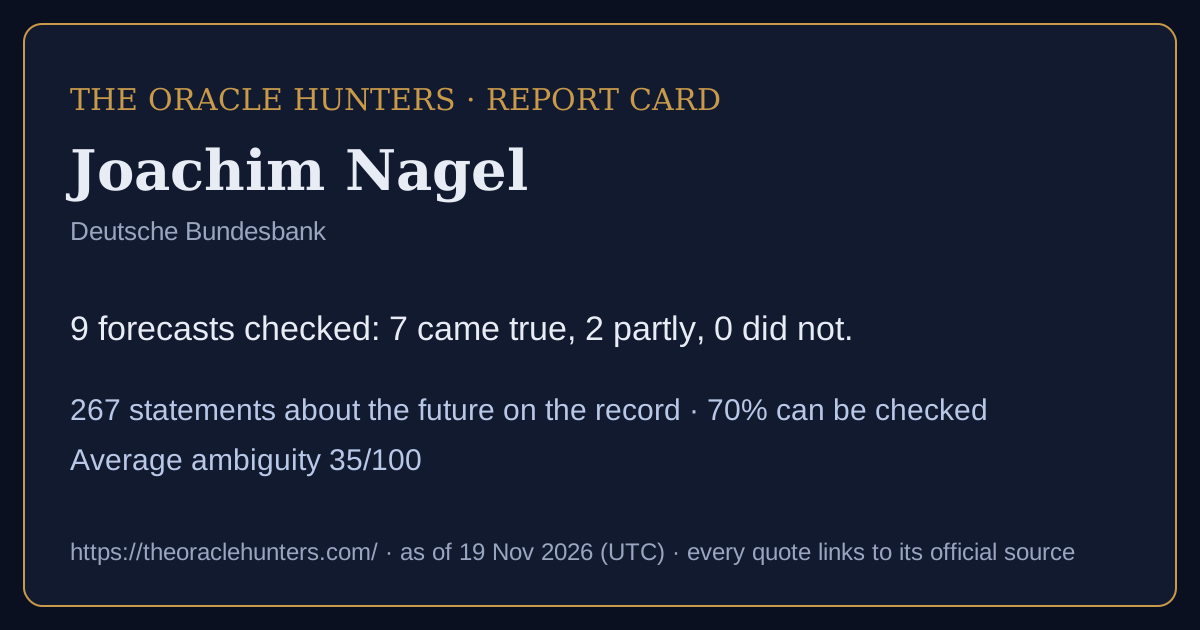
Track record: 9 forecasts checked: 7 came true, 2 partly, 0 did not.
267forecasts & commitments on the record
70%can be checked as stated
35average ambiguity (0-100)
0goalpost moves recorded
0confirmed U-turns
Timeline
came true partly did not not due / being checked / too vague
Calibration score: shown after 10 checked forecasts with a stated likelihood (now 7).
How they speak about the future: based on data 220, stated on authority 34, educated guess 13.
Kinds of claim: forecast 217, mixed claim 30, scenario (if… then) 15, commitment 5. · Download this report card as a picture
In the nine words
πρόγνωσιςInference from evidence214 · 80%μαντείαInspired knowledge29 · 11%πρόνοιαPreparing for the future14 · 5%προαναγγελίαPublic pre-announcement5 · 2%φρόνησιςPractical wisdom3 · 1%πρόβλεψιςSeeing the signs2 · 1%
How to read this
Each box is one sentence a public figure or institution said about the future, word for word, with a link to the official text. Can be checked means it names what will happen, by when, and how likely - so it can be compared with official figures later. Too vague to check means it does not. Ambiguity (0-100) is how many different ways the sentence can be read. When the date passes, the forecast is compared with official data and marked came true, partly or did not come true. Labels judge the sentence, never the person. Full guide and glossary.Checked
The German Council of Economic Experts, writing in its latest annual report, expects the economy to shrink by 0.1 percent, followed by meagre growth of 0.4 percent next year.
Came true. Said: economic growth around 0.4% in 2025. Official figure for Germany: 0.2% (World Bank open data). On target. Off by 0.2 points. official data · checked 14 Nov 2026 · automatic check against official data (rules v3)
Indeed, economic growth is expected to strengthen in the course of 2024.
Came true. Said: economic growth would rise in 2024. Official figures for Germany: -0.9% in 2023, -0.5% in 2024 (World Bank open data). official data · checked 14 Nov 2026 · automatic check against official data (rules v3)
Based on the assumption that both domestic and foreign demand will recover, they expect GDP growth to pick up to 0.8% in 2024 and 1.2% in 2025.
Came true. Said: economic growth below 0.8% in 2024. Official figure for Germany: -0.5% (World Bank open data). On target. official data · checked 14 Nov 2026 · automatic check against official data (rules v3)
Italy's annual growth rate is expected to accelerate from 0.7% this year to 0.9% in 2024 and 1.2% in 2025.
Came true. Said: economic growth around 0.9% in 2024. Official figure for Italy: 0.8% (World Bank open data). On target. Off by 0.1 points. official data · checked 14 Nov 2026 · automatic check against official data (rules v3)
Our experts project that inflation as measured by the Harmonised Index of Consumer Prices (HICP) will fall to 6% this year, down from 8.7% in 2022.
Came true. Said: inflation around 6% in 2023. Official figure for Germany: 5.9% (World Bank open data). On target. Off by 0.1 points. official data · checked 14 Nov 2026 · automatic check against official data (rules v3)
In the latest projections, euro area inflation is estimated to be 5.4% this year.
Partly came true. Said: inflation around 5.4% in 2023. Official figure for Euro area: 5.9% (World Bank open data). Close: outside the margin, but within one more half point. Off by 0.6 points. official data · checked 14 Nov 2026 · automatic check against official data (rules v3)
Inflation is likely to continue to fall, down to 2.2% on average in 2025.
Came true. Said: inflation around 2.2% in 2025. Official figure for Germany: 2.2% (World Bank open data). On target. Off by 0.0 points. official data · checked 14 Nov 2026 · automatic check against official data (rules v3)
For this year, the experts forecast inflation to average 5.3%.
Partly came true. Said: inflation around 5.3% in 2023. Official figure for Germany: 5.9% (World Bank open data). Close: outside the margin, but within one more half point. Off by 0.7 points. official data · checked 14 Nov 2026 · automatic check against official data (rules v3)
The inflation forecasts for the next two years have likewise been raised to an average of 5.5% for 2023 and a still considerable 2.3% for 2024.
Came true. Said: inflation around 5.5% in 2023. Official figure for Germany: 5.9% (World Bank open data). On target. Off by 0.5 points. official data · checked 14 Nov 2026 · automatic check against official data (rules v3)
On the record (267)
And, according to the timetable, the agreement on reforming the European securitisation framework that will have been reached by then should enter into force as early as the beginning of next year.
With the legislative frame -work expected to be fi nalised by the end of 2026, the Eurosystem is fi rmly on track to launch the digital euro in 2029.
We will be starting a pilot phase in mid-2027.
These are likely to have dampened euro area inflation by 0.4 percentage point in May.
According to the Harmonised Index of Consumer Prices (HICP), the rate of inflation in the euro area rose from just under 2% at the beginning of the year to a provisional 3.2% in May.
Economic activity is therefore likely to regain momentum by 2028.
We are committed to setting monetary policy to ensure that inflation stabilises at our 2% target in the medium term.
Next year, economic growth will accelerate to 0.8% in calendar-adjusted terms.
This may contribute to the fact that the ECB's Consumer Expectations Survey from March and April indicates perceptibly elevated inflation expectations. 1 Overall, the Eurosystem staff projection expects that inflation will be 3.0% this year.
Our objective is clear: We want the inflation rate to stabilise again at 2% over the medium term.
One thing is clear: The longer the conflict persists, the greater the risk that inflation will remain elevated if monetary policymakers fail to act.
Until recently, this part of my speeches tended to elicit boredom: inflation hovered around the 2% mark and the outlook promised the same.
Everything could then be ready for a possible first issue in 2029.
I am confident that, with regard to the legal side, everything will be signed and sealed by the end of the year.
And indeed, we see that members of the public now expect significantly higher inflation: From February to March, medium-term inflation expectations of euro area households rose from an average of 2.5% to 3.0%. 1
Recent estimates by the OECD suggest that in a scenario of rapid adoption, AI could elevate aggregate annual labour pro -ductivity growth over the next decade by somewhere between 0.8 and 1.3 percentage point in G7 economies.
The International Energy Agency projects that global electricity consumption for data centres will double by 2030, representing just under 3 % of total global electricity consumption at that time.
If the con fl ict comes to a swift end, a political agreement is reached, and there is, at most, minimal damage to the energy infrastructure in the region, then energy prices could soon fall again.
This year , the Bundesbank will report an annual loss again.
It amounted to € 19.2 billion and was carried forward to the next year .
It is clear that these headwinds will be a major concern for us this year , too.
On this basis, we will then decide whether the current monetary policy stance remains appropriate or whether action needs to be taken.
We will once again carry the accumulated loss over to next year and o ff set it against future pro fi ts.
Compared to the previous situation, theUS effective tariff rate for Germany will decline by about 4 percentage points.
In December, the Eurosystem staff revised its projections a bit upwards, with the euro area economy forecasted to expand by 1.2% this year and by 1.4% in 2027 (calendaradjusted).
For 2028, the Eurosystem staff expects a point landing at 2%.
According to the December projections for the euro area, there will be a temporary slight undershooting of the 2% mark this year and next.
We forecast that the German economy will grow by about 0.6% this year and by an even stronger 1.3% next year (on a calendar-adjusted basis).
Unadjusted growth rates will be somewhat higher at 0.9% for 2026 and 1.4% for 2027 due to more working days.
Will 2026 or 2027 be years in which centuries pass, as the novelist Homero Aridjis argued?
However, the rise of stablecoins could entail risks for the euro area if stablecoins, particularly those denominated in a foreign currency, were widely used as means of payment and store of value in the euro area.
If that were to happen, inflation levels could increase all over the world.
What will the average be for Caldara and Iacoviello's geopolitical risk index this year?
It did so most recently in 2025, thereby confirming the view that it has held since 2021: 2 price stability can be best maintained when the ECB Governing Council aims for 2% inflation over the medium term.
In their December 2025 projections, the Eurosystem staff forecast inflation to stand at 1.9% in 2026.
In 2003, the ECB Governing Council clarified that the inflation rate should be under, but close to, 2% over the medium term.
For 2027, it is likely to fall to 1.8%, but then rise again to 2% in 2028.
According to the latest projections from December 2025, core inflation will fall to 2.2% in 2026 and 1.9% in 2027, before rising slightly again to 2.0% in 2028.
Since last summer, our experts have forecast that inflation this year and next year will be just below this "ideal room temperature" of 2%.
They will include an initial projection for 2028.
On the other hand, expansionary fi scal policy will help to drive a recovery from next year onwards.
This could support GDP (gross domestic product) growth by roughly three -quarters of a percentage point in cumulative terms over the next two years.
On the one hand, US (United States) tari ff s and policy uncertainty will weigh on growth this year and next.
In the latest projections from September 2025, ECB (European Central Bank) sta ff expected in fl ation to average around 2 per cent over the next three years, including a slight dip in 2026.
The European Commission estimates that EU (European Union) countries will have to invest over € 1.2 trillion annually from 2021 to 2030.
In the Eurosystem-which comprises the European Central Bank and 20 national central banks-our goal is to keep inflation at 2 percent over the medium term.
Similar growth of around 2% is expected for 2025.
For another, dollarisation could increase if US dollar stablecoins become more widespread.
As things stand, it probably won't be possible to launch the digital euro before 2028.
ECB staff now expect economic growth of 1.2% instead of the 0.9% previously projected.
Showing the newest 50 - the ledger has all 267.
Also said - not checkable as stated (12 newest)
Remarks about the future with no date, figure or likelihood that could be checked. They are kept on the record and shown here, but not scored.
However, I will bookend this part with a brief overview of the status quo of the European financial system at the start and then the state of play with regard to simplifying banking regulation at the end.
In this regard, it is important to first put things into context: European and non-European banks are much more rarely in direct competition than might be assumed.
US banks – and, in some cases, British banks – are ahead of European institutions in key performance indicators, such as net interest margins and price-to-book ratios.4 At this point, some people may be tempted to explain the lower profitability by an overcapitalisation of European banks.
One goal is to agree on the specific design of the 28th regime by the end of this year.
Deeper European equity and venture capital markets could therefore help more European start-ups to become European scale-ups and, ultimately, global enterprises.
If introduced, it will propel central bank money into the digital age.
What levers do we have to stimulate innovation and drive growth in Europe?
And look at the technological frontier: the most capable models currently come from the United States, with China firmly in second place. (#footnote-1-Rl5VNkucqyRl7IQwQaxlH9OicZiUzLI_wRuL_A7WNP4) What could it mean for us if AI is developed and controlled largely elsewhere?
We have world-class universities, producing excellent research and training a significant share of global AI talent. (#footnote-3-2snY4ZU2NuVQFlc4jzi6lPlXX4DOBbH8vDL7psU6Le4) Our industry holds a treasure trove of data that could prove invaluable for AI development.
And we also have vast private savings that could finance AI innovation and infrastructure.
That's something we can see from the work on the savings and investments union and the digital euro: if we want to achieve more together in Europe, EU institutions and Member States will need to pull together.
In capital markets especially, it's still the case that not everything that could be more impactful together has grown together.