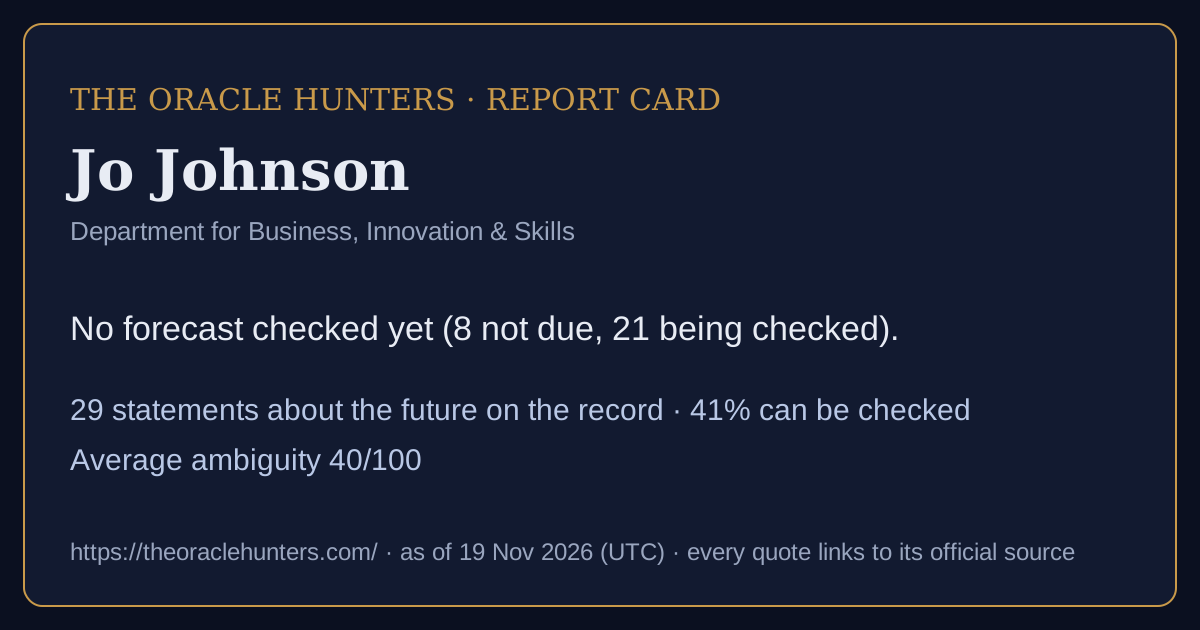
Jo Johnson
Department for Business, Innovation & Skills · GBR
Track record: No forecast checked yet (8 not due, 21 being checked).
29forecasts & commitments on the record
41%can be checked as stated
40average ambiguity (0-100)
0goalpost moves recorded
0confirmed U-turns
Timeline
came true partly did not not due / being checked / too vague
Calibration score: shown after 10 checked forecasts with a stated likelihood (now 0).
How they speak about the future: based on data 26, stated on authority 3.
Kinds of claim: forecast 19, commitment 6, mixed claim 4. · Download this report card as a picture
In the nine words
πρόγνωσιςInference from evidence21 · 72%προαναγγελίαPublic pre-announcement6 · 21%μαντείαInspired knowledge2 · 7%
How to read this
Each box is one sentence a public figure or institution said about the future, word for word, with a link to the official text. Can be checked means it names what will happen, by when, and how likely - so it can be compared with official figures later. Too vague to check means it does not. Ambiguity (0-100) is how many different ways the sentence can be read. When the date passes, the forecast is compared with official data and marked came true, partly or did not come true. Labels judge the sentence, never the person. Full guide and glossary.On the record (29)
Next year will see the launch of the Office for Students (OfS), which will take up the regulatory baton that HEFCE has borne for the past 25 years.
Grade inflation can fuel disengagement on both sides - if students know that 80-90 per cent will get a 2:1 or first from a high-reputation provider, there is less incentive to work hard – and less incentive by the provider to focus on teaching.
Some 1.8 million new jobs will be created between 2014 and 2024, and 70% of them will be in the occupations most likely to employ graduates
Students applying to university this year, and across this parliament, will have more information, more choice and more flexible ways of learning than ever before.
Firstly, we will incorporate powerful new analysis of graduate outcomes, the Longitudinal Educational Outcomes data set, which looks at employment and earnings of higher education graduates 1, 3 and 5 years after graduation.
I can also announce today that we are investing £22 million in ultra-high and very-high field Nuclear Magnetic Resonance facilities in the UK which will help us understand how macromolecules play a role in health and disease.
The government’s underwrite will include those schemes not directly administered by the Commission but that award Horizon 2020 funding.
By the end of this Parliament, the government will invest an additional £2 billion a year in research and innovation, including a new Industrial Strategy Challenge Fund overseen by UKRI once established.
By the time the RRS Sir David Attenborough reaches sea trials in 2018, Cammell Laird will be 190 years old.
While we are still members of the EU, universities that competitively bid for European Commission Research funding (for example, under Horizon 2020) will have payments of such awards underwritten by the Treasury, even when those projects continue beyond the UK’s departure from the EU.
This will remain an important theme through the coming months.
We are also creating a new £1 million Newton Prize, starting next year.
That’s why I am concerned by reports that UK participants are being asked not to lead or participate in Horizon 2020 project bids or are reluctant to apply for longer projects as they are not confident they will receive money due after the UK’s eventual departure from the EU.
We are creating a new £1 million Newton Prize, starting next year.
Through UKRI, we will have a national research and innovation strategy developed organically by the research and innovation community itself, helping to guide more than £6 billion in annual government investment and delivering greater coordination across the delivery plans of each of UKRI’s 9 autonomous Councils.
Under the proposed transparency duty, all universities (approved providers) will be required to publish data on application and offer rates broken down by gender, ethnicity, and disadvantage from 2018.
In this funding round, Horizon 2020, we have secured 15.4% of funds, behind only Germany on 16.5%, and with the second largest number of project participations .
The whole research community will then have the opportunity to feed in to Research Council and Innovate UK delivery plans towards 2020.
That’s £1.5 billion extra for the science budget by 2021 - additional funding that will help us stay at the forefront of global research.
We are also beginning to link student number controls to the quality of the provider, through a “performance pool” which will operate for 2016 to 2017.
This needs serious attention and I will be writing to OFFA asking them to focus on this in their guidance to institutions on 2017 to 2018 access agreements.
We also want to see a 20% increase in the number of black and minority ethnic students going to university by 2020, with matched improvements in their completion rates and progression into work.
While it may overstate matters — official statistics show that in fact only 20% of recent graduates did not find a graduate level job within 3 years of leaving college — it is clear that universities must do more to demonstrate they add real and lasting value for all students.
Research Council Boards will have moved from one in four female appointments in July 2014 to around 2 in 5 by September 2015, with 2 councils achieving 50:50 gender balance.
And this is why we will now invest new capital on a record scale – £6.9 billion in new equipment, new laboratories and new research institutes across the UK.
And we will invest new capital on a record scale – £6.9 billion in the UK’s research infrastructure up to 2021 – which will mean new equipment, new laboratories and new research institutes.
The Teaching Excellence Framework we will introduce will include incentives for the sector to tackle degree inflation and ensure that hard-won qualifications hold their value.
We are committed to increasing education exports from £18 billion in 2012 to £30 billion by 2020.
This year the government will spend over £70m on scholarships in the Chevening, Commomwealth and Marshall schemes.
Also said - not checkable as stated (12 newest)
Remarks about the future with no date, figure or likelihood that could be checked. They are kept on the record and shown here, but not scored.
So I have called on the railway to provide a vision for how it will decarbonise.
We will tackle this with the urgency it deserves by setting tough new environmental performance goals in each rail franchise which the train operators will have to meet.
Through the environmental performance goals we are setting in each rail franchise, we will hold the train operators to account for progress.
By reconnecting the two university cities with rail services, and by linking up Milton Keynes, Bedford, Bicester and Bletchley in the Golden Triangle, we aim to create a knowledge corridor that will drive growth and jobs for generations to come.
Rail may be less carbon intensive than road transport.
So today I am calling on the railway to provide a vision for how it will decarbonise.
But the drive to decarbonise must come from all sectors of the industry.
Indeed, in 1673 Spinoza refused a prestigious appointment as professor of philosophy at the University of Heidelberg, because the job offer came with a restriction on what he could say - a stipulation that he must “not insult the principles of the established religion”.
While he hoped the OfS never has to intervene in a university in relation to freedom of speech, he undertook that, if it does, it will be to widen it rather than restrict it.
But we will continue to watch the system carefully.
Last October, it was reported that police were called to University College London to quell a violent anti-Israel protest which left Jewish students barricaded in a room, after being told their safety could not be guaranteed if they left alone.
In a recent article entitled “In Defence of Uncomfortable”, arguing that universities need to foster a climate of open inquiry in order to provide a truly valuable education, Michael pointed out that “Diversity of view and disagreement, is a vital ingredient of places of higher learning”.