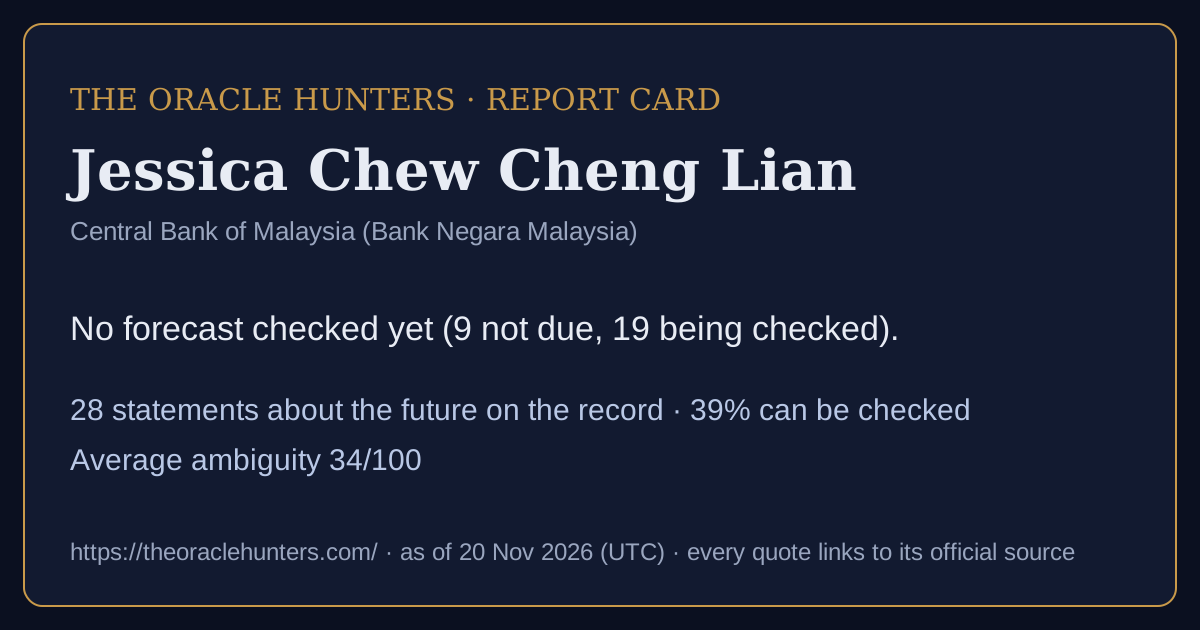
Jessica Chew Cheng Lian
Central Bank of Malaysia (Bank Negara Malaysia)
Track record: No forecast checked yet (9 not due, 19 being checked).
28forecasts & commitments on the record
39%can be checked as stated
34average ambiguity (0-100)
0goalpost moves recorded
0confirmed U-turns
Timeline
came true partly did not not due / being checked / too vague
Calibration score: shown after 10 checked forecasts with a stated likelihood (now 0).
How they speak about the future: based on data 21, stated on authority 6, educated guess 1.
Kinds of claim: forecast 24, commitment 2, scenario (if… then) 1, mixed claim 1. · Download this report card as a picture
In the nine words
πρόγνωσιςInference from evidence21 · 75%μαντείαInspired knowledge4 · 14%προαναγγελίαPublic pre-announcement2 · 7%πρόνοιαPreparing for the future1 · 4%
How to read this
Each box is one sentence a public figure or institution said about the future, word for word, with a link to the official text. Can be checked means it names what will happen, by when, and how likely - so it can be compared with official figures later. Too vague to check means it does not. Ambiguity (0-100) is how many different ways the sentence can be read. When the date passes, the forecast is compared with official data and marked came true, partly or did not come true. Labels judge the sentence, never the person. Full guide and glossary.On the record (28)
Bank Negara Malaysia will also be embarking on the review of the policy document on Corporate Governance in 2025.
It is projected that 84% of Southeast Asian consumers will use e-wallets by 2025. 1 This has motivated the establishment of numerous bilateral payment linkages across the region, with more than 10 bilateral payment linkages already up and running.
It is estimated that 20% of Malaysia's GDP and 23% of the workforce are associated with hard-to-abate sectors of our economy 2 . 60% of SMEs claim that they are looking to increase business opportunities and create longterm value by strengthening ESG practices 3 , and will need help to do so.
These include the CCPT, disclosure mandates that will take effect for financial institutions next year, the data catalogue, improvements in climate governance, and ongoing work to advance capabilities in climate risk management, scenario analysis, and stress testing.
The World Economic Forum estimates that by 2025, half of all employees will need reskilling.
The latest Future of Jobs Report released by The World Economic Forum last month revealed that over 80% of organisations surveyed identify higher adoption of frontier technologies, broadening digital access and the application of Environmental, Social and Governance (ESG) standards as key trends most likely to drive workforce transformation.
Another key deliverable of JC3 this year is the upcoming publication of a data catalogue that will point users to credible sources of critical climate data needed to support identified use cases.
While we will be mainly focusing on green housing at this event, it is important not to forget that this is a cross-cutting agenda that requires many different parts of the ecosystem to work effectively.
On its part, the Bank will continue to support transition activities through the RM1 billion Low Carbon Transition Facility and other funds for SMEs which will complement funds extended by financial institutions to help SMEs implement sustainable low carbon practices.
As an example, for green finance, the Islamic banking industry is supporting approximately 4,500 renewable energy and green projects worth more than USD2.2 billion.
We expect this to gain momentum with the implementation of the Climate Change and Principle-based Taxonomy for financial institutions that was issued by Bank Negara Malaysia in April this year.
Going forward, the Bank will be intensifying our monitoring and engagements with insurers and takaful operators on their preparations in the run up to 2021.
The final IFRS 17 standards represent a historic milestone - for the first time, insurers in over 120 countries, with assets worth at least USD13 trillion, will be reporting financial statements based on a common set of standards when IFRS 17 comes into effect in January 2021.
The requirement for employers to pay foreign workers' salaries through their local bank accounts starting next year will provide further impetus for the digitalisation of remittance services.
Earlier this year, we completed a year-long project within Bank Negara to further strengthen the Bank's surveillance of ML/TF risks in the MSB industry and improve our ability to identify illegal or unreported MSB activities, through the use of data analytics.
Growth for the region is still expected to outperform average global growth in 2017 and 2018, and this is expected to be sustained going forward.
As an example, a recent survey conducted under this project on remittance behaviors revealed that more than 74% of migrant workers in Johor Bahru own a smartphone.
By 2021, we expect to complete the process of integrating financial education content in the formal school curriculum at all levels of primary and secondary education.
All of them - the fallout from the global financial crisis, Asia's growth trajectory, the focus on climate risk, and more entrenched technological revolution in the delivery of financial services - are converging to re-define expectations, possibilities and risks in the insurance broking sector in a profound way that will determine if a firm will thrive or be marginalised in …
In Malaysia, avenues for customers to address disputes with insurance brokers are being enhanced with establishment of a Financial Ombudsman Scheme that will include insurance and takaful brokers as members of the Scheme in the later part of this year.
Reflecting its growing contribution to global growth, Asia accounted for approximately 28% of the world's premiums, after Europe (35%) and North America (30%). 1 Coupled with a high population growth rate, there are projections that Asia will overtake North America as the second largest contributor to world insurance premiums in several years.
This will include specific measures with respect to foreign participation in the insurance and takaful broking industry in line with the recommendation of the Bank's Financial Sector Blueprint 2011 2020.
The establishment of the ASEAN Economic Community at the end of 2015 will create a single large market and production base with freer flow of goods, services, investment, skilled labour, and capital; opening up huge opportunities for business growth from a combined GDP of over USD2 trillion and population of 600 million people.
The IMF's latest forecast projects growth for Asia at 6.4 and 6.2 percent in 2015 and 2016 respectively, in sharp contrast with anaemic growth in more advanced economies.
With effect from the second half of 2015, financial advisers and insurance and takaful brokers will also be brought within the scope of the Financial Ombudsman Scheme that will be approved under the Financial Services Act, providing an avenue for consumers to address complaints against advisers for non-disclosures or misrepresentations.
The Bank has lowered the minimum capital requirement for financial advisers to RM50,000 which will take effect from 1 January 2015 to encourage more advisers to enter the industry.
The Bank will continue to work in close collaboration with AFA to increase the talent pool.
We have substantially completed a review of the existing corporate governance frameworks for the banking and insurance industries and expect to be able to consult with industry on our specific proposals to update and harmonise the frameworks later this year.
Also said - not checkable as stated (12 newest)
Remarks about the future with no date, figure or likelihood that could be checked. They are kept on the record and shown here, but not scored.
In cases of fraud and serious misconduct, we will not hesitate to take strong actions in collaboration with other law enforcement agencies to hold perpetrators to account, including barring individuals from working in the financial sector.
In rising to meet the expanded scope and higher expectations of it, FMOS will have to contend with a fast-changing environment, and be able to navigate the terrain between legal and fairness considerations in specific cases.
In addition, one of its most important roles will be the ability to provide crucial and timely feedback to the regulators on systemic issues and poor practices to prompt early regulatory responses that can prevent future harm to consumers.
As an example, if boards are not controlling the board agenda, setting clear standards on what, when and how information should be provided to them to enable them to discharge their oversight role, or doing enough to drive a strong culture of accountability for prudent risk taking and fair treatment of consumers, then they are more likely to feel overwhelmed.
We see Responsibility Mapping as being a critical lever to help boards effectively discharge their oversight role as senior managers will have to demonstrate that they have taken appropriate and necessary actions to ensure the effective management of areas under their purview.
Along a similar vein, we will also be seeking your feedback on the requirement for individual entities within a financial group to establish their own board committees.
In more serious cases of criminal misconduct, recurring and unresolved risk management and control deficiencies, we will escalate our actions to enforcement actions such as administrative penalties, compounds and public reprimands.
And in more than a few institutions, the data revolution appears to be sweeping through every part of the organisation except the boardroom, when one should expect technology advancements and data availability to also have a more profound impact on the way boards function.
Critically, it also reflects the need to anticipate and manage risks to the central bank's mandates.
While this role may vary across countries, central bank responsibilities over payment systems generally stem from an interest in: supporting the implementation of monetary policy; preventing systemic risks that can arise from the transmission of financial stress through the payment system; and promoting fair, efficient and inclusive operations of payment systems given their central role in the economy.
Banks now co-exist alongside significant non-bank payment providers that include 'big tech' and crypto asset players that may not be consistently regulated.
Nexus will expand access for individuals and businesses to low-cost, convenient, safe and fast payments across borders by building on the familiarity of users with domestic payment systems.