Jesse Norman
Department for Transport · GBR
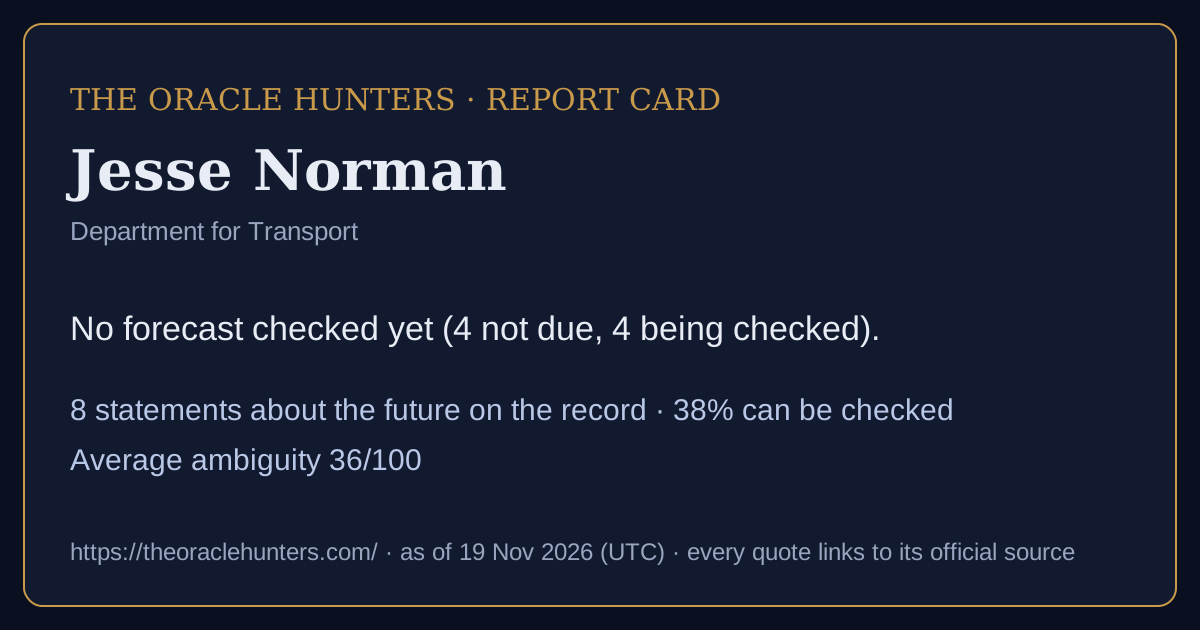
Track record: No forecast checked yet (4 not due, 4 being checked).
8forecasts & commitments on the record
38%can be checked as stated
36average ambiguity (0-100)
0goalpost moves recorded
0confirmed U-turns
Timeline
came true partly did not not due / being checked / too vague
Calibration score: shown after 10 checked forecasts with a stated likelihood (now 0).
How they speak about the future: based on data 5, stated on authority 2, educated guess 1.
Kinds of claim: forecast 7, mixed claim 1. · Download this report card as a picture
In the nine words
How to read this
Each box is one sentence a public figure or institution said about the future, word for word, with a link to the official text. Can be checked means it names what will happen, by when, and how likely - so it can be compared with official figures later. Too vague to check means it does not. Ambiguity (0-100) is how many different ways the sentence can be read. When the date passes, the forecast is compared with official data and marked came true, partly or did not come true. Labels judge the sentence, never the person. Full guide and glossary.On the record (8)
And I’ll talk a bit more about that later, but I think you know that by April of next year, smaller VAT registered businesses will be required to join the larger organisations that already signed up to MTD.
Now if you look overall, we’ve got something like a £407 billion package of support, part of the overall response to the COVID pandemic, and so there is a very wide range of help for people who may not have been able to be helped by those schemes, and many have been able to avail themselves of that as well.
You probably know that the Job Retention Scheme alone has paid out more than £53 billion over the period; that’s protected 11.2 million jobs, an astonishing intervention.
And today, I can also announce a further 25 million pounds for the next round of Advanced Propulsion Centre projects, to further accelerate the shift to low carbon vehicles.
Later this year, backed by our Industrial Strategy, Oxbotica will be leading an end-to-end journey from London to Oxford, which will be at least as complex as anything attempted anywhere else in the world.
By 2040, demand for UK-produced batteries is expected to be 50 times what it is today.
So I’m delighted to announce that next month, we will launch a competition to develop a state-of-the-art cyber testing facility here in the UK.
As you will know, we are already investing nearly £1.5 billion between 2015 and 2021 to support the growth of ultra-low emission vehicles (ULEVs) - one of the most comprehensive programmes of support for ULEVs anywhere in the world.
Also said - not checkable as stated (12 newest)
Remarks about the future with no date, figure or likelihood that could be checked. They are kept on the record and shown here, but not scored.
We should think not in terms of two geographies, Europe and the Far East but also a third in the Middle East and that is going to impose new stresses and strains on that system.
In the simplest terms: if the economy of one partner is being targeted by an aggressive regime, then we should be prepared – and we will be prepared through this new mechanism – to support them.
And these are sectors I will be focusing my team on within government in the coming months.
We need to build and maintain that trust – and we will.
That means focusing on deepening co-operation with G7 allies to build a new economic security mechanism; what the Prime Minister has called an ‘Economic NATO’ that will improve our collective ability to assess, deter, and respond to threats from aggressive powers, including economic coercion.
And our new independent trade policy allows us to do more for emerging economies including through the Developing Countries Trading Scheme – a scheme that will offer 65 developing countries greater opportunities from exporting to the UK.
Public trust is a basic aspect of all taxation and if we’re going to make these kinds of changes that I’ve described, we need to ensure that the public’s faith in the tax system remains undiminished.
The first is what you might call the wider collaboration, the policy and the schemes that HMRC has put in place, and the work they have done with stakeholders through the whole Covid-19 pandemic.
The second is what the future looks like for the organisation and for taxpayers more generally; and then thirdly, what our experience has been and how that experience might in turn shape how we as a government, through the tax system and through Her Majesty’s Revenue and Customs, think about how we respond to future crises of this kind, or …
It’s sobering to reflect that many more people will almost certainly face redundancy or unemployment in the next few months.
I should also say that we are coming to this, as you will appreciate, in a very specific economic context, certainly unlike any other in recent experience.
Having successfully introduced a new, digital VAT service for business, we will be: