Jerome H Powell
Federal Reserve · USA
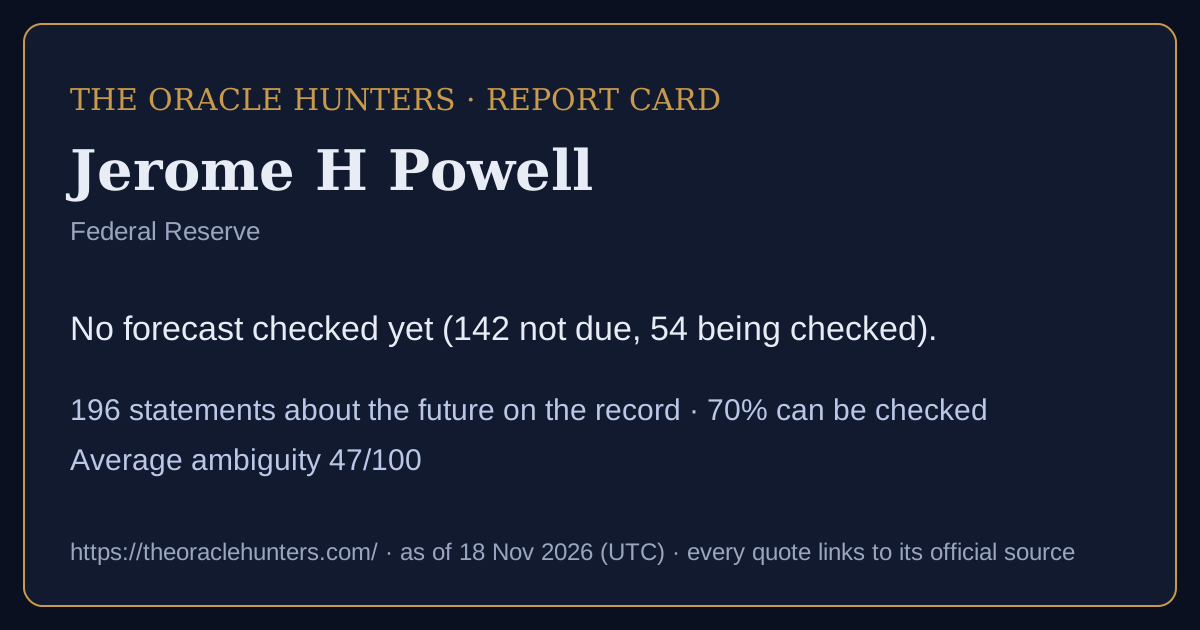
Track record: No forecast checked yet (142 not due, 54 being checked).
196forecasts & commitments on the record
70%can be checked as stated
47average ambiguity (0-100)
0goalpost moves recorded
0confirmed U-turns
Timeline
came true partly did not not due / being checked / too vague
Calibration score: shown after 10 checked forecasts with a stated likelihood (now 0).
How they speak about the future: based on data 159, stated on authority 26, educated guess 11.
Kinds of claim: forecast 137, mixed claim 32, scenario (if… then) 16, commitment 11. · Download this report card as a picture
In the nine words
πρόγνωσιςInference from evidence144 · 73%μαντείαInspired knowledge19 · 10%πρόνοιαPreparing for the future16 · 8%προαναγγελίαPublic pre-announcement11 · 6%πρόβλεψιςSeeing the signs4 · 2%φρόνησιςPractical wisdom1 · 1%εἰκασίαConjecture1 · 1%
How to read this
Each box is one sentence a public figure or institution said about the future, word for word, with a link to the official text. Can be checked means it names what will happen, by when, and how likely - so it can be compared with official figures later. Too vague to check means it does not. Ambiguity (0-100) is how many different ways the sentence can be read. When the date passes, the forecast is compared with official data and marked came true, partly or did not come true. Labels judge the sentence, never the person. Full guide and glossary.On the record (196)
In a speech at the Economic Club of Chicago on May 19, 1982, with unemployment above 9 percent and critics calling for him to change course, Volcker acknowledged the pain of wringing out inflation through high interest rates but held out the prospect of a return to price stability, and with it a much brighter future.
For example, the median respondents to the Survey of Primary Dealers in June 2022 anticipated that the size of the System Open Market Account (SOMA) portfolio would ultimately fall by more than $2 trillion in less than three years, from its mid-2022 level of $8.5 trillion to $6.25 trillion by 2025:Q1.
We remain committed to supporting maximum employment and bringing inflation sustainably to our 2 percent goal.
We will make sure that this one-time increase in prices does not become an ongoing inflation problem.
We will carefully assess and manage the risk of higher and more persistent inflation.
Beyond the next year or so, however, most measures of longer-term expectations remain consistent with our 2 percent inflation goal.
If we ease too aggressively, we could leave the inflation job unfinished and need to reverse course later to fully restore 2 percent inflation.
Instead, the revised document now states more precisely that "the Committee recognizes that employment may at times run above real-time assessments of maximum employment without necessarily creating risks to price stability." Of course, preemptive action would likely be warranted if tightness in the labor market or other factors pose risks to price stability.
The economic conditions that brought the policy rate to the ELB and drove the 2020 framework changes were thought to be rooted in slow-moving global factors that would persist for an extended period—and might well have done so, if not for the pandemic.8 The 2020 consensus statement included several features that addressed the ELB-related risks that had become increasingly prominent …
The final benchmark revision will be incorporated into the monthly employment data in February 2026.
Come what may, we will not allow a one-time increase in the price level to become an ongoing inflation problem.
The median projection of the longer-run level of the federal funds rate was 3.0 percent in the March 2025 SEP, up from 2.5 percent in the December 2019 SEP.
Similarly, the December 2021 Survey of Primary Dealers as well as the December 2021 Blue Chip consensus anticipated core inflation in 2022 of 2.5 percent and 2.6 percent, respectively, alongside average projections of short-term interest rates that remained below 1 percent throughout 2022.
In December 2021, the median SEP projection anticipated core inflation declining from 4.4 percent in 2021 to 2.7 percent in 2022, while the federal funds rate projection for the end of 2022 was 0.9 percent, below its longer-run estimate of 2.5 percent.
In the January 2012 Summary of Economic Projections (SEP), the range of estimates for the longer-run unemployment rate was 5 percent to 6 percent, and the median was 5.5 percent; by December 2019, that range was 3.5 percent to 4.5 percent, and the median had declined to 4.1 percent.
That projection was consistent with other central banks with different frameworks and the vast majority of forecasters (figure 4).10 When the evidence showed otherwise, we hiked 525 basis points over a period of 16 months.
If I could capture that era with one statistic, it would be that the policy rate had been stuck at the lower bound for seven long years following the onset of the Global Financial Crisis in late 2008 (figure 2).
We remain committed to returning inflation sustainably to our 2 percent objective.
By most measures, longer-term inflation expectations—those beyond the next few years—remain well anchored and consistent with our 2 percent inflation goal.
After a couple of years of solid growth, many forecasters have anticipated somewhat slower growth this year.
The 2 percent longer-run inflation goal will be retained and is not a focus of the review.
Beyond the next year or so, however, most measures of longer-term expectations remain stable and consistent with our 2 percent inflation goal.
With labor market conditions in rough balance and inflation expectations well anchored, I expect inflation to continue to come down toward our 2 percent objective, albeit on a sometimes-bumpy path.
In the August 2021 Survey of Professional Forecasters (the closest survey to the September SEP), the median projection for headline inflation in 2022 was also 2.2 percent.
In the September 2021 Summary of Economic Projections (SEP), the median projection for headline inflation in 2022 was 2.2 percent.
On August 21, the Bureau of Labor Statistics released the preliminary estimate of the upcoming annual benchmark revision to the establishment survey data, which will be issued in February 2025.
Disinflation while preserving labor market strength is only possible with anchored inflation expectations, which reflect the public's confidence that the central bank will bring about 2 percent inflation over time.
With an appropriate dialing back of policy restraint, there is good reason to think that the economy will get back to 2 percent inflation while maintaining a strong labor market.
As we begin this process later this year, we will be open to criticism and new ideas, while preserving the strengths of our framework.
Reducing rates too soon or too much could result in a reversal of the progress we have seen on inflation and ultimately require even tighter policy to get inflation back to 2 percent.
We do not expect that it will be appropriate to lower our policy rate until we have greater confidence that inflation is moving sustainably down toward 2 percent.
If the economy evolves broadly as we expect, most FOMC participants see it as likely to be appropriate to begin lowering the policy rate at some point this year.
For example, the November 2023 Blue Chip consensus forecast is for Q4-over-Q4 real GDP growth to drop from 2.5 percent in 2023 to 0.8 percent in 2024.
Both the June Summary of Economic Projections and the August Survey of Professional Forecasters showed a near-uniform view that the incipient inflation would pass quickly and that inflation for 2022 would run near 2 percent.
The median projections of Q4-to-Q4 core PCE inflation from the February 2021 Survey of Professional Forecasters were 1.8 percent, 1.9 percent, and 2.0 percent for 2021, 2022, and 2023, respectively.
The 12-month change in the core PCE measure, which excludes the volatile food and energy prices and therefore may provide a better signal of where inflation is headed, has declined from 5.5 percent in September 2022 to 3.7 percent in September 2023.
We are making decisions meeting by meeting, based on the totality of the incoming data and their implications for the outlook for economic activity and inflation, as well as the balance of risks, determining the extent of additional policy firming that may be appropriate to return inflation to 2 percent over time.
U.S. inflation has come down over the past year but remains well above our 2 percent target (figure 1).1 My colleagues and I are gratified by this progress but expect that the process of getting inflation sustainably down to 2 percent has a long way to go.
With time, we will continue to learn from the experience of the past few years, and what implications it may hold for monetary policy.
Some projections anticipate even stronger growth, such as GDPNow, which currently anticipates 5.4 percent annualized growth in the third quarter, additional information is available on the Federal Reserve Bank of Atlanta's website at https://www.atlantafed.org/cqer/research/gdpnow.
Still, the record suggests that a sustainable return to our 2 percent inflation goal is likely to require a period of below-trend growth and some further softening in labor market conditions.6
Forecasters generally expect gross domestic product to come in very strong for the third quarter before cooling off in the fourth quarter and next year.
While the path is likely to be bumpy and take some time, my colleagues and I are united in our commitment to bringing inflation down sustainably to 2 percent.
We are prepared to raise rates further if appropriate, and intend to hold policy at a restrictive level until we are confident that inflation is moving sustainably down toward our objective.
Getting inflation sustainably back down to 2 percent is expected to require a period of below-trend economic growth as well as some softening in labor market conditions.
Based on this assessment, we will proceed carefully as we decide whether to tighten further or, instead, to hold the policy rate constant and await further data.
My remarks this year will be a bit longer, but the message is the same: It is the Fed's job to bring inflation down to our 2 percent goal, and we will do so.
Over the 12 months ending in May, total personal consumption expenditures (PCE) prices are estimated to have risen 3.9 percent; excluding the volatile food and energy categories, core PCE prices likely rose 4.7 percent.
As noted in the FOMC's Summary of Economic Projections, a strong majority of Committee participants expect that it will be appropriate to raise interest rates two or more times by the end of the year.1
But as long as new lease inflation keeps falling, we would expect housing services inflation to begin falling sometime next year.
Showing the newest 50 - the ledger has all 196.
Also said - not checkable as stated (12 newest)
Remarks about the future with no date, figure or likelihood that could be checked. They are kept on the record and shown here, but not scored.
What the public has every right to expect is that we will make our decisions based only on our best economic analysis of what would most benefit the people we serve.
While we will have political differences, at the end of the day, we all love this wonderful country, and want what is best for it and for our fellow Americans.
The public would lose faith that the central bank will make decisions based only on what's best for all Americans.
The threat of criminal charges is a consequence of the Federal Reserve setting interest rates based on our best assessment of what will serve the public, rather than following the preferences of the President.
This is about whether the Fed will be able to continue to set interest rates based on evidence and economic conditions—or whether instead monetary policy will be directed by political pressure or intimidation.
I will continue to do the job the Senate confirmed me to do, with integrity and a commitment to serving the American people.
Just to be clear, I will not address current economic conditions or monetary policy.
With the clarity of hindsight, we could have—and perhaps should have—stopped asset purchases sooner.
I will stress again that these projections should be understood as representing a range of potential outcomes whose probabilities evolve as new information informs our meeting-by-meeting approach to policymaking.
We will set policy based on the evolution of the economic outlook and the balance of risks, rather than following a predetermined path.
These purchases supported the flow of credit to households and businesses and fostered more accommodative financial conditions to support the recovery of the economy when it ultimately came.7 This source of policy accommodation was important as we had lowered the federal funds rate close to zero and expected it to remain there for some time.
In December 2020, as the economic outlook remained highly uncertain, the FOMC said that we expected to maintain that pace of purchases "until substantial further progress has been made toward the Committee's maximum employment and price stability goals."8 That guidance provided assurance that the Fed would not prematurely withdraw support while the economic recovery remained fragile amid unprecedented conditions.