Jeremy Quin
Ministry of Defence · GBR
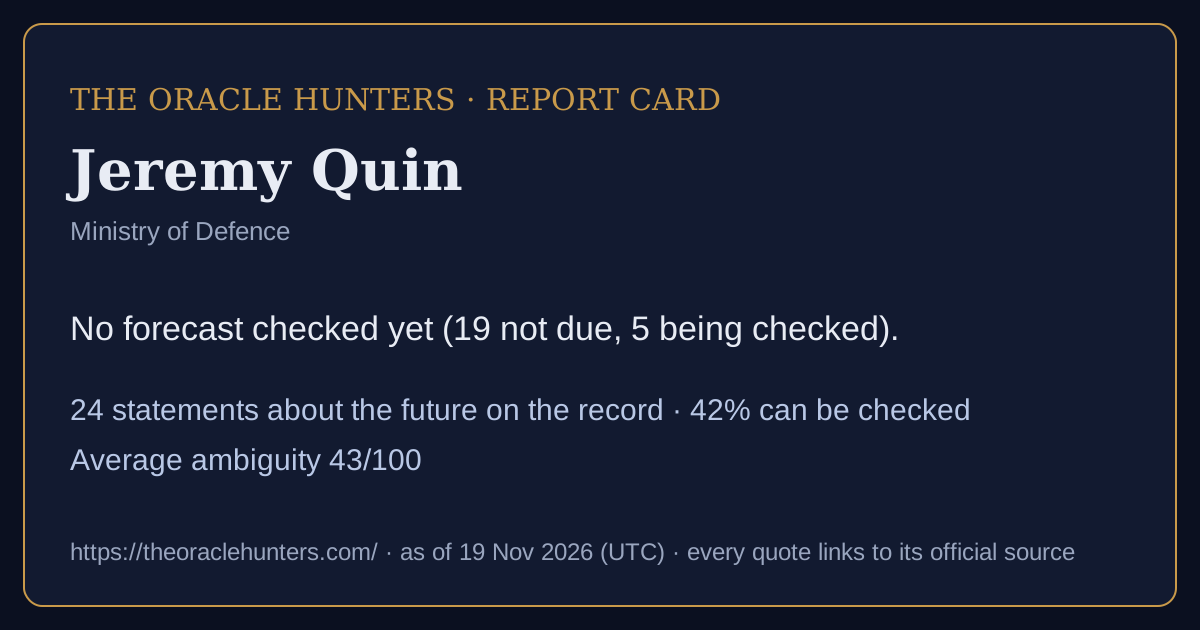
Track record: No forecast checked yet (19 not due, 5 being checked).
24forecasts & commitments on the record
42%can be checked as stated
43average ambiguity (0-100)
0goalpost moves recorded
0confirmed U-turns
Timeline
came true partly did not not due / being checked / too vague
Calibration score: shown after 10 checked forecasts with a stated likelihood (now 0).
How they speak about the future: based on data 21, stated on authority 2, educated guess 1.
Kinds of claim: forecast 12, mixed claim 8, commitment 3, scenario (if… then) 1. · Download this report card as a picture
In the nine words
πρόγνωσιςInference from evidence19 · 79%προαναγγελίαPublic pre-announcement3 · 12%πρόνοιαPreparing for the future1 · 4%μαντείαInspired knowledge1 · 4%
How to read this
Each box is one sentence a public figure or institution said about the future, word for word, with a link to the official text. Can be checked means it names what will happen, by when, and how likely - so it can be compared with official figures later. Too vague to check means it does not. Ambiguity (0-100) is how many different ways the sentence can be read. When the date passes, the forecast is compared with official data and marked came true, partly or did not come true. Labels judge the sentence, never the person. Full guide and glossary.On the record (24)
It will be available to all government departments this year and in the future supported by funds worth over £50m for evaluations to generate new evidence in critical areas of policy making.
I believe we will find further scope to enhance Places for Growth - including by focussing on our Arms Length bodies.
Through the Digital Excellence Programme we will be equipping government leaders with these skills, starting with 3,000 senior leaders this year.
Make no mistake, helping the UK reach its legally binding 2050 net zero target will be one the biggest challenges we face.
The number of people who lack sufficient water will rise by a billion and we will need to produce almost 50% more food to meet global demand, despite Chatham House predicting a 30% drop in yields.
As many of you in this room know, by 2050 It’s estimated that climate change will push 720 million people into poverty.
In the last five years our Defence and Security Accelerator (DASA) has provided over £180 million worth of funding for more than 1,000 projects, 58% of which were awarded to SMEs.
This is just the base from which I am confident we will see rapid growth in the years ahead.
And we are even more thankful that last Thursday the Prime Minister went one step further by making clear that the critical capabilities we are pursuing in defence from FCAS to AUKUS mean that we will reach 2.5% of GDP by the end of the decade.
The upgrade, worth over £300 million, will enable the UK to become the first European country to operate a maritime ballistic missile defence capability, helping our Royal Navy to counter the threat of anti-ship ballistic missiles at sea.
A further £1.5 billion allocated to support defence operations over the next decade.
Rekindling that arrangement, in partnership with the American National Reconnaissance Office, this year we will send Prometheus 2 into space with Virgin Orbit.
Shipbuilding is a case in point – we’ve just announced a new strategy which will create jobs and boost skills with a 30-year pipeline of 150 government vessel procurements, backed by £1.7 billion a year specifically for Royal Navy shipbuilding.
The UK, as you all know, has been at the forefront of efforts to support Ukraine and, as the Prime Minister announced to the Ukrainian parliament on Monday, we will be delivering £300m more in military aid in the coming days, making us the biggest supplier in Europe.
In addition to the £5 billionn over 10 years already allocated to our future Skynet Satellite communications, a further £1.4 billion has been allocated to support defence operations over the next decade.
It remains impossible to share with this House 100% confidence that this programme will succeed or, if it does, the timing of achieving Full Operating Capability.
I’m sure many of you will be familiar with the Integrated Review and Defence Command Paper published earlier this year.
And that’s also why our Defence Command Paper set out our determination to invest in space capabilities over the coming years, backed by around £1.4bn funding on top of the £5bn already being invested in Skynet.
The Prime Minister has committed to spending £188bn on Defence over the coming four years – an increase of £24bn.
We’ve got to go with 80 per cent solutions and be prepared for onward spiral development, I think General Bowder and Alex both made that point, but to do so comfortable that Defence will find the resources.
It is to such projects that we will be committing part of our £6.6bn plus of R&D investment: turning around the long-term decline in Defence R&D since the end of the cold war.
We have launched the next phase of our programme to design and deliver Tempest and I am proud to say that, over the next four years, we will invest more than £2bn as Government into a world-leading future combat air system to keep us and our allies safe alongside us, leveraging additional investment from our first rate international and industrial …
In 2023 we will be looking to conduct a flight-test programme for the demonstrator.
By 2040 we imagine our air fleets will need to operate in highly contested environments where our enemies can disguise all traces of their approach.
Also said - not checkable as stated (12 newest)
Remarks about the future with no date, figure or likelihood that could be checked. They are kept on the record and shown here, but not scored.
A revolution is underway in digital and AI and our civil servants must be part of it: taxpayers will, rightly, demand the same ease of access to services and support that will become second nature in the private sector.
We need to ensure that GOV.UK, with over 1m visits a day and over 29bn page views since 2012 provides a service equal what we would expect to see in the public service.
So we will create a pathway for them to join the civil service through a secondment and empower them to drive real tangible change….
At the heart of that agreement is an understanding that adapting our people, aircraft, equipment, critical resources and supply chains will take decades.
At sea, we’re exploring the use of hybrid powertrain technologies that could power Royal Navy vessels and reduce carbon emissions.
And I was in Portsmouth last month to open the Navy’s first net zero building, which will help service and kit out our carriers prior to deployment.
We look forward to seeing the fruits of industry’s investment in skills, capacity, R&D and export campaigns and in return we will be supporting them through clarity of purpose, investment in defence science and technology and the full gamut of support to access UK and international markets.
We will continue in defence procurement to work with industry tirelessly to deliver the multiple improvements which together will guarantee more agile and reliable programmes on which we can all rely.
We need to ensure that not only will the equipment procured be deployed effectively by all our armed forces, including as vividly set out by the new CGS through “Operation Mobilise”.
I’m also delighted to announce that today we will be joining a tri-national agreement together with France and Italy that will enable us to upgrade missile defences on our Type-45 destroyers.
But we’re not just giving suppliers confidence in industry order books, we are going to give them greater clarity about our requirements too by setting out policy and technology priorities, so they can invest and upskill.
All the while, we have entered the next stage of the climate change battle, and the High North has become a region of state competition as melting ice exposes natural resources and makes the prospect of a north-western sea passage ever more likely.