Jeremy Hunt
Department for Digital, Culture, Media & Sport (2017 to 2023) · GBR
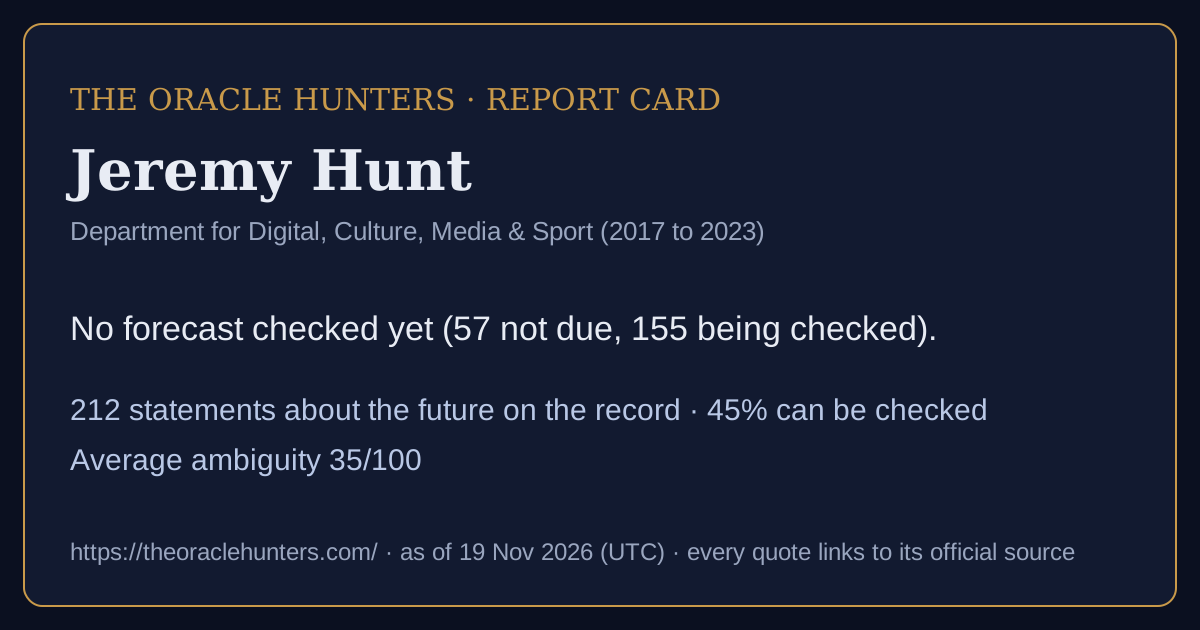
Track record: No forecast checked yet (57 not due, 155 being checked).
212forecasts & commitments on the record
45%can be checked as stated
35average ambiguity (0-100)
0goalpost moves recorded
0confirmed U-turns
Timeline
came true partly did not not due / being checked / too vague
Calibration score: shown after 10 checked forecasts with a stated likelihood (now 0).
How they speak about the future: based on data 160, stated on authority 51, educated guess 1.
Kinds of claim: forecast 139, mixed claim 66, commitment 6, scenario (if… then) 1. · Download this report card as a picture
In the nine words
πρόγνωσιςInference from evidence156 · 74%μαντείαInspired knowledge47 · 22%προαναγγελίαPublic pre-announcement6 · 3%πρόβλεψιςSeeing the signs2 · 1%πρόνοιαPreparing for the future1 · 0%
How to read this
Each box is one sentence a public figure or institution said about the future, word for word, with a link to the official text. Can be checked means it names what will happen, by when, and how likely - so it can be compared with official figures later. Too vague to check means it does not. Ambiguity (0-100) is how many different ways the sentence can be read. When the date passes, the forecast is compared with official data and marked came true, partly or did not come true. Labels judge the sentence, never the person. Full guide and glossary.On the record (212)
I can today confirm we will increase the rate of tax credit by 5% and remove the 80% cap for visual effects costs in the Audio-Visual Expenditure Credit.
At the current rate of expansion, we will be second only to Hollywood globally by the end of 2025.
By January of next year, as promised in the Autumn Statement, we will have a new, faster connections process to the grid up and running.
Underlying debt, which excludes Bank of England debt, will be 91.7% in 2024-25 according to the OBR, then 92.8%, 93.2%, 93.2% before falling to 92.9% in 2028-29 with final year headroom against debt falling of £8.9bn.
From April 2025, new arrivals to the UK will not be required to pay any tax on foreign income and gains for their first four years of UK residency, a more generous regime than at present and one of the most attractive offers in Europe.
Having worked closely with the Culture Secretary and listened carefully to representations from companies like Pinewood, Warner Brothers and Sky Studios, we will provide eligible film studios in England with 40% relief on their gross business rates until 2034.
According to the OBR, borrowing is lower this year and next, and on average across the forecast by £0.7 billion every year compared to the Spring Budget forecasts.
The OBR today forecast underlying debt will be 91.6% of GDP next year, 92.7% in 2024-25, 93.2% in 2026-27, before declining in the final two years of the forecast to 92.8% in 2028-29.
And the OBR say headline inflation will fall to 2.8% by the end of 2024, before falling to the 2% target in 2025.
I confirm that we will make available £4.5 billion of support over the 5 years to 2030 to attract investment into strategic manufacturing sectors.
We will invest £110m over this year and next to deliver high quality nutrient mitigation schemes, unlocking 40,000 homes.
From April 2024, we will increase the full new state pension by 8.5% to £221.20 a week, worth up to £900 more a year.
Ahead of Autumn Statement, we will test options to open those investment opportunities in high-growth companies to pension funds as a way of crowding in more investment.
And finally, we will reform and simplify our financial services rulebook to ensure we have the most growth-friendly regulation possible without compromising our commitment to stability.
And finally, government must lead by example, so we will consult on accelerating the consolidation of Local Government Pension Scheme assets, with a deadline of March 2025 for all LGPS funds to transfer their assets into local government pension pools and ensure greater transparency on investments.
Alongside that, we will explore the case for government to play a greater role in establishing investment vehicles, building on the skills and expertise of the British Business Bank’s commercial arm which has helped to mobilise £15bn of capital into over 20,000 companies.
Working with the Bank, we will do what is necessary for as long as necessary to tackle inflation persistence and bring it back to the 2% target.
We will also consult on an ambition to double the existing local government pension scheme allocations in private equity to 10%, which could unlock a further £25 billion by 2030.
But to keep up with projected spending pressures that would mean increasing annual tax revenues by £200 billion by 2071 in today’s money, or to think of it more simply at least doubling the basic rate of income tax and main rate of employee National Insurance.
The OBR’s analysis suggests that without any action, the result of these demographic pressures could be a public sector debt of 217% of GDP by 2071, more than double the current proportion.
According to the OBR’s long-term forecasts for the public finances from the end of this decade, our economy’s long term trend growth rate is 1.6% but public spending - even excluding debt interest - will grow by 2% a year.
The OBR’s 2022 Fiscal Risks and Sustainability report’s long-run projections using the 205,000 net-migration sensitivity (in line with the ONS’ January 2022 projections) project primary spending to rise from 38.5% to 41.9% of GDP between 2027-28 and 2050-51.
If we increase our productivity growth in the public sector by 0.5% a year, we stabilise the proportion of GDP consumed by the state by closing the gap between anticipated growth and anticipated spending up to 2050.
More innovation in the NHS, building on the success, for example, of the new surgical hubs that reduce waiting times and will give us 1 million extra procedures by 2024-25.
And the IMF say that our approach to fiscal policy will help to significantly reduce the deficit over the forecast - by 3% of GDP between 22/23 and 27/28.
That is even higher than the Bank of England’s forecast – published last week - for 0.25% growth in 2023.
Their report forecasts growth of 0.4% in 2023 – a 0.7 percentage point upgrade versus their April forecast.
Today the IMF say that the supply-side measures in the Budget “should have a positive effect on medium-term growth” and we will continue this work in the months ahead.
The OBR judged these policies – including a major expansion of childcare support – will result in 110,000 more individuals in the labour market by 2027-28, directly increasing employment by 0.3% and GDP by 0.2%.
The IMF say that we have acted decisively to fight inflation, which will “substantially” reduce to around 5% by the end of the year.
Underlying debt is forecast to be 92.4% of GDP next year, 93.7% in 2024-25; 94.6% in 2025-26, and 94.8% in 2026-27, before falling to 94.6% in 2027-28.
Despite continuing global instability, the OBR report today that inflation in the UK will fall from 10.7% in the final quarter of last year to 2.9% by the end of 2023.
So we will increase the funding paid to nurseries providing free childcare under the hours offer by £204m from this September rising to £288 million next year.
Today the Office for Budget Responsibility forecast that because of changing international factors and the measures I take, the UK will not now enter a technical recession this year.
Today, following representations from our persuasive Defence Secretary, I confirm that we will add a total of £11 billion to our defence budget over the next five years and it will be nearly 2.25% of GDP by 2025.
But today, the OBR forecast we will not enter a recession at all this year with a contraction of just 0.2%.
Shortly over 50% of the population of England will be covered by a devolution deal and two thirds covered by a unitary authority and that’s a very important part of that.
That means restraint on spending - and in case anyone is in any doubt about who will actually deliver that restraint to make a lower tax economy possible, I gently point out that in the three weeks since others promised no big government chequebook they have made £45 billion of unfunded spending commitments.
McKinsey estimate that the global market opportunity for UK green industries could be worth more than £1 trillion between now and 2030.
PWC say that UK GDP will be up to 10% higher in 2030 because of AI alone.
So this year we will announce investment zones, mini-Canary Wharfs, supporting each one of our growth industries, and each one focused in high potential but underperforming areas, in line with our mission to level up.
It is an important principle that bills should accurately reflect market values so we will proceed with the revaluation of business properties from April 2023.
For many, that would clearly be unaffordable so today I can announce that this government will cap the increase in social rents at a maximum of 7% in 2023-24.
I want to go further, so today I protect our entire research budget and confirm that we will increase public funding for R&D to £20 billion by 2024-5 as part of our mission to make the United Kingdom a science superpower.
This year we will be spending an extra £150 billion on energy compared to pre-pandemic levels, equivalent to paying for an entire second NHS through our energy bills.
Taking account of this, I have decided that from January 1st until March 2028 we will increase the Energy Profits Levy from 25% to 35%.
While I have decided to freeze the Employers NICs threshold until April 2028, we will retain the Employment Allowance at its new, higher level of £5,000. 40% of all businesses will still pay no NICs at all.
So I confirm today that the support we are providing between now and April next year will not change.
It will support millions of people through a difficult winter and will reduce inflation by up to 5%.
Taken together with the decision not to cut Corporation Tax, and restoring the top rate of income tax, the measures I’ve announced today will raise around £32 billion every year.
Showing the newest 50 - the ledger has all 212.
Also said - not checkable as stated (12 newest)
Remarks about the future with no date, figure or likelihood that could be checked. They are kept on the record and shown here, but not scored.
This is a plan for growth and not a series of measures or announcements, which will have to wait for budgets and autumn statements in the years ahead.
Firstly, we will join other governments to establish a new Global Media Defence Fund, to be administered by UNESCO.
And of course, I need to say, it may be my only chance, newspapers also make mistakes.
Our officials might tell us what we want to hear; the media tell us what we need to hear, providing unvarnished reality whether we wish it or not.
We have raised his case with the Chinese authorities and I urge them again to disclose Huang Qi’s fate and provide any medical care he may need.
Secondly, we will establish an international task force to help governments to deliver their commitments on media freedom, including by developing national action plans.
We will never be able to extirpate anti-Christian bigotry.
Thirdly, as we establish independent national sanctions regimes after Brexit, the report says we must be prepared to consider imposing such measures on perpetrators of serious, religiously-driven human rights abuses.
He wrote: ‘The first job of the historian and the journalist is to find facts….The facts themselves must be checked against all the available evidence.
In 2014 the Allies agreed that a cyber attack could result in the invoking of Article V of the Washington Treaty, meaning that the incident would then be treated as an attack on every member of NATO.
Deciding to do nothing would be an important decision in itself – and the consequences could be escalatory.
So it must prove this time as we strengthen and adapt NATO’s power of deterrence – our priceless asset – to meet the challenge of the cyber age.