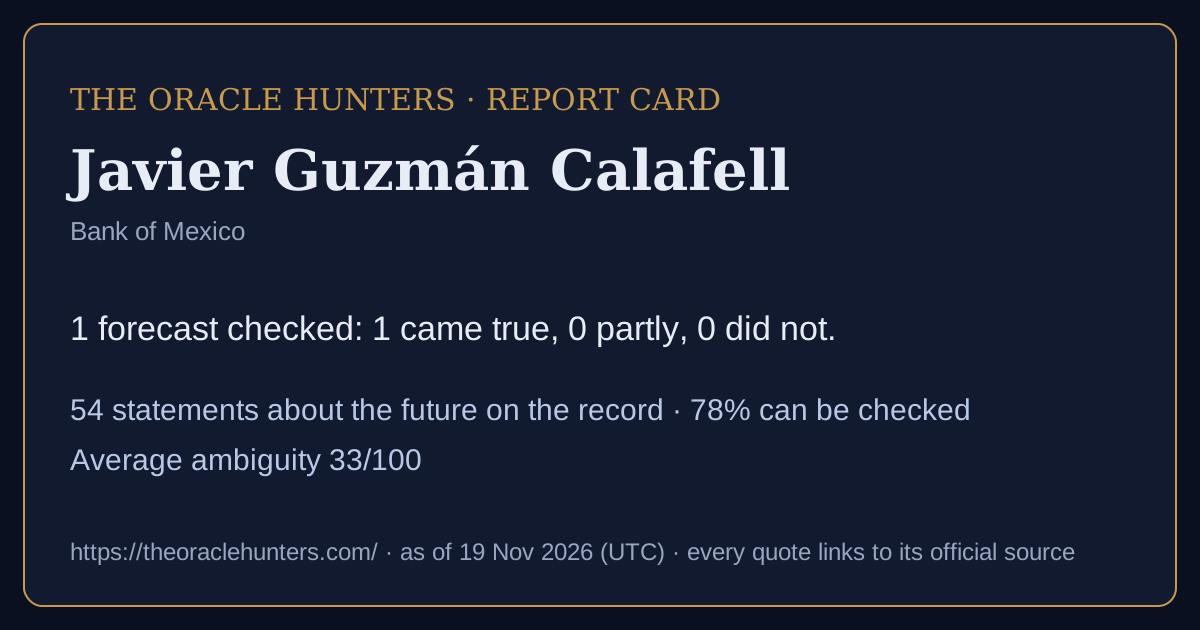
Javier Guzmán Calafell
Bank of Mexico
Track record: 1 forecast checked: 1 came true, 0 partly, 0 did not.
54forecasts & commitments on the record
78%can be checked as stated
33average ambiguity (0-100)
0goalpost moves recorded
0confirmed U-turns
Timeline
came true partly did not not due / being checked / too vague
Calibration score: shown after 10 checked forecasts with a stated likelihood (now 1).
How they speak about the future: based on data 42, stated on authority 8, educated guess 4.
Kinds of claim: forecast 47, mixed claim 5, scenario (if… then) 2. · Download this report card as a picture
In the nine words
πρόγνωσιςInference from evidence41 · 76%μαντείαInspired knowledge8 · 15%εἰκασίαConjecture2 · 4%πρόνοιαPreparing for the future2 · 4%φρόνησιςPractical wisdom1 · 2%
How to read this
Each box is one sentence a public figure or institution said about the future, word for word, with a link to the official text. Can be checked means it names what will happen, by when, and how likely - so it can be compared with official figures later. Too vague to check means it does not. Ambiguity (0-100) is how many different ways the sentence can be read. When the date passes, the forecast is compared with official data and marked came true, partly or did not come true. Labels judge the sentence, never the person. Full guide and glossary.Checked
While the task is not finished yet, the results thus far can be deemed as satisfactory, since inflation is expected to decline sharply in 2018 and long-
Came true. Said: inflation would fall in 2018. Official figures for Mexico: 6.0% in 2017, 4.9% in 2018 (World Bank open data). official data · checked 14 Nov 2026 · automatic check against official data (rules v3)
On the record (54)
In addition, positive economic surprises over the summer, especially in advanced economies (AEs), have led to a slight improvement in the outlook for 2020-2021, with a less severe decline expected for this year, to be followed by a somewhat less vigorous bounce next year.
The case of Latin America is illustrative in this regard, with a GDP fall of 8.1 percent anticipated for 2020 and a modest 3.6 percent expansion in 2021.
In the specific case of emerging market and developing economies (EMDEs), notwithstanding a slight downward revision in the growth forecast for 2020, the nearly twice-as-large rebound expected for 2021 gives the impression of a reasonable overall outlook for this year and the next.
Average estimates of the impact of a 3 degrees Celcius increase in world temperatures point to a 2 percent decline in potential global GDP by the end of this century. 2 However, these estimates are surrounded by considerable uncertainty.
According to recent estimates, some additional USD 600 billion per year will be needed, on average through 2030, in order to keep infrastructure investment across transport, energy, water and telecom systems consistent with the above-noted limits on global warming.
7 According to results recently reported by the Bank for International Settlements, only about 25% of the central banks surveyed are (or will soon be) legally allowed to issue CBDCs.
In addition, the pace of reduction of its balance sheet will be slower starting next month, a process that is intended to conclude in September this year.
For instance, according to the most recent projections by the IMF, the upturn of global growth in 2020 depends entirely on higher growth rates in these countries, and projections for the long term do not show a much different picture.
In fact, according to the Fund, emerging markets and developing economies' share in global growth will increase from around 76 percent this year to 85 percent in 2024. 2
throughout this year of a number of variables points to the effects that such a situation may already be exerting on the world economy.
Although relatively contained during the initial stages of this process, the inflationary pressures deriving from exchange rate depreciation and a series of supply shocks that took place during 2017, 5 resulted in an upturn in annual inflation to levels that in December of that year reached figures (6.77 percent) unseen since May 2001.
Inflation has been on a downward trajectory over the course of 2018, with headline figures falling from 6.77 percent at the end of 2017 to 4.65 in June of this year, consistent with the Banco de México's projections.
Consequently, since February of this year, information is provided regarding the time lapse over which inflation is expected to converge to the target.
4 As per the most recent projections (March 2018), public oil revenues are expected to amount to 4.0 percent of GDP this year.
The observed increase in interest rates in the United States, the prospects that this trend will continue during this year and the next, and the materialization of a higher risk-aversion environment, have led to an appreciation of the dollar.
Consequently, the upward trend of public debt would accelerate over the next decade, to 96.2 percent of GDP by 2028, nearly 20 percentage points above the level recorded last year. 3 Notwithstanding the short-term boost of these measures to economic activity, their potential to accentuate vulnerabilities in both the US and the global economy is substantial.
The deficit of the Federal Government is projected to rise by 3 percentage points of GDP from 2015 to 2022, and remain at elevated levels thereafter.
Given its relevance for the Mexican economy, it is important to highlight that, according to IMF figures, 2 within the advanced world it is the US economy that has seen one of the largest improvements in projections for GDP growth during the period 2018-2019.
Not surprisingly, then, projections for global growth for this year and the next have been revised upwards.
However, in view of the recent behavior and the prospects for inflation, even assuming an orderly behavior of the exchange rate, no demand pressures on prices, and the absence of new supply shocks, a convergence of inflation to the 3 percent target by the end of this year appears to be unrealistic.
Technical estimates suggest that the output gap is at present not statistically different from zero and that no significant demand pressures are likely to emerge during the period 2018-2019.
To this one must add the potential implications for these variables of the apprehension that may result from the electoral process that will take place in Mexico this year.
At the same time, this adjustment should protect the Mexican economy from the risks derived from the expected increase in the federal funds rate in the United States in March of this year, since if similar adjustments finally take place in both countries, the differential between policy rates would remain constant.
While the task is not finished yet, the results thus far can be deemed as satisfactory, since inflation is expected to decline sharply in 2018 and long-
Came true. Said: inflation would fall in 2018. Official figures for Mexico: 6.0% in 2017, 4.9% in 2018 (World Bank open data). official data · checked 14 Nov 2026 · automatic check against official data (rules v3)
In other words, the cumulative increase in interest rates required to contain upward pressures on inflation will be larger if the initial response is tardy or insufficient.
Furthermore, an environment of high uncertainty is likely to persist, especially in view of ongoing NAFTA negotiations and other potential actions by the US government, the normalization of monetary policy in that country, and the electoral process in Mexico in 2018.
However, a sharp decline is expected for 2018, and by the end of that year inflation is anticipated to show figures falling within the interval.
Consequently, it is anticipated that the output gap will fall again into negative territory in coming months.
Notwithstanding these positive developments, the world economy seems to have lost part of the long-term dynamism displayed in the past, as global GDP growth during 2017-2022 is forecast to be, on average, almost one percentage
Since then, the differential between these two economies has continued to widen and, according to the latest projections by the IMF, 6 China's participation in the global economy is expected to increase to over one fifth of total output by 2022, nearly a tenfold increase since 1980.
In this respect, it is worth to note that the fact that the impact of the most recent shocks on prices has concentrated mostly on short-term inflation expectations, with a sharp downturn in price growth anticipated since early 2018, attests to the merits of the actions undertaken thus far and in general to the credibility of monetary policy.
4 The annual rate of growth of the CPI recorded figures below 3 percent during the period May 2015September 2016.
The implementation of corporate tax reform measures geared towards subsidizing exports and taxing imports, or a trade policy aimed at increasing import tariffs in this country, should they materialize, would also give a boost to the valuation of the dollar.
next year, interest rates in Mexico are likely to be significantly affected by the evolution of interest rates in the United States.
While demand pressures on prices are likely to remain subdued given the expectation of a negative output gap throughout next year, the outlook for inflation presents, in my opinion, risks tilted to the upside.
It is reasonable to expect that the expansion of economic activity will continue during the remainder of this year and in 2017.
On the one hand, the level of output is below the estimated potential, and the available forecasts suggest that this gap will remain in negative territory through end-2017.
Accordingly, the Public Sector Borrowing Requirements (PSBR), the most comprehensive measure of the deficit, should display next year a reduction equivalent to 1.2 percent of GDP with respect to 2015 (and 1.7 percent with respect to 2014).
General inflation is projected to increase gradually during the rest of this year towards levels slightly above 3 percent, and to fluctuate around this figure in 2017, but it should be noted that the latter is subject to some uncertainty, since the proposal to liberalize gasoline prices starting in 2017, which may affect the evolution of inflation, is still under …
Currently, these economies are estimated to represent nearly 60 percent of world GDP, and their rates of growth are projected to remain significantly higher than those in
In this regard, it is also important to emphasize that renewal of the New Arrangements to Borrow (NAB) for the five year period starting in 2017 has yet to be discussed and agreed upon, and that there is a risk that the bilateral borrowing agreements set forth in 2012 will not be extended and thus start to expire later this …
10 The annual rate of growth of the prices of telephone services fell from 13.7 percent in December 2013 to minus 14.5 percent in December 2015 and minus 12.8 percent in the first two weeks of May 2016.
As of the first half of May, the annual inflation rate in Mexico stood at 2.5 percent, below the 3 percent target.
4 According to IMF data through October 2015 presented in its World Economic Outlook , Mexico's real GDP growth forecast for 2015 has been revised downwards by 1.7 percent points (p.p.) since it was initially projected at 4.0 percent in April 2010.
Headline CPI inflation registered eight consecutive months of historical minima in the period May-December 2015, with a figure of 2.1 percent in December.
In fact, Banco de Mexico's forecasts currently place real output growth at 2.5-3.5% in 2016, and at 3.0-4.0% in 2017.
On the other hand, it is important to note that downside risks for growth persist, and that a negative output gap is expected to prevail until the end of 2017.
It is reasonable to expect the continuation of a gradual strengthening of economic activity in 2016 and 2017.
Meanwhile, CPI inflation is projected to rise moderately from the current minima to levels around the 3 percent target throughout both 2016 and 2017.
Some authors have stressed the significance of financial market turmoil during May-August 2013, despite the relatively small decrease in capital flows to EMEs (about 1% of GDP). 4
Showing the newest 50 - the ledger has all 54.
Also said - not checkable as stated (12 newest)
Remarks about the future with no date, figure or likelihood that could be checked. They are kept on the record and shown here, but not scored.
It should be noted, however, that although improving, global economic activity remains very weak and an extraordinary level of uncertainty surrounds the baseline scenario, as the COVID-19 pandemic is still unfolding.
Given the complex and multidimensional nature of the issue at hand, as well as the extensive and, to a significant degree, unknown ramifications that may ensue, any sensible proposal with realistic chances to effectively contribute to a solution must contemplate the simultaneous and coordinated action of diverse, albeit complementary, policy tools.
On the one hand, at the microprudential level, central banks and other financial authorities ought to undertake a continuous and careful evaluation and monitoring of the risks for individual financial institutions deriving from their exposure to assets, projects, entities and/or income streams that are directly affected by climate-related developments.
Closely related to the above, significant efforts must still be made in order to bridge remaining data gaps. 5 The better equipped investors are to more accurately assess returns and risks associated to green financial instruments, the more likely they are to partake.
Mainly as a result of increasing carbon dioxide and other greenhouse gas emissions that have come about as a byproduct of economic activity at large, but particularly in sectors heavily reliant on fossil fuels, global temperatures are at present higher relative to pre-industrial levels, and are projected to rise further in coming decades.
Notwithstanding the appeal that CBDCs may gather on the basis of these and other favorable attributes, important negative implications must be acknowledged as well.
First, should CBDCs become entrenched as a close substitute of, or a superior alternative to, commercial deposit accounts (which would very likely be the case if they are designed as account-based and interest-bearing), the amount of resources effectively intermediated by the private financial sector could be curtailed.
- As for financial inclusion, even though in principle it should be favored by the introduction of CBDCs, there may be instances in which remaining
Adding to the contraction in the supply of loanable funds derived from retail depositors opting to hold CBDCs instead of bank accounts, loan demand could be affected too as a result of banks' attempts to preserve margins by increasing their lending rates.
regulatory requirements in place may force them to cut back on credit or hold a higher proportion of liquid assets, either of which would result in less resources available for lending.
There are also strong indications that, without independence, central banks would probably not have been able to undertake the measures needed to face the crisis.
This does not imply, though, that central banks should be stripped of their independence.