Janusz Wojciechowski
European Commission · EU
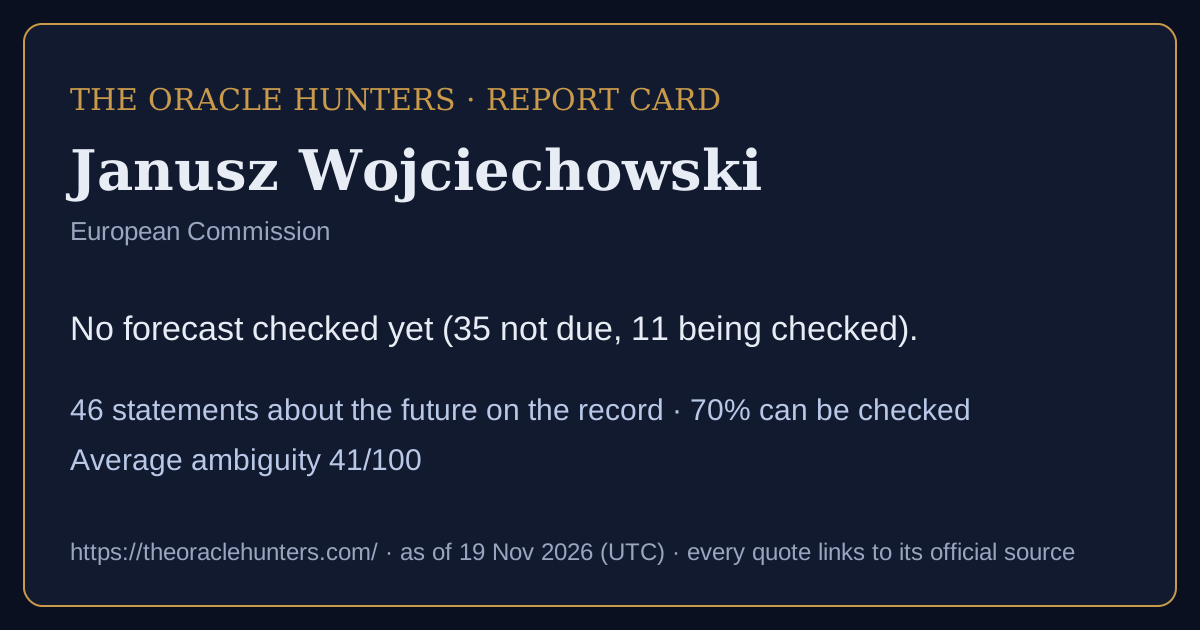
Track record: No forecast checked yet (35 not due, 11 being checked).
46forecasts & commitments on the record
70%can be checked as stated
41average ambiguity (0-100)
0goalpost moves recorded
0confirmed U-turns
Timeline
came true partly did not not due / being checked / too vague
Calibration score: shown after 10 checked forecasts with a stated likelihood (now 0).
How they speak about the future: based on data 40, stated on authority 6.
Kinds of claim: forecast 35, mixed claim 7, commitment 4. · Download this report card as a picture
In the nine words
πρόγνωσιςInference from evidence39 · 85%προαναγγελίαPublic pre-announcement4 · 9%μαντείαInspired knowledge3 · 7%
How to read this
Each box is one sentence a public figure or institution said about the future, word for word, with a link to the official text. Can be checked means it names what will happen, by when, and how likely - so it can be compared with official figures later. Too vague to check means it does not. Ambiguity (0-100) is how many different ways the sentence can be read. When the date passes, the forecast is compared with official data and marked came true, partly or did not come true. Labels judge the sentence, never the person. Full guide and glossary.On the record (46)
In cereals, milk and processed milk, meat or fruit and vegetables, the Union has a 10-20 % export surplus and competition on this market may be difficult for Ukraine, given the high quality and production method requirements.
Following the Russian aggression, most of Ukraine's grain exports were directed to the European Union, with over 50% of exports going to the market.
Looking at the pre-war Ukrainian agriculture We see growing yields and harvests, and we see high exports of Ukrainian grain, over 50 million tonnes a year, with more than 80% of these exports going to Asian and African countries, and less than 20% going to countries in the European Union, mainly Spain, the Netherlands and Italy.
In total, between May 2022 and August 2024, 153.4 million tonnes of Ukrainian grain, oilseeds and related products were exported through the Solidarity Lanes and the Ukrainian Black Sea ports.
The CAP is key in this regard: from 2023 to 2027, €14.7 billion from the CAP budget will support organic farmers, and those who convert to organics.
In the coming weeks, the European Council will adopt a new strategic agenda, taking us to 2029.
That is why, from 2023 to 2027, close to €98 billion from the CAP (representing 32% of the total spending) will be devoted to delivering environmental and animal welfare benefits.
Here, CAP support for producer groups, producer organisations, local markets, short supply chains and quality schemes is expected to reach around 760,000 farms (corresponding to roughly 8% of all farms).
And looking to the future, projections for 2050 indicate the need to produce 60% more food, to feed a world population of more than 9 billion people.
But to provide food for a growing global population, which may approach 10 billion by 2050, we must work together with international partners.
In 2023, agricultural imports from Ukraine will also exceed €12 billion.
However, I can assure you that this risk has not materialized and that all agricultural funds, over €300 billion planned for 2023-2027, will be used.
As we approach next year's European elections, some will ask: “why should the European Union provide resources to rural communities?”
For example, we are committed to supporting exports from Ukraine – who normally supply around 45 million tonnes of grain to the global market every year.
Between May 2022 and September 2023, these alternative routes have allowed Ukraine to export 102 million tonnes of goods, including 57.4 million tonnes of agricultural goods, a large portion of which has been grain, oilseeds, and other related products.
We will continue to increase the capacity of the existing routes, lowering their cost and developing further alternatives, so that Ukraine can export its products to its traditional markets, which are key for global food security.
The latest report of the World Food Programme warns that acute food insecurity is likely to increase in 2024.
We are a few months away from 2024, when our citizens will decide on the direction of the European Union.
This will also be a plan for elements of the Common Agricultural Policy after 2027, and I intend to prepare and present such a plan in the coming months, certainly still in 2023.
Yes, with a CAP budget of 0.4 % of GDP, we will not be able to respond effectively to the big challenges faced by agriculture in this major crisis.
Under the work programme for 2023 and 2024, we expect to fund 10 more projects.
Between 2021 and 2024, the Commission has allocated more than €120 million to research and innovation projects focused on rural areas, in which researchers and rural stakeholders work hand in hand.
At the end of 2023, the Commission will publish a first report to assess the joint effort of all CAP Strategic Plans.
And I am proud to present an overview of the new CAP that will start to apply as of 1 January 2023.
Solidarity Lanes have been a particular success, allowing over 19 million tonnes of grains to leave Ukraine since May.
Over 200 million people across 53 countries are expected to face acute insecurity of food supply, according to the latest reports from the Global Network Against Food Crises.
It will also be an important step towards a vision on how the CAP should look like beyond 2027.
Since May of this year, more than 14 million tonnes of Ukrainian grain, oilseeds and other products have been exported via our Solidarity Lanes initiative.
The new European Hydrogen Bank, which will direct €3 billion to kick-starting a hydrogen market in the European Union.
This will allow us to decrease our use of fertilisers by 20%, without threatening our production levels or the contribution we make to global food security.
Our target to sustainably produce up to 35 billion cubic meters of biomethane by 2030 will also create a new supply stream of organic fertilisers, through their by-products
Lower EU production also has consequences at a global level: if EU farmers have a lower harvest in 2023, grain exports to world markets will decrease and countries in Northern Africa or Middle East could be the most affected.
At least 30% of the Horizon Europe budget for actions in the field of agriculture, forestry and rural areas will be dedicated to topics relevant for the organic sector.
To raise public awareness of organic products, the Commission has dedicated €50 million of the agricultural promotion budget, which will be backed up by information measures financed under the Common Agricultural Policy.
I look forward to continuing our work together, and to all that we will celebrate during next year's EU Organic Day, and those in the years to come.
As we began to emerge from the pandemic at the beginning of this year, we could not have imagined the new crisis on the horizon.
This shows that the share is increasing, but we still have work ahead of us to achieve our target of 25% by 2030.
The Commission has rapidly mobilised €93 million in initial humanitarian funding for Ukraine and Moldova of which €90 million has already been disbursed to humanitarian partners (€3 million for Moldova will be contracted shortly).
The situation for commodities such as sunflower-based products may be even more challenging, since the two countries provide almost 80% of the global trade therein.
For cheese, one of our flagship agri-food products, total EU exports could increase by an additional 10%, with a positive effect on prices.
As regards EU beef imports, that attracted a lot of attention in 2016, they are expected to increase by a total of 85 000 to 100 000 tonnes by 2030 compared to the scenario without FTAs.
The cumulated effect on the dairy sector could add additional 900 million euros to the market receipts of milk producers in 2030.
This would increase further the net positive EU agri-food trade balance - already projected to remain largely positive in 2030 –by 800 million to 1 billion euros depending on the scenario considered.
In May 2020, the Commission proposed to increase the CAP budget by EUR 26 billion, i.e. from EUR 365 billion to EUR 391 billion.
Naturally, we will continue to promote exports and to strengthen the position of European agriculture on the global markets.
I am optimistic that together with the Parliament and the Council we will make our agriculture more friendly towards the environment, climate and animal welfare, and our agricultural policy more friendly to farmers, while strengthening the food security of our citizens and the economic security of our farmers.
Also said - not checkable as stated (12 newest)
Remarks about the future with no date, figure or likelihood that could be checked. They are kept on the record and shown here, but not scored.
In view of its agricultural trade relations with the European Union, Ukraine should think about restructuring its agricultural production, focusing on oilseeds and protein crops, as the European Union has and will probably continue to have a deficit in these products.
What will be the continued role of Ukrainian agriculture, after the war, after the victory, in which we believe, and after the EU-supported reconstruction of the country?
Over the coming days, we are here to speak about “Dairy for the Future”, the topic of this year's summit.
The European Union, as one of the world's largest dairy producers and as the world's largest exporter of dairy products, is actively promoting such solidarity and I am convinced that this will continue in the future.
It is my deep belief that the future of agriculture, including that of dairy, should be shaped in accordance with a “4 s” principle – security, stability, sustainability, and solidarity.
We must support our farmers to continue reducing emissions, and to increase their potential for carbon farming.
We must give a clear long-term perspective to this important sector paving the way towards its greater resilience and sustainability, preserving diversity across Europe, and enhanced attractiveness for the younger generation.
Ultimately, the Observatory will aim to build trust between all actors in the agri-food supply chain – with each other and with the public authorities – and ensure that every actor is fairly remunerated for their work, for the benefit of all economic operators, consumers, and the public at large.
In this forum, your expertise and experience will greatly help to enhance transparency and trust within the food supply chain, and ultimately, to strengthen the competitiveness, resilience and sustainability of our food system in the European Union.
Your work is of paramount importance, and I will follow your achievements with great interest.
And in the coming months, the new college of Commissioners will be selected, to implement our policies.
Based on my experience over the past five years, the future of the CAP must be rooted in the “four S principle”: security, stability, sustainability, and solidarity.