Janet L Yellen
Federal Reserve
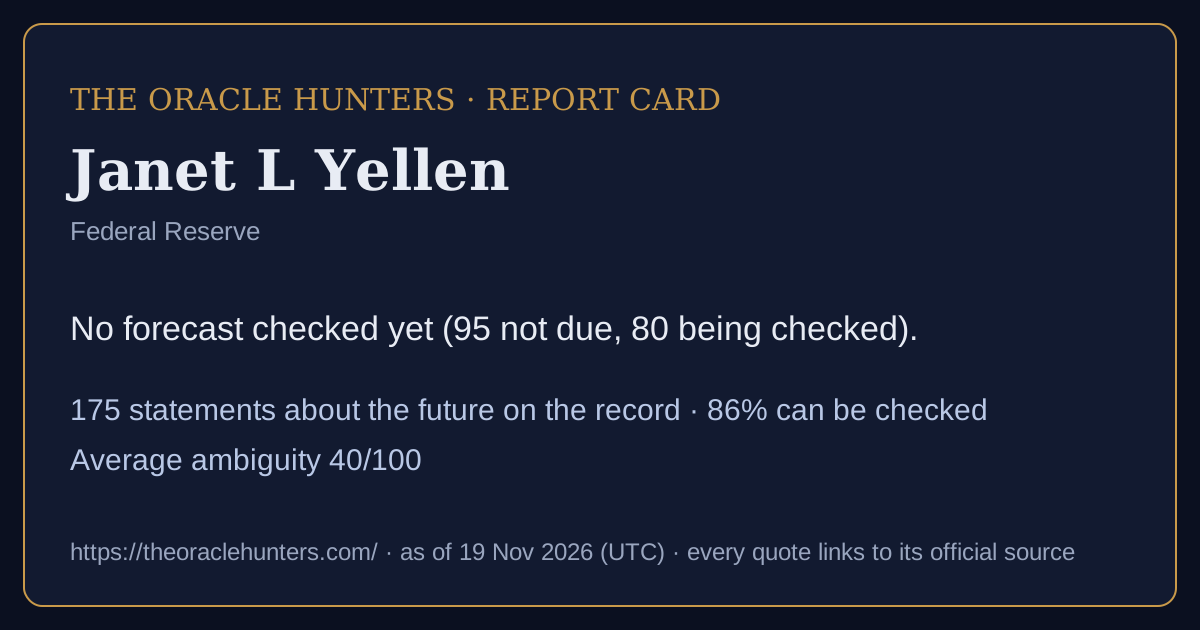
Track record: No forecast checked yet (95 not due, 80 being checked).
175forecasts & commitments on the record
86%can be checked as stated
40average ambiguity (0-100)
0goalpost moves recorded
0confirmed U-turns
Timeline
came true partly did not not due / being checked / too vague
Calibration score: shown after 10 checked forecasts with a stated likelihood (now 0).
How they speak about the future: based on data 133, stated on authority 26, educated guess 16.
Kinds of claim: forecast 129, mixed claim 31, scenario (if… then) 14, commitment 1. · Download this report card as a picture
In the nine words
πρόγνωσιςInference from evidence125 · 71%μαντείαInspired knowledge25 · 14%πρόνοιαPreparing for the future14 · 8%πρόβλεψιςSeeing the signs5 · 3%εἰκασίαConjecture4 · 2%φρόνησιςPractical wisdom1 · 1%προαναγγελίαPublic pre-announcement1 · 1%
How to read this
Each box is one sentence a public figure or institution said about the future, word for word, with a link to the official text. Can be checked means it names what will happen, by when, and how likely - so it can be compared with official figures later. Too vague to check means it does not. Ambiguity (0-100) is how many different ways the sentence can be read. When the date passes, the forecast is compared with official data and marked came true, partly or did not come true. Labels judge the sentence, never the person. Full guide and glossary.On the record (175)
If we are indeed living in a low-neutral-rate world, a significantly less severe economic downturn than the Great Recession might be sufficient to drive short-term interest rates back to their effective lower bound.
As a result, if the Federal Reserve raised the rate it paid, other short-term lending rates would likely rise as well.11 This new approach for raising short-term interest rates is working well: Since December 2015, we have raised the interest paid on excess reserves and the target range for the federal funds rate by 100 basis points, and the effective …
Indeed, with the economy now operating near maximum employment and inflation expected to rise to the FOMC's 2 percent objective over the next couple of years, the FOMC has been scaling back the accommodation provided in response to the Great Recession.
If so, some further tightening in the labor market might be needed to lift inflation back to 2 percent.
For October through December of this year, the decline in the Federal Reserve's securities holdings will be capped at $6 billion per month for Treasury securities and $4 billion per month for agency securities.
To be sure, our understanding of the forces that drive inflation is imperfect, and we recognize that this year's low inflation could reflect something more persistent than is reflected in our baseline projections.
In the latest Summary of Economic Projections, my colleagues and I project inflation to move higher next year and to reach 2 percent by 2019.
My best guess is that these soft readings will not persist, and with the ongoing strengthening of labor markets, I expect inflation to move higher next year.
The latest projections from FOMC participants have a median of 2-1/2 percent GDP growth this year.
However, studies of this issue do not, on balance, provide much empirical support for this possibility.23 Moreover, foreign economic growth has firmed this year and the global economy appears to have largely recovered, so any influence that global resource utilization might have on U.S. inflation would presumably be small.
In interpreting incoming data, we will need to stay alert to these possibilities and, in light of incoming information, adjust our views about inflation, the overall economy, and the stance of monetary policy best suited to promoting maximum employment and price stability.
Before the series' starting point in 1947:Q2, actual productivity growth is padded with an ARIMA(4,1,0) model; after its 2017:Q2 endpoint, the series is padded with the CBO's January 2017 forecast of average nonfarm business trend productivity growth from 2017 to 2027 (which is 1.67 percent in log differences) and with the 2027 value of the CBO forecast (1.77 percent) thereafter.
For example, Aaronson and others (2015) estimate that increases in the average age and educational attainment of U.S. workers will reduce the sustainable rate of unemployment almost 1/2 percentage point between 2014 and 2020.
As the figure shows, based on that history, there is a 30 percent probability that inflation could be greater than 3 percent or less than 1 percent next year.6
Based on analyses of this sort, my colleagues and I currently think that this year's low inflation is probably temporary, so we continue to anticipate that inflation is likely to stabilize around 2 percent over the next few years.
If these obstacles persist, we will squander the potential of many of our citizens and incur a substantial loss to the productive capacity of our economy at a time when the aging of the population and weak productivity growth are already weighing on economic growth.
Our individual projections for the appropriate path for the federal funds rate reflect economic forecasts that generally envision that economic activity will expand at a moderate pace in coming years, labor market conditions will strengthen somewhat further, and inflation will be at or near 2 percent over the medium term.
Inflation also was lower than expected, with headline PCE prices rising less than 1 percent over the course of 2015, instead of around 1-3/4 percent as we had anticipated in June 2014.
In particular, the unemployment rate still stood above our assessment of its longer-run normal level--that is, the unemployment rate that we expect to prevail when the economy is operating at maximum employment--and inflation remained below the 2 percent objective.
However, partly because my colleagues and I expect the neutral real federal funds rate to rise somewhat over the longer run, we projected additional gradual rate hikes in 2018 and 2019.
With the job market strengthening and inflation rising toward our target, the median assessment of FOMC participants as of last December was that a cumulative 3/4 percentage point increase in the target range for the federal funds rate would likely be appropriate over the course of this year.
Because my colleagues and I expected that labor market conditions would continue to improve and that inflation would move back to 2 percent over the medium term, we anticipated that the time was approaching when the economy would be strong enough that we should start to scale back our support.
Barring future major swings in oil prices and the foreign exchange value of the dollar, inflation is likely to move up to 2 percent over the next couple of years, aided by a strong labor market.
With the unemployment rate near its longer-run normal level and likely to move a bit lower this year, a natural question is whether monetary policy has fallen behind the curve.
But recent readings on business sentiment and new orders for equipment are consistent with the view that capital spending will likely strengthen modestly this year; another positive factor is that oil drilling, which plummeted after oil prices fell sharply back in late 2014, has recently begun to pick up.
In the coming months, I expect some further strengthening in labor market conditions as the economy continues to expand at a moderate pace--a view that is shared by most of my colleagues on the Federal Open Market Committee (FOMC).5 Overall economic growth has been driven by consumer spending, which has been bolstered by substantial gains in household income and wealth.
For these reasons, I consider it prudent to adjust the stance of monetary policy gradually over time--a strategy that should improve the prospects that the economy will achieve sustainable growth with the labor market operating at full employment and inflation running at about 2 percent.
With the federal funds rate still near zero, the Committee recognizes that, should the economy unexpectedly weaken in the next year or two, there would likely be only limited scope to respond by lowering short-term rates.
If you are a borrower, it means that, although the interest rates you pay on, say, your auto loan or mortgage or credit card likely will creep higher, they probably will not increase dramatically.
But productivity growth of 1 percent a year means the average standard of living will double only every 70 years.
With productivity growth of 2 percent a year, the average standard of living will double roughly every 35 years.
In addition, inflation is still running below our 2 percent objective, and, by some measures, there may still be some room for progress in the job market.
That said, as of last month, I and most of my colleagues--the other members of the Fed Board in Washington and the presidents of the 12 regional Federal Reserve Banks--were expecting to increase our federal funds rate target a few times a year until, by the end of 2019, it is close to our estimate of its longer-run neutral rate …
Everything I have said so far could apply to the graduates this year of any college or university.
More research is needed, however, to better understand the influence of movements in aggregate demand on aggregate supply.8 From a policy perspective, we of course need to bear in mind that an accommodative monetary stance, if maintained too long, could have costs that exceed the benefits by increasing the risk of financial instability or undermining price stability.
The latest long-run forecast from the Administration (www.whitehouse.gov/sites/default/files/omb/budget/fy2016/assets/16msr.pdf) is also close to 3 percent, as was the projection made by the Congressional Budget Office earlier in the year (see www.cbo.gov/about/products/budget_economic_data).
In the Blue Chip Financial Indicators survey released on June 1, 2016, the consensus forecast for the longer-run level of the federal funds rate was 3.2 percent.
The confidence interval equals (subject to a lower bound of 12.5 basis points) the median SEP path for the federal funds rate plus or minus average root mean squared prediction errors (RMSPEs) of the three-month Treasury bill rate, for horizons from zero to nine quarters ahead, based on forecast errors made over the past 20 years.
Before the onset of the crisis, the volume of reserves was generally small--only about $45 billion or so.4 Thus, even small open market operations could have a significant effect on the federal funds rate.
Looking ahead, the FOMC expects moderate growth in real gross domestic product (GDP), additional strengthening in the labor market, and inflation rising to 2 percent over the next few years.
But even after the volume of reserves falls substantially, IOER will still be important as a contingency tool, because we may need to purchase assets during future recessions to supplement conventional interest rate reductions.14 Forecasts now show the federal funds rate settling at about 3 percent in the longer run.15 In contrast, the federal funds rate averaged more than 7 …
And as I just noted, I expect to see inflation moving up to 2 percent over the next couple of years.
As the downward pressure on prices from these two forces dissipates and as the labor market strengthens further, I expect inflation to move back to 2 percent.
An encouraging aspect of the report, however, was that average hourly earnings for all employees in the nonfarm private sector increased 2-1/2 percent over the past 12 months--a bit faster than in recent years and a welcome indication that wage growth may finally be picking up.3
If incoming data are consistent with labor market conditions strengthening and inflation making progress toward our 2 percent objective, as I expect, further gradual increases in the federal funds rate are likely to be appropriate and most conducive to meeting and maintaining those objectives.
Applying the drop in gasoline prices since the first half of 2014, savings per household averaged about $110 in the second half of 2014, $780 in 2015, and another $420 through May of this year, implying a cumulative overall gain of more than $1,300 per household on average.
Concerns about slowing growth in China and falling commodity prices, which afflicted global financial markets early this year and thus likely weighed on demand, appear to have eased somewhat.
Specifically, the median projections of real GDP growth in 2016 and 2017 revised down 0.2 percentage point and 0.1 percentage point, respectively; the median projections of real GDP growth in 2018 and the longer run were unrevised.
For example, the median of FOMC participants' projections for the federal funds rate is now only 0.9 percent for the end of 2016 and 1.9 percent for the end of 2017, both 1/2 percentage point below the December medians.
In particular, foreign economic growth now seems likely to be weaker this year than previously expected, and earnings expectations have declined.
Showing the newest 50 - the ledger has all 175.
Also said - not checkable as stated (12 newest)
Remarks about the future with no date, figure or likelihood that could be checked. They are kept on the record and shown here, but not scored.
While I believe that influencing short-term interest rates should continue to be our primary monetary policy lever in normal times, our unconventional policy tools will likely be needed again should some future economic downturn drive short-term interest rates back to their effective lower bound.
Consequently, the probability that short-term interest rates may need to be reduced to their effective lower bound at some point is uncomfortably high, even in the absence of a major financial and economic crisis.
Second, in light of evidence suggesting that the neutral level of short-term interest rates is significantly lower than it was in previous decades, the likelihood that future monetary policymakers will have to confront those two challenges again is uncomfortably high.
I am cheered to see that finance students at the University of Akron remain interested enough in community banking to participate in a case-study competition related to community banking, and I am pleased that the conference will hear a presentation of the winning case study.
To be sure, market-based measures may not reflect true risks--they certainly did not in the mid-2000s--and hence the observed improvements should not be overemphasized.16 But supervisory metrics are not perfect, either, and policymakers and investors should continue to monitor a range of supervisory and market-based indicators of financial system resilience.
Repeating a familiar pattern, the "madness of crowds" had contributed to a bubble, in which investors and households expected rapid appreciation in house prices.
Moreover, both the risk-weighted and simple leverage requirements are higher for the largest, most systemic firms, which lowers the risk of distress at such firms and encourages them to limit activities that could threaten financial stability.10 Finally, the largest U.S. banks participate in the annual Comprehensive Capital Analysis and Review (CCAR)‑‑the stress tests.
In addition, the Congress required that the largest banks submit living wills that describe how they could be resolved under bankruptcy.12 And the Federal Reserve has mandated that systemically important banks meet total loss-absorbing capacity requirements, which require these firms to maintain long-term debt adequate to absorb losses and recapitalize the firm in resolution.
Moreover, these steps promote market discipline, as creditors--knowing full well that they will bear losses in the event of distress--demand prudent risk-taking, thereby limiting the problem of too-big-to-fail.
Such changes include adjustments that may simplify regulations applying to small and medium-sized banks and enhance resolution planning.22
Among the women who were fighting for better labor standards early in the 20th century, many were heavily influenced by elite cultural standards that viewed a woman's place as in the home and argued that men should be paid a "family wage" that would allow them to support their family singlehandedly--a standard that many working-class families could not afford.
This rise suggests that while the incentive, and in many cases the imperative, remained for women to drop out of the labor market at marriage when they could rely on their husband's income, mores were changing.