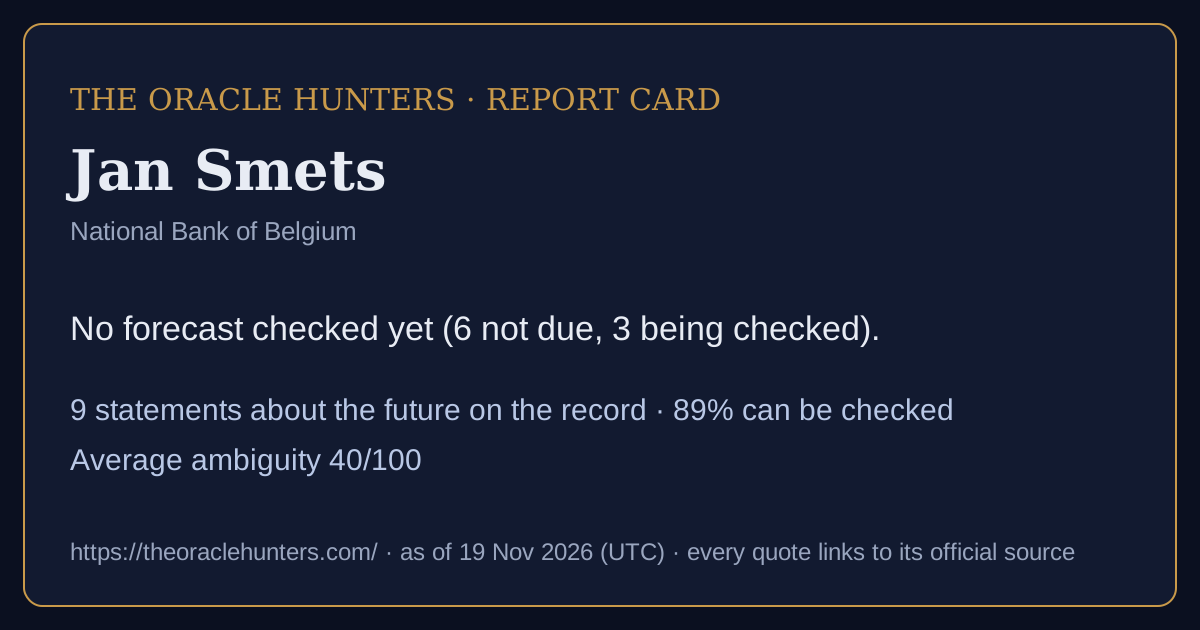
Jan Smets
National Bank of Belgium
Track record: No forecast checked yet (6 not due, 3 being checked).
9forecasts & commitments on the record
89%can be checked as stated
40average ambiguity (0-100)
0goalpost moves recorded
0confirmed U-turns
Timeline
came true partly did not not due / being checked / too vague
Calibration score: shown after 10 checked forecasts with a stated likelihood (now 0).
How they speak about the future: based on data 6, educated guess 3.
Kinds of claim: forecast 6, scenario (if… then) 3. · Download this report card as a picture
In the nine words
How to read this
Each box is one sentence a public figure or institution said about the future, word for word, with a link to the official text. Can be checked means it names what will happen, by when, and how likely - so it can be compared with official figures later. Too vague to check means it does not. Ambiguity (0-100) is how many different ways the sentence can be read. When the date passes, the forecast is compared with official data and marked came true, partly or did not come true. Labels judge the sentence, never the person. Full guide and glossary.On the record (9)
By stabilising inflation and hence inflation expectations at a level below, but close to, 2% in the medium term, we make sure that the steady state level of nominal interest rates will be supported by an inflation compensation component of that magnitude.
Therefore, we decided to reduce the monthly pace of our purchases to €15 billion from October onwards and we anticipate ending them after December 2018, subject to incoming data confirming our medium-term inflation outlook.
Not only was there a risk that the inflation outlook would no longer be in line with our aim of inflation below, but close to, 2% over the medium term, there were also increasing indications that the economy could slip into outright deflation.
Consequently, US monetary policy makers project core inflation to pick up, running slightly above 2 % in 2019 and 2020.
In March the rate's target range was hiked to 1.5 % to 1.75 %; currently markets expect 3 more rate hikes this year while Fed officials pencil in 2 more.
Looking forward, underlying inflation is projected to only gradually rise to 1.8 % in 2020.
Indeed, some analyses show that, when rates are at zero or below, new rate cuts will weigh more on banks' stock prices and on their lending volumes if banks are more funded through retail deposits.
If the adverse impact of our measures on bank profitability becomes - or is expected to become - too large, banks' capacity to lend may decline, and we would not achieve the more favourable financial conditions we seek.
This measure is the unemployment rate which is consistent with stable wage inflation, the NAWRU (non-accelerating wage rate of unemployment): if unemployment is higher than this equilibrium rate, increases in wages will be slower; if lower, wages will go up faster.
Also said - not checkable as stated (12 newest)
Remarks about the future with no date, figure or likelihood that could be checked. They are kept on the record and shown here, but not scored.
In this process we will examine the impact alternative forms of money have on the central banks' basic tasks to formulate and implement monetary policy and to contribute to financial stability.
The issuance of euro banknotes is one of the best known and most visible activities of the Eurosystem central banks 1 but, as will become clear hereafter, it is by no means the most important of their tasks.
Instead, central banks will take a broad interest in the many different appearances and functions of money.
Evolutions like the rise of local currencies or the emergence of digital money such as privately issued cryptocurrencies will certainly not go unnoticed.
I will then clarify the process through central banks create central bank money, and position central bank money against alternative forms of money such as local currencies and cryptocurrencies.
Thirdly, according to Article 19.1 of the Statute of the ESCB, the ECB may require commercial banks to hold minimum reserves (or compulsory deposits) on accounts with the Eurosystem central banks.
Only to the extent that central banks will be successful on all three fronts I have mentioned, they should not fear outside competition.
Increased communication efforts will have to be made to explain policy actions, not only to the more informed audience of financial markets participants but also to the wider public.
Ladies and gentlemen, it is a great pleasure for me to address this conference organised by the Belgian Financial Forum and SUERF on the impact of the crisis and how it may have shaped a new normal for the economy, for the financial system and for central banks.
## Reflections on the future of monetary policy may require new data needs
The interplay of these phenomena could potentially have serious implications for the way we think about monetary policy going forward, be it in terms of objectives, instruments, transmission channels or data monitoring.
expected inflation and the anticipated change in real marginal costs - the so-called NewKeynesian Phillips curve which links economic activity and inflation.