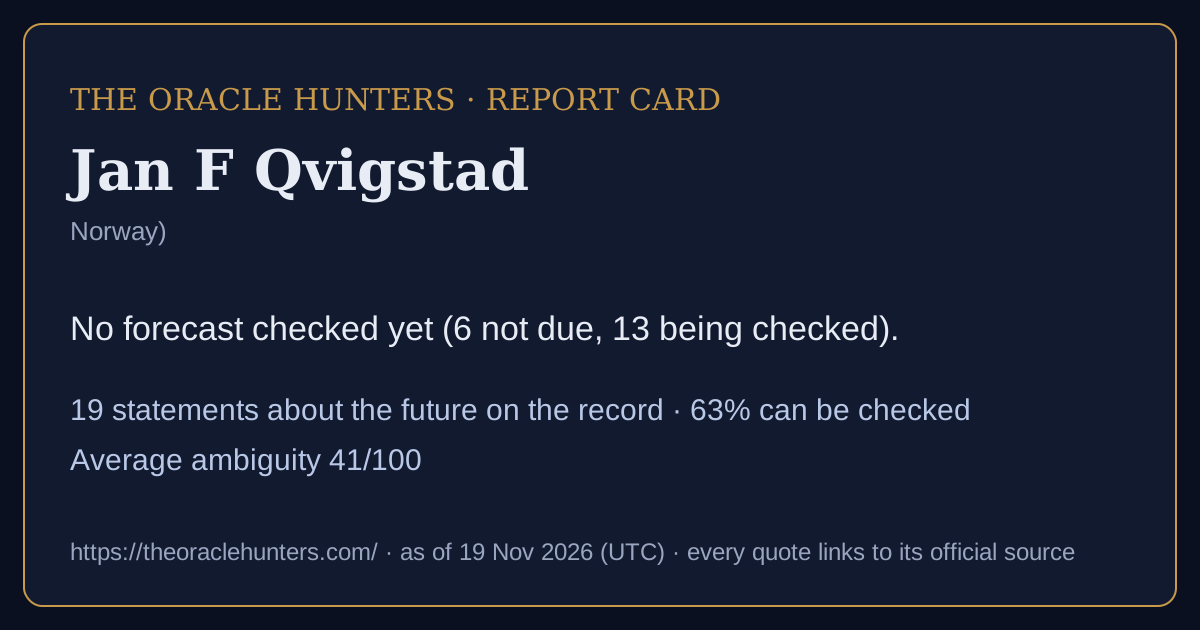
Jan F Qvigstad
Norway)
Track record: No forecast checked yet (6 not due, 13 being checked).
19forecasts & commitments on the record
63%can be checked as stated
41average ambiguity (0-100)
0goalpost moves recorded
0confirmed U-turns
Timeline
came true partly did not not due / being checked / too vague
Calibration score: shown after 10 checked forecasts with a stated likelihood (now 0).
How they speak about the future: based on data 14, stated on authority 3, educated guess 2.
Kinds of claim: forecast 14, mixed claim 5. · Download this report card as a picture
In the nine words
πρόγνωσιςInference from evidence13 · 68%μαντείαInspired knowledge3 · 16%εἰκασίαConjecture2 · 11%πρόβλεψιςSeeing the signs1 · 5%
How to read this
Each box is one sentence a public figure or institution said about the future, word for word, with a link to the official text. Can be checked means it names what will happen, by when, and how likely - so it can be compared with official figures later. Too vague to check means it does not. Ambiguity (0-100) is how many different ways the sentence can be read. When the date passes, the forecast is compared with official data and marked came true, partly or did not come true. Labels judge the sentence, never the person. Full guide and glossary.On the record (19)
In May this year, I had the pleasure of visiting Stavanger Cathedral School.
In line with our past experience of dividing responsibilities, the Ministry of Finance will implement countercyclical capital requirements from 2013.
But this is difficult; in summer 2008, the average OECD country overestimated the budget situation in 2007 - the year prior to the forecast in an amount equivalent to 2 percent of GDP (National Budget 2013).
Within a few years, as much as 15-20 per cent of the welfare state could be financed by the return on the oil fund.
But if we squander the capital in the fund, we will either have to match the shortfall with tax increases or make substantial cuts in government welfare.
If unemployment is above 4 per cent of the labour force, it might signal a labour market out of order.
The governor will step down at the end of the year.
Norges Bank will celebrate its two hundred year anniversary in 2016.
If economic developments are broadly in line with projections, the appropriate key policy rate will be 2.75 per cent around the end of next year.
Structural non-oil deficit and expected return on the Government Pension Fund — Global In billions of Z010-NOK. 2007 -2012
Housing investment may start to increase towards the middle of next year.
The decline in business investment will probably come to a halt in the course of 2010 as growth recovers, funding conditions improve further and interest rates remain low.
Since wage growth is higher in Norway than abroad, relative costs will rise ahead even if the nominal krone exchange rate should remain unchanged.
These prices suggest that the oil price in 2010 and 2011 will be USD 5-10 above the current level.
Consumer price inflation is expected to fall to somewhat below 2 per cent in 2010, and then gradually pick up to around 2.5 per cent towards the end of the projection period.
In Chart 10, he shows how the various interest rate paths, differing by around ½ percentage point in the period to summer, could result in differences in the inflation rate of close to 4 percentage points as early as next autumn.
Norges Bank's assessment of the current situation and the forecasts - with below-target inflation and a considerably negative output gap - might, under criteria 1 and 2, indicate in isolation that the interest rate should be set very low and even be negative towards the end of 2009.
House prices plummeted by more than 50 per cent at that time and several banks collapsed in the next few years.
Since then G7, IMF and governments all over the world have taken active policy measures that hopefully will steer the financial world into smoother water, although the real economy probably will be in dire straits the next year or two.
Also said - not checkable as stated (12 newest)
Remarks about the future with no date, figure or likelihood that could be checked. They are kept on the record and shown here, but not scored.
The diminished role of the institution, which persisted well into the 1980s, must be seen in the light of mixed experiences with par policy, ambitious aims of micromanaging the economy, and the conviction that lower unemployment could be achieved by accepting higher inflation. 40 At the same time, major imbalances were building up in the economy.
When making interest rate forecasts, we must also take into consideration the promises made yesterday.
My contribution will have to be a presenttime analysis with the inherent scope and limitations. 34 Was this a good policy?
'As you may have seen from the Norwegian newspapers, I have in several lectures proposed that we should consider building entirely new towns as part of solving the problems of the districts.' Discussions with Viking Medstad on 3 January and 24 October 2013.
Leaders must be aware that the institution will be held accountable - it must practice transparency as a principle.
The short-term forecast from SAM is the basis for the initial conditions when we use NEMO and when we make our policy decisions - and hence of core importance to monetary policy.
We will seek to improve systemic risk indicators and macro-stress testing approaches, keeping them at the research frontier.
We will also work to better incorporate the financial sector in our macroeconomic models.
Norges Bank will make recommendations for its buffer decisions.
The reports will form the basis for both monetary policy decisions and for our advice on the buffer.
Furthermore, Norges Bank gives weight to the risk that a prolonged period of low interest rates could lead to elevated risk-taking and excessive debt accumulation in the household and business sectors.
We should be less concerned about what is completely right and correct according to the prevailing truths, and more concerned about avoiding major mistakes, irrespective of what the truth might be. 21 And this is the line of thinking behind our inflation target for monetary policy and the fiscal rule for oil revenue spending.