James Proudman
Bank of England
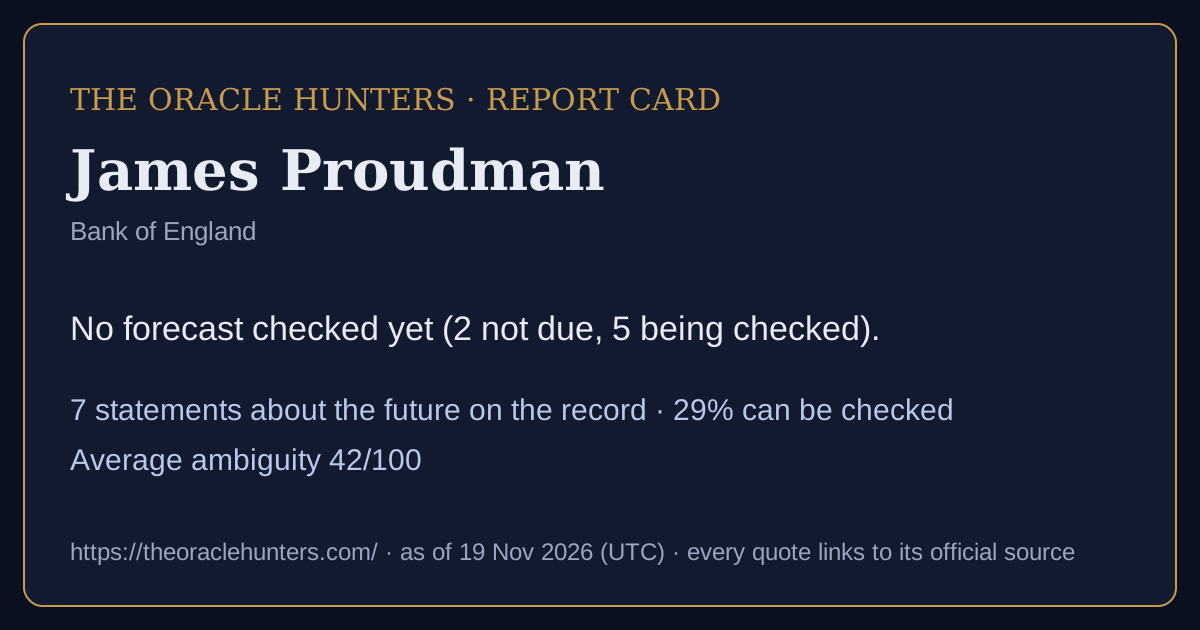
Track record: No forecast checked yet (2 not due, 5 being checked).
7forecasts & commitments on the record
29%can be checked as stated
42average ambiguity (0-100)
0goalpost moves recorded
0confirmed U-turns
Timeline
came true partly did not not due / being checked / too vague
Calibration score: shown after 10 checked forecasts with a stated likelihood (now 0).
How they speak about the future: based on data 5, stated on authority 2.
Kinds of claim: forecast 6, mixed claim 1. · Download this report card as a picture
In the nine words
How to read this
Each box is one sentence a public figure or institution said about the future, word for word, with a link to the official text. Can be checked means it names what will happen, by when, and how likely - so it can be compared with official figures later. Too vague to check means it does not. Ambiguity (0-100) is how many different ways the sentence can be read. When the date passes, the forecast is compared with official data and marked came true, partly or did not come true. Labels judge the sentence, never the person. Full guide and glossary.On the record (7)
The median firm reported deploying six distinct such applications currently, and expected three further applications to go live over the next year, with ten more over the following three years.
The process of granting or refusing applications for waivers and modifications is now all but complete, and rule waivers and modifications will be published by the PRA in the Financial Services Register when the regime goes live in 2019.
Overall, the Bank estimates that ring-fenced banks' total loss absorbency will be, on average, around 27% of their risk-weighted assets, higher than the 17% recommended by the ICB. 3
We expect ring-fenced banks to have, on average, around 1.5 percentage points more high-quality 'Tier 1' capital than non-systematically important banks. 2 And a ring-fenced bank will not be able to be capitalised by debt raised externally by its group, which would give rise to so-called 'double leverage'.
From next year, the PRA will report annually to Parliament on the steps the banks have taken to implement ring-fencing and their level of compliance.
## How will the banks operate from 2019?
And by the end of this year, we will have assessed and approved more than 50 applications for senior management positions within these groups, and considered the suitability of their proposed prudential sub-groups, containing hundreds of entities between them.
Also said - not checkable as stated (11 newest)
Remarks about the future with no date, figure or likelihood that could be checked. They are kept on the record and shown here, but not scored.
In a more automated, fast-moving world of AI/ML, boards - not just regulators - will need to consider and be on top of these issues.
As the rate of introduction of AI/ML in financial services looks set to increase, so too does the extent of execution risk that boards will need to oversee and mitigate.
And third, the acceleration in the rate of introduction of AI/ML will create increased execution risks during the transition that need to be overseen.
So there is a need to understand carefully the assumptions built into underlying algorithms, and how they will behave in different circumstances, including by amplifying potential and/or unintended human prejudice.
Firms will need to consider how to allocate individual responsibilities, including under the Senior Managers Regime.
And regulators would need to guard against the moral hazard that could arise if firms perceived that responsibility for the accuracy and congruence of data had transferred from regulated entities to regulators.
You might even use it to access your bank account.
At the macroeconomic level, changes in technology, including AI, could, over time, profoundly affect the nature of the financial services consumed and may result in changes to the structure of the financial services industry.
Increasing levels of automation, machine learning and AI could improve the safety and soundness of firms in some ways.
ML may also improve the quality of credit risk assessments, particularly for high-volume retail lending, for which plenty of data are available and can be used for training machine learning models.
But the increased use of ML and AI may also increase some risks to the safety and soundness of firms.