James Brokenshire
Home Office · GBR
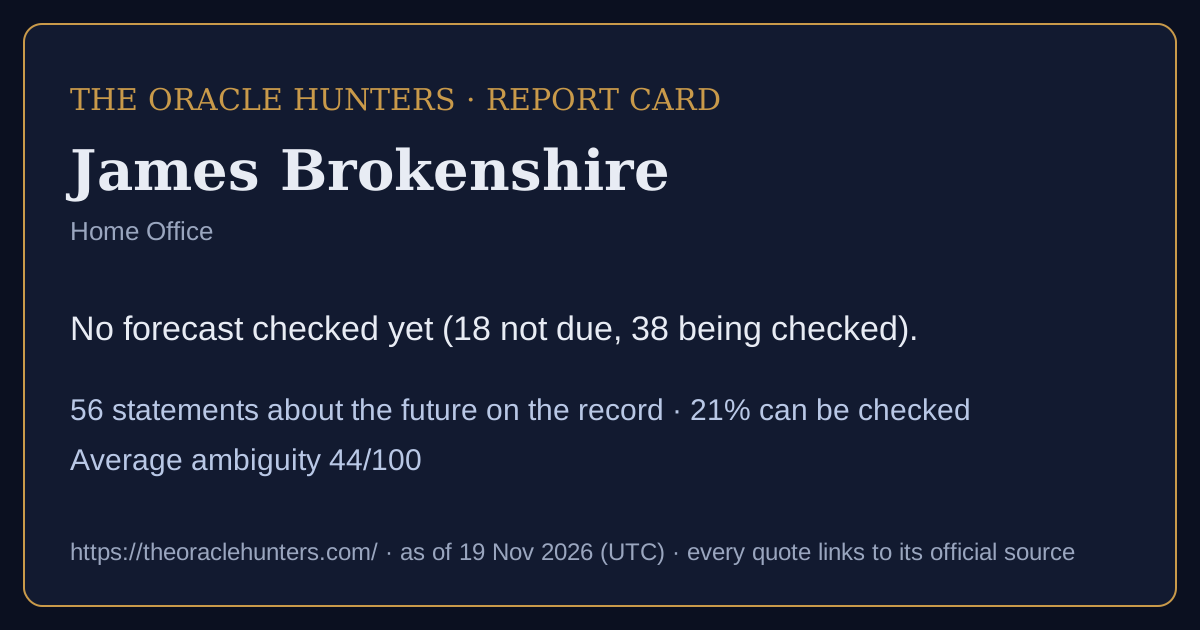
Track record: No forecast checked yet (18 not due, 38 being checked).
56forecasts & commitments on the record
21%can be checked as stated
44average ambiguity (0-100)
0goalpost moves recorded
0confirmed U-turns
Timeline
came true partly did not not due / being checked / too vague
Calibration score: shown after 10 checked forecasts with a stated likelihood (now 0).
How they speak about the future: based on data 35, stated on authority 20, educated guess 1.
Kinds of claim: forecast 36, mixed claim 11, commitment 8, scenario (if… then) 1. · Download this report card as a picture
In the nine words
πρόγνωσιςInference from evidence33 · 59%μαντείαInspired knowledge14 · 25%προαναγγελίαPublic pre-announcement8 · 14%πρόνοιαPreparing for the future1 · 2%
How to read this
Each box is one sentence a public figure or institution said about the future, word for word, with a link to the official text. Can be checked means it names what will happen, by when, and how likely - so it can be compared with official figures later. Too vague to check means it does not. Ambiguity (0-100) is how many different ways the sentence can be read. When the date passes, the forecast is compared with official data and marked came true, partly or did not come true. Labels judge the sentence, never the person. Full guide and glossary.On the record (56)
Since I took up my ministerial post earlier this year, the world has changed in ways that we could scarcely have imagined.
The centre will be fully delivered and operational within the next 5 years, with the first parts of the building complete and operational as early as next year.
We will be introducing legislation early next year that will extend the tools available to Counter Terrorism Policing as part of the Government’s response to Jonathan Hall QC’s independent review of multi-agency public protection arrangements.
And also bolstering the defences of communities against weather-related emergencies through initiatives such as the Thames Estuary 2100 Plan – which aims to protect 1.3 million people – including £275 billion worth of property and infrastructure – from the increasing risk of tidal flooding.
We’re investing over £290 million in 41 projects across north Kent and south Essex, through the South East Local Enterprise Partnership, to generate the jobs and growth this area needs.
By acting as one, we can together ensure that our work will have a greater impact as it gets underway over the next 2 years.
With budget planning underway, I hear your calls loud and clear for early clarity and certainty for 2020 to 2021 to give councils enough time to plan and recognise that significant changes introduced quickly could lead to poor value for money.
All these issues – particularly your pressing need for clarity, which cannot wait until the end of the year – will need to be addressed by the new government as we consider what a sustainable settlement looks like for local government for the coming years.
I’ve also said that the new Help to Buy scheme from 2021 will not be used to support the unjustified use of leasehold.
We will be introducing a new Help to Buy scheme, which will run until 2023.
And I think it’s great to see the sector really embracing MMC – both new entrants as well as established players like L&Q, which has announced that it will use MMC in all new builds by 2025.
From 2020, T Levels will be a high-quality technical alternative to A Levels, rivalling some of the world’s best-performing systems.
And why we announced a new Help to Buy scheme which will run until 2023 – a policy that, together with schemes including Right to Buy, has helped over half a million people get their foot on the housing ladder since 2010.
We’re also investing in skills through, for example, a £24 million Construction Skills Fund that will see 7 housing sites in London benefit from on-site construction training hubs.
Under today’s system, local authorities estimate they will retain around £2.4 billion in business rates growth in 2018-19 – a significant revenue stream on top of the core settlement funding.
It’s why, at last month’s provisional local government finance settlement, we provided a cash-increase of 2.8%: from £45.1 billion this year, to £46.4 billion next year.
Next year we will finalise the new formula.
We’ve created city region mayors – with new powers to boost jobs and skills, to build homes and improve travel – and devolution deals such as the West Midlands, which will see over £1 billion invested over the next 30 years.
2019 will be a turning point in this respect, with the outcomes of the Fair Funding Review and Spending Review to come.
We’ve put £650 million for adult and children’s social care in and this includes £240 million to ease next year’s winter pressures – just as we have done so for this year.
Which is why I’m working with the Health and Social Care Secretary on the upcoming Green Paper on the future of social care, and I look forward to working with many of you on this as well – as well as looking towards the Spending Review next year where I will continue to be a champion for local government.
The Prime Minister’s announcement, yesterday, of the £2 billion initiative – enabling the most ambitious housing associations to apply for funding over the next decade – takes this to the next level.
In July, I announced 8 longer-term strategic partnerships between housing associations and Homes England worth around £590 million which will yield about 14,000 new affordable homes, including for social rent.
Someone has been charged in relation to it and it will go to trial later this year.
2020 will be a big year for local government.
This will be published alongside our consultation on the approach to next year’s annual settlement.
Local authorities estimate they will receive around £2.4 billion in business rates growth in 2018 to 2019 – a significant sum on top of the settlement.
Over £100 million is available within the Fund this year and sufficient funds will be made available to Homes England to meet demand and deliver value for money.
While I will be setting out further details in July, what I can tell you is that our focus will be in three core areas: prevention, intervention and recovery – so that by 2027, nobody should have to sleep on our streets.
And we remain committed to the devolution of Corporation Tax so that Northern Ireland is better able to compete for investment with its nearest neighbour, Ireland.
Earlier this year I had to step in and legislate to set some local taxes so that local councils could continue to carry out their functions.
As I have said before … we joined the Common Market in 1973 as one United Kingdom and we will leave the European Union in 2019 as one United Kingdom.
That is why we are committed to investing in infrastructure, technology and skills to deliver the best possible base for strong future growth.
And just think how much better we could do if we had an Executive in place and could devolve Corporation Tax powers to enable them to lower it to the same levels south of the border.
And as the Stormont House Agreement set out we will provide up to £150 million to help fund them.
Next year we will mark the 20th anniversary of the Belfast or Good Friday Agreement, an Agreement intended to herald a new beginning for relationships in these islands, within Northern Ireland, between Norther Ireland and Ireland and between the United Kingdom and Ireland.
Just as we joined the Common Market in 1973 as one United Kingdom, we will leave the EU in 2019 as one United Kingdom.
I am also pleased that the Treasury has provided a guarantee to the agricultural sector that it will receive the same level of funding that it would have received under Pillar 1 of CAP until the end of the MFF (Multiannual Financial Framework) in 2020.
In particular we will prioritise an outcome that means the land border remains as seamless and frictionless as possible, recognising the particular issues for businesses, like many of those represented here tonight, with complex cross-border supply chains and distinct animal and plant health regimes.
We are determined to maintain and strengthen the unique relationship between the UK and Ireland, tied by centuries of history, geography and trade.
The Chancellor has already announced that the Treasury will guarantee direct payments to farmers on the same basis as currently paid under the cap until 2020.
This year the IMF say that the UK is the fastest growing economy in the G7, with growth higher than expected in the three months after the result of the EU referendum.
The Chancellor has already announced that the Treasury will guarantee direct payments to farmers on the same basis as currently paid under the cap until 2020 and guarantee funding for structural and investment fund projects signed before the UK leaves the EU, even where projects continue after we leave.
As we have seen this year even potentially sensitive anniversaries that might once have divided us are now handled in ways that are inclusive, respectful, and promote shared mutual understanding.
That’s because the fundamentals of our economy remain strong with solid growth, record levels of employment and falling unemployment and because the UK will remain an outward looking, global trading nation.
And we remain committed to the devolution of corporation tax powers in accordance with the conditions on financial stability set out in the Stormont House Agreement.
I look forward to signing the Treaty along with Charlie Flanagan shortly that will enable the UK and Irish Governments, along with the Executive, that will enable us to get the new Commission up and running by the end of the year.
And that’s why the Chancellor announced last month that all European structural and investment funding agreements in the UK signed before this year’s Autumn Statement will be fully funded, even after we have left the EU.
In addition, we will match the current level of direct payments given to farmers until 2020 - a boost to the agriculture sector which in Northern Ireland is the backbone of the local economy.
This is why we will be reducing the permitted visa refusal rate from 20% to 10% from 1 November.
Showing the newest 50 - the ledger has all 56.
Also said - not checkable as stated (12 newest)
Remarks about the future with no date, figure or likelihood that could be checked. They are kept on the record and shown here, but not scored.
We will always take the strongest possible action to protect our national security and be clear about the threat that we face from terrorism.
And we will ensure that our domestic nuclear security capabilities are even more robust than they are already.
I also want to say to those concerned about our security position as we come to the end of the EU transition period: the safety and security of our citizens is our top priority, and the UK will continue to be a global leader on security and one of the safest countries in the world.
And it’s important we recognise, that while substantial government efforts will of course be required to meet our ambitions for the Estuary, local people and local businesses here in Kent and Essex must remain in the driver’s seat.
Today I want to make clear again that where there are innovative ideas for major housing and regeneration projects – especially in places of high housing need – we will back them.
Indeed, one of these Institutes will be at Barking and Dagenham College – an endeavour I hope will set many people on the path to great jobs and great careers.
We will shortly have a new Prime Minister and a new government.
To achieve this, I believe the next leader of my Party will need to rethink the relationship between central and local government and the systems and structures underpinning local government; acknowledging the part we all play in giving local authorities the freedom to deliver, but also spotting problems earlier and helping each other improve.
A moment of national renewal – a moment when your work at the heart of our communities will, once again, be of the utmost importance.
We need to consider how we implement these important and challenging reforms to make sure we get these right.
That’s why I believe that the next leader of my Party will need to look afresh at the entire ecosystem underpinning local government and acknowledge that role we all have to play - to spot problems earlier, champion best practice and help each other improve.
Central government, for example, could and should do more to identify and support struggling councils earlier to prevent failure and protect residents.