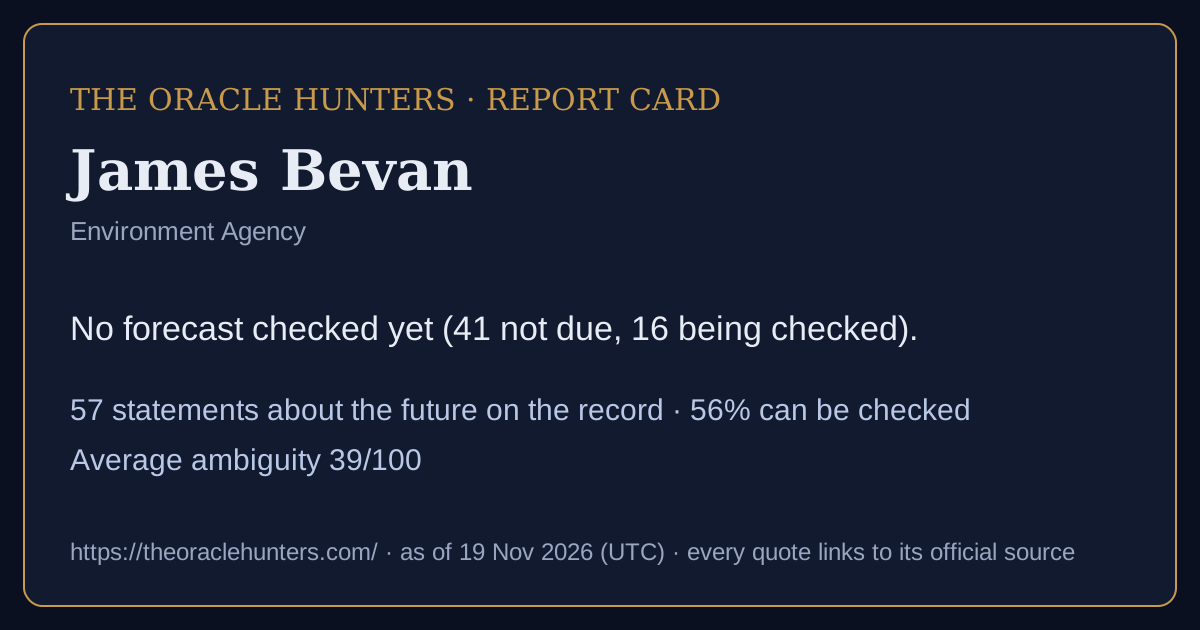
James Bevan
Environment Agency · GBR
Track record: No forecast checked yet (41 not due, 16 being checked).
57forecasts & commitments on the record
56%can be checked as stated
39average ambiguity (0-100)
0goalpost moves recorded
0confirmed U-turns
Timeline
came true partly did not not due / being checked / too vague
Calibration score: shown after 10 checked forecasts with a stated likelihood (now 0).
How they speak about the future: based on data 46, stated on authority 6, educated guess 5.
Kinds of claim: forecast 37, mixed claim 10, scenario (if… then) 5, commitment 5. · Download this report card as a picture
In the nine words
πρόγνωσιςInference from evidence41 · 72%προαναγγελίαPublic pre-announcement5 · 9%πρόνοιαPreparing for the future5 · 9%μαντείαInspired knowledge3 · 5%εἰκασίαConjecture2 · 4%πρόβλεψιςSeeing the signs1 · 2%
How to read this
Each box is one sentence a public figure or institution said about the future, word for word, with a link to the official text. Can be checked means it names what will happen, by when, and how likely - so it can be compared with official figures later. Too vague to check means it does not. Ambiguity (0-100) is how many different ways the sentence can be read. When the date passes, the forecast is compared with official data and marked came true, partly or did not come true. Labels judge the sentence, never the person. Full guide and glossary.On the record (57)
Which is one reason why in 2020 only about a third (36%) of global climate projects were related to adaptation.
In February this year we helped manage the combined impacts of Storm Dudley, Eunice and Franklin by warning 60,000 properties of the potential risk of flooding, deploying 1,700m of flood barriers, and coordinating the on-the-ground response 24 hours a day, for ten days straight.
Unless we take further action to adapt, under a very plausible 2°C by 2100 warming scenario, those damages will be 27% higher by 2050 and 40% higher by 2080.
We will see significant and growing threats to our habitats, our soil health, our crops, our power systems, our physical and mental health, and our economy.
This will set out the actions that the government and others will take to adapt to the challenges of climate change in England from 2024 to 2029, and there’s widespread agreement that it needs to be the most ambitious yet.
We can and should continue to expect governments to push this agenda forward, and at COP27 in Egypt next month we can expect further focus on how the public sector can commit to further unlocking the opportunities that green finance present.
We are doing both of those things in the new multi-year capital building programme which will invest double the amount of money - £5.2bn – in some 2000 new projects to better protect communities by 2027.
Research by the Green Alliance found that creating a circular economy, in which there would be no place for waste crime, could create 450,000 jobs in the UK by 2035.
Following the recent Spending Review we have just got our financial settlement from the government for the next three years, and it will be those two things on which we spend most of our time and money over that period.
The second debate was a more philosophical one, which was this: at the time of the decision, we didn’t actually know whether or indeed how we could reach our proposed 2030 target.
Once the decision in principle to make the EA Net Zero in 2030 had been made, there remained the small matter of how we were going to do it.
This includes hard targets: that the risk of needing severe water restrictions will be limited to no more than 0.2% in any given year; that we will get water consumption down to 110 litres of water per person per day from the current average of 150 litres or more; halving leakage, which currently loses around 20% of water put into …
That is putting pressure on governments around the world to act, and they are: the commitments made at COP26 last November – if implemented – will get us much closer to the climate stable world we want.
You aim to be the first zero carbon higher education institution, with a 75% carbon reduction from your estate already on track to be achieved by the end of next month, and the goal of achieving Net Zero in 2030.
That trend is going to continue: by 2050, most of the people on this planet (some 70% or more) will be living in cities and other urban areas.
A recent report by the Global Commission on Adaptation found that while it would cost $1.8 trillion this decade to make the world more resilient to the effects of climate change, that investment could yield over $7 trillion in net benefits.
And we are trying to walk the walk ourselves with our own commitment that we and our entire supply chain will reach Net Zero by 2030.
In May this year a Dutch court ordered Shell to reduce its emissions by 45% by 2030.
It identifies England’s long-term water needs up to 2050 and beyond, estimates how much water users in each region will need then, and which sectors (agriculture, industry, power) will use the most.
In England, May 2020 was the driest on record The Environment Agency’s estimate is that summer rainfall is expected to decrease by approximately 15% by the 2050s in England, and by up to 22% by the 2080s; and that by 2100 in the south-east we will increasingly see temperatures above 35°C, and sometimes 40°C.
The current commitments made by the international community will deliver a projected decrease in global emissions of 12% by 2030 (compared to 2010 levels).
It means that if we don’t take action, by 2050 the amount of water available in England could be reduced by up to 15%; that some rivers will have up to 80% less water in summer; and that we will need around 3.4 billion extra litres of water a day to meet the needs of people, industry and agriculture.
It would also help the whole nation’s economy and health, because the NHS could save over £2 billion in treatment costs if everyone in England had equal access to good quality green space.
Instead we are going to have to find new ways to do all these things which produce much lower or preferably zero carbon.
Hitting our net zero 2030 target is going to be hard, and we have deliberately made it harder for ourselves by adopting a tough, internationally recognised definition of net zero: including not just the carbon we produce ourselves but also the much larger amount of carbon produced through our supply chain.
We plan to achieve that by reducing our carbon emissions by at least 45% by 2030, and by neutralising the effect of our remaining emissions through tree planting and other measures that will lock up carbon harmlessly and deliver multiple other benefits like reduced flood risk.
Most of the 2.7m homes in England which are at risk of flooding from rivers or the sea now have some form of flood defence.
But we will only succeed in future in managing the growing levels of flood risk, and tackling all the other effects of the climate emergency, if we all do our bit.
The EA is close to completing our current six year £2.6bn building programme which will better protect another 300,000 homes and businesses by April 2021.
Climate change means we could see nearly 60% more winter rainfall by 2050 – seriously worrying for a country with so many rivers, and so many communities in the flood plains of those rivers.
It makes economic sense, because it will save the NHS billions of pounds: the NHS could save an estimated £2.1bn every year in treatment costs if everyone in England had access to good quality green space.
This development between Oxford and Cambridge may see up to one million new homes by 2050, more infrastructure, and more businesses based on the knowledge economy.
And all of this will more than pay for itself, because it will drive growth and innovation, and because the cost of making ourselves resilient to flooding is about a tenth of the cost of repairing things if we don’t.
The government has pledged a further £4bn for flood defence over the coming years: that will be the biggest single investment ever.
We are spending £2.6bn over six years (2015-2021) to build new flood defences that will better protect 300,000 properties and over £1bn to maintain our existing defences.
Secondly, it’s the route to failure, because if you force people to choose between growth, jobs, prosperity and housing on the one hand, and action on climate on the other, most of them will choose growth.
The Global Commission for Adaptation, headed by a pretty successful businessman you may have heard of (Bill Gates) has found that investing $1.8 trillion from 2020 to 2030 in five specific areas (early warning systems, resilient infrastructure, improved crop production, mangrove protection and more resilient water supply) could generate $7.1 trillion in total net benefits.
We aim to achieve this by reducing our carbon emissions by at least 45% by 2030, and addressing the effect of our remaining emissions through tree planting and other measures that will lock up carbon harmlessly and deliver multiple benefits like reduced flood risk.
It is a low carbon design: 95% of the carbon emitted in the project’s 120 year life will come from the construction – it uses low carbon concrete, and the parts are designed to last for 120 years so there will be no need for (carbon heavy) replacement.
And despite a lot of recent rain, if we have a third dry winter now then next year we will be facing water shortages in the South East.
That is why earlier this month the Environment Agency announced that we will set ourselves the goal of becoming a net zero organisation by 2030.
Our vehicle fleet has tightly defined CO2 and NOx limits and by 2025 all of it will be ultra low emission.
But – if we are going to deliver the future our children want - net gain to growth as well.
First, it will introduce a Future Homes Standard by 2025, so that new build homes are future-proofed with low carbon heating and world-leading levels of energy efficiency.
Even if we didn’t produce another gram of carbon from this moment on, sea levels will continue to rise for centuries.
Because while we will always seek to protect people and property where we can, including through hard flood and coastal defences, we will not be able to prevent all flooding and coastal change – particularly as the climate crisis drives more violent weather, higher rainfall in shorter periods, and faster coastal erosion.
By 2030 the cost of global adaptation to climate change will be up to $300 billion a year.
I’m inviting all the main water companies’ CEOs to join me next month at the National Drought Group which I chair to ensure we are all in the best possible place as we go into the summer.
We are enhancing the nation’s resilience to another of the effects of climate change, more and more severe flooding, through our leadership of the government’s £2.6bn programme to build flood defences that will better protect 300,000 homes and businesses by 2021.
By 2040, we expect more than half of our summers to exceed 2003 temperatures.
Showing the newest 50 - the ledger has all 57.
Also said - not checkable as stated (12 newest)
Remarks about the future with no date, figure or likelihood that could be checked. They are kept on the record and shown here, but not scored.
Five things need to be true if we are to tackle the climate emergency successfully.
Second, because the climate emergency can only be stopped by collective global action, there needs to be international consensus on the need to tackle it, agreement on how, and a mechanism to ensure it gets done.
Third, governments around the world need to take action themselves to tackle the climate emergency at national level.
We welcome this government’s various initiatives in this space, including the 25 Year Environment Plan itself, the new targets for water and other essential elements for nature recovery announced in December and the Environmental Improvement Plan announced last month – all of which the EA helped design and which we will now play a central part in delivering.
I welcome the fact that the Environment Agency itself is being challenged to do more: no organisation is perfect; all good organisations constantly seek to listen, learn and improve; and while we will always do the best we can with the powers and resources we have, we can always do better.
All that’s good: there’s nothing more important than water, and when people mobilise behind a cause things happen that might not otherwise have done so.
And finally while it’s my job to take the criticism that comes the EA’s way, let’s please remember that the staff of the Environment Agency are not the enemy or the problem: they are the people trying to fix the problem, they are passionate and committed professionals who will always go the extra mile for the people and places we …
The Environment Agency is committed to doing so, because if we really are going to be the first generation to leave the environment in a better state than we found it – an aspiration we all share – then the single most important thing we can do over the coming years is to ensure that we do have clean and …
My case for climate optimism is simple: we know what the problem is; we know what we have to do to solve it; we have started to do it; and if we keep on doing it we will succeed – not just in ending the climate emergency but in building a better world too.
And that matters because the rebuilding of trust between rich and poor countries that this agreement can help achieve will make it much more likely that we sustain the collective international commitment we need to tackle the climate emergency successfully.
That too gives me confidence that the right decisions will get made and that we will indeed tackle the climate emergency and come out on the other side with a better world.
Tackle it successfully, and we will achieve all those goals.