Jaime Caruana
Basel Committee on Banking Supervision
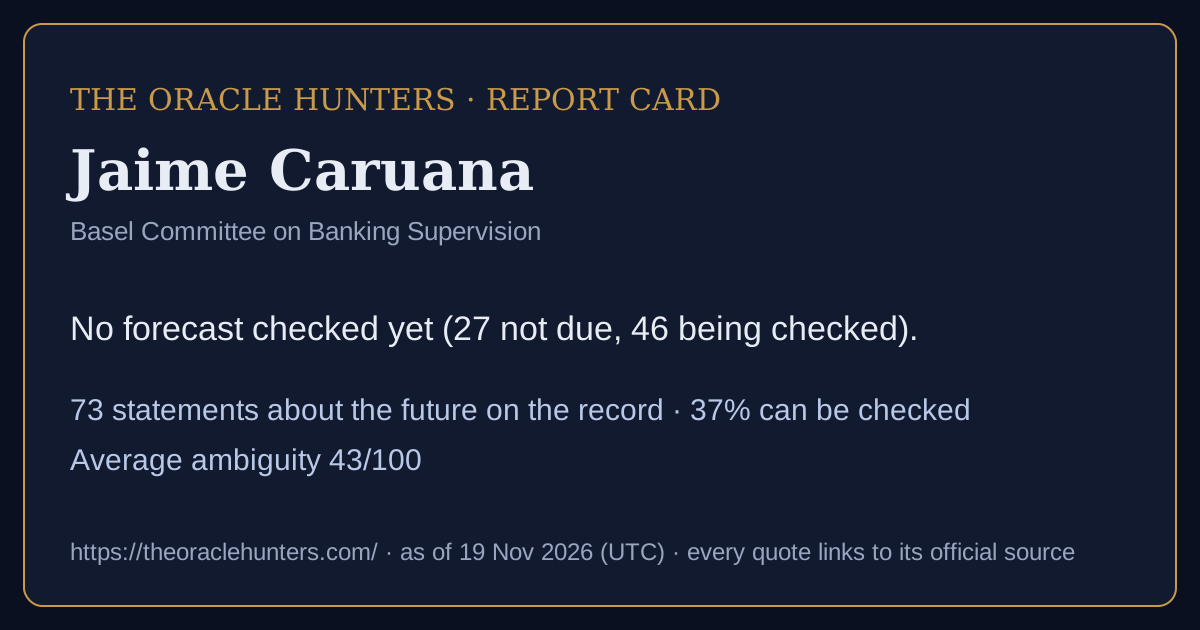
Track record: No forecast checked yet (27 not due, 46 being checked).
73forecasts & commitments on the record
37%can be checked as stated
43average ambiguity (0-100)
0goalpost moves recorded
0confirmed U-turns
Timeline
came true partly did not not due / being checked / too vague
Calibration score: shown after 10 checked forecasts with a stated likelihood (now 0).
How they speak about the future: based on data 50, stated on authority 12, educated guess 11.
Kinds of claim: forecast 47, scenario (if… then) 13, mixed claim 11, commitment 2. · Download this report card as a picture
In the nine words
πρόγνωσιςInference from evidence46 · 63%πρόνοιαPreparing for the future13 · 18%μαντείαInspired knowledge11 · 15%προαναγγελίαPublic pre-announcement2 · 3%εἰκασίαConjecture1 · 1%
How to read this
Each box is one sentence a public figure or institution said about the future, word for word, with a link to the official text. Can be checked means it names what will happen, by when, and how likely - so it can be compared with official figures later. Too vague to check means it does not. Ambiguity (0-100) is how many different ways the sentence can be read. When the date passes, the forecast is compared with official data and marked came true, partly or did not come true. Labels judge the sentence, never the person. Full guide and glossary.On the record (73)
Indeed, the figures for the opening months of this year suggest the marked buoyancy of tax revenue will continue, raising the likelihood that public revenue will once again outpace budgetary projections.
Early this year, further oil price rises were manifest in a fresh increase in inflation in the area, and also made themselves felt in the underlying component, which may denote a growing rootedness of upward pressures.
This pattern will possibly also extend to Japan this year, making it likely that, for the first time in 15 years, there will be a phase of monetary policy tightening in the three major developed areas.
It should be recalled that the entry into force of the EU Financial Perspectives 2007-2013 will entail fewer financial flows from Community coffers.
In this case, and from the perspective of the macroeconomic scenario of sustained growth projected for 2006, the general government surplus should feasibly and desirably stand a few tenths of a point above the 2005 figure, improving on the target of 0.9% set in the last Stability Programme update.
The inflationary outlook for 2006 and 2007 indicates that the rate of change of the HICP may be close to the price stability benchmark of 2%, or might even exceed it again.
Turning now to implementation, the Basel Committee has announced that it will conduct a fifth quantitative impact study beginning next month and running until the spring next year.
Having said that, I should also be clear that Basel II will never be implemented with 100% consistency across borders, just as Basel I is not currently implemented with 100% consistency.
The measures aimed at raising the supply of housing and its accessibility will not be sufficiently effective if they do not include a reorganisation of the land market, which remains one of the main unresolved issues facing the Spanish economy.
Maintaining high levels of job creation is, and will continue to be, a powerful means of expanding the economy's growth potential, but it will be impossible to sustain economic momentum in the long term if the economy does not improve its competitive position in the increasingly dynamic international setting.
And second, the increase in household debt that has accompanied the expansion of consumption and residential investment, which might constrain households' spending capacity, particularly if developments in the housing markets were to prompt any uncertainty about the value of this sector's wealth, which is strongly concentrated in real-estate assets.
There are thus persistent risks and vulnerabilities which, if not corrected, might endanger the continuity of growth.
Although the Accord will not enter into force until 2007, work has commenced on the long and complicated task of development, implementation, internal validation by institutions and review by the Banco de España of these methodologies, at speeds which will inevitably differ depending on the preparedness of the institutions.
Indeed, the initial estimate of the HICP for May (3.1%) suggests it already has done.
In so doing, I believe that we will help achieve our objective of a stable and healthy banking system that contributes to the proper functioning of the economy.
Pillar 3 will thus grease the wheels of the market for bank capital, building up capital providers' and depositors' confidence about the efficient use of their resources and easing the conditions under which banks may gain additional funding if required.
Even if the likelihood of such episodes of macroeconomic distress is low, the considerable implications in the economy and in terms of welfare have led to increasing concern among central banks and much discussion and research on what the monetary policy response to this kind of underlying risk could and should be.
As we are conscious of the workload of this exercise, the Committee does not intend to set data requirements or timeframes for the parallel calculation that will be conducted in 2006.
The calibration of the revised Framework will be discussed in spring 2006 on the basis of QIS 5 data.
The Committee thinks that this early recalibration, in the spring of 2006, will give banks and supervisors more time to reflect and will facilitate implementation.
I expect that the Committee will release a proposal for a six-week period of public comment next month such that the proposals can be released in final form this summer.
In a more risk-sensitive capital framework, capital requirements for an advanced bank may actually rise relative to the current rules if the bank's exposures are actually riskier than the measures under the 1988 Accord would have suggested.
Nonetheless, the Committee recognises that any risk-sensitive capital framework will cause the minimum capital requirement to fluctuate for the same exposure if a borrower's creditworthiness strengthens or weakens.
We are consequently confident that we will issue papers for public discussion on these topics by early April this year so that
Indeed, these considerations were to the fore in the strategy review published last May, as we clarified that the 2% reference for HICP was not only supposed to minimise the risks of deflation in the area but also to take into account inflation differentials across countries.
These rules were further refined in the Stability and Growth Pact, agreed by Member States in 1997, which also introduced the idea that, in order not to breach the 3% limit, the underlying budgets should be balanced in the medium term.
As for prices, at this stage we expect inflation to moderate over the next few months, although changes in indirect taxes and administered prices in some countries may limit the speed of the process.
Therefore, although the lack of harder data in Europe and other areas attesting to this new scenario obliges us to remain cautious, it is now very likely that world growth and trade will expand significantly next year.
While GDP growth was 3.5 % in 2000, it will barely be around half a percentage point this year.
In the review that took place earlier this year the Governing Council confirmed that definition and clarified that, in pursuing its primary objective, it will aim to maintain the inflation rate close to 2%.
I would encourage those interested to read the statement outlining our proposed revision on our website and to share any thoughts you may have by the end of this year.
If supervisors are uncomfortable with the use of external ratings in their countries, they may opt to weight all corporate claims at 100%, while sovereigns and banks can be risk weighted according to the risk scores of export credit agencies.
This seems appropriate, since we expect that, given the very good progress that we have noted in banks preparing to adopt the New Accord, supervisors and the industry will be ready to implement the new rules by the end of 2006.
The project's first phase will be available at the beginning of next year.
In accordance with the mandate of the European Union, these standards will affect the preparation of the annual accounts of groups with securities listed on any regulated market of the Union from 1 January 2005.
Despite these risks, the outlook is for growth in 2004 and 2005 of around 3%, close to the economy's potential, which would be based on a very gradual change in its composition, as productive investment progressively strengthens in response to improved corporate earnings and to the completion of the restructuring currently under way.
The need to increase these efforts has become even more pressing since 11 May this year, when the Basel Committee on Banking Supervision approved the text of the Accord, which will be released at the end of June.
This could mean that capital requirements for an advanced bank may actually rise relative to the current rules if the bank's exposures are actually riskier than the measures under the 1988 Accord would have suggested.
Nonetheless, the Committee recognises that any risk-sensitive capital framework will cause the capital requirement to fluctuate for the same exposure if a borrower's creditworthiness strengthens or weakens.
Consequently, those banks that will adopt Basel II's advanced approaches to risk will be permitted to implement the new rules at year-end 2007, or just one year after the standardised and foundation banks.
The Committee confirmed that the new framework will be implemented by year-end 2006 for those banks adopting the standardised and foundation approaches to risk.
However, we are well on track to resolving outstanding issues by the middle of this year, in line with the time schedule and work plan we set ourselves in October 2003, and to ensuring that the text will provide a solid basis for national implementation processes and the industry's preparations to continue.
That will help all of us to consider the work ahead and make us even better prepared for the implementation of the New Accord by the end of 2006.
That will allow the Committee to meet its goal of resolving outstanding issues by the middle of this year and agreeing on the text of the Accord that will provide a solid basis for national rule-making processes and for the industry's preparations to continue.
The Committee's working groups are refining these and other technical matters in the New Accord and will report their solutions to the Committee by May 2004.
Moreover, whether a country intends to implement the New Accord by the end of 2006 or perhaps later, the Basel Committee recommends that supervisors everywhere encourage their banks to strengthen their abilities to identify, measure, and manage the full range of risks they face through internal processes.
In a statement to the press after our meeting, the members of the Committee noted that we expect to take account of the remaining issues and complete the text of the New Accord in the coming months and not later than mid-year 2004.
By now you may have read that the Basel Committee reached an agreement last month to address the final issues raised in public consultations over the summer and to complete the new rules by mid-year 2004.
In a statement to the press after our meeting, the members of the Committee noted that we expect to take account of the remaining issues and complete the text of the New Accord in the coming months and not later than mid-year 2004.
This seems appropriate, since we expect that, given the very good progress that we have noted in banks preparing to adopt the New Accord, supervisors and the industry will be ready to implement the new rules by the end of 2006.
Showing the newest 50 - the ledger has all 73.
Also said - not checkable as stated (12 newest)
Remarks about the future with no date, figure or likelihood that could be checked. They are kept on the record and shown here, but not scored.
This pragmatic view is consistent with the idea that monetary policy decisions should be based not only on the most likely scenarios but also on other, less probable ones which, however, may have far-reaching implications
Furthermore, the magnitude of the financial funds flowing across different countries at the present time and the uncertainty surrounding the sustainability and the possible effects of an eventual correction of the so-called global imbalances means that central banks worldwide must take a much broader and complex set of indicators into consideration when formulating their policies.
I agree with him on this important point: central bankers should continuously monitor markets and should extract from them as much information as possible.
In any event, one of the most robust lessons we can extract from the recent period of global monetary and output growth stability is that low inflation may well be consistent with episodes of high financial volatility.
Indeed, a long period of monetary stability coupled with low interest rates, as has been the case for some years now, may arguably be conducive to certain types of imbalances in asset markets.
Therefore, an otherwise beneficial context of price stability and low financing costs might sometimes sow the seeds for the emergence of financial imbalances.
I think the examples I have given from the banking perspective show that we are already making some good progress, although there is of course more that could, and should, be done.
It will also facilitate the exchange of information among supervisors, because we will be speaking a more common language.
However, without convergence of the reporting requirements that stem from these standards and approaches, entities will still have to produce and transmit different information, in different formats, to the regulators in the countries in which they are
Speech by Mr Jaime Caruana, Governor of the Bank of Spain, at the 13th XBRL International Conference, Madrid, 16 May 2006.
I guess that, looking from the outside, it might seem somewhat strange that banking supervisors and other regulators are taking such an active interest in a computer language.
In doing so, I will draw on my experience as the Governor of an EU central bank with prudential supervisory responsibilities, and also as the current Chairman of the Basel Committee on Banking Supervision.