Jacques Santer President
European Commission · EU
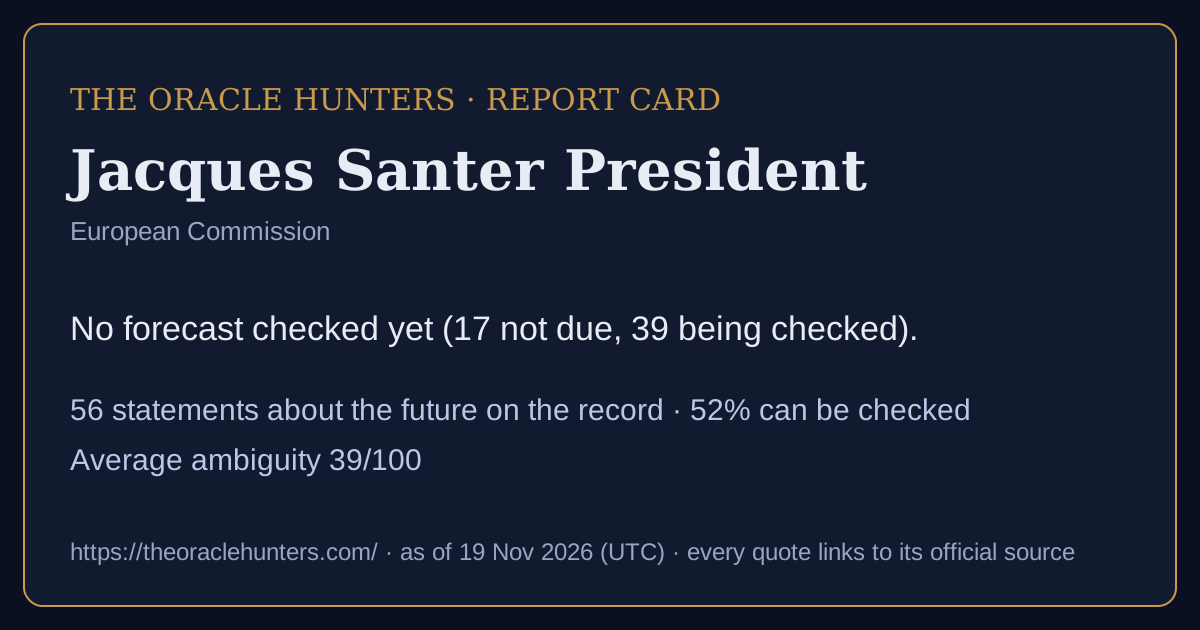
Track record: No forecast checked yet (17 not due, 39 being checked).
56forecasts & commitments on the record
52%can be checked as stated
39average ambiguity (0-100)
0goalpost moves recorded
0confirmed U-turns
Timeline
came true partly did not not due / being checked / too vague
Calibration score: shown after 10 checked forecasts with a stated likelihood (now 0).
How they speak about the future: based on data 41, stated on authority 14, educated guess 1.
Kinds of claim: forecast 44, mixed claim 8, commitment 2, scenario (if… then) 2. · Download this report card as a picture
In the nine words
πρόγνωσιςInference from evidence39 · 70%μαντείαInspired knowledge13 · 23%προαναγγελίαPublic pre-announcement2 · 4%πρόνοιαPreparing for the future2 · 4%
How to read this
Each box is one sentence a public figure or institution said about the future, word for word, with a link to the official text. Can be checked means it names what will happen, by when, and how likely - so it can be compared with official figures later. Too vague to check means it does not. Ambiguity (0-100) is how many different ways the sentence can be read. When the date passes, the forecast is compared with official data and marked came true, partly or did not come true. Labels judge the sentence, never the person. Full guide and glossary.On the record (56)
I hope these recommendations will be discussed openly and thoroughly this year.
We are preparing to take the decisions on Agenda 2000 that will play a decisive role in how we meet up to the challenges of the 21st century and will prepare the Union to take in a substantial number of new Member States.
I will not go into the reforms already carried out as part of the SEM 2000 exercise, but there are three other initiatives I would like to mention here:
This will be very useful for the hearings of the future Members of the Commission which Parliament will organise towards the end of the year.
The question whether we should continue working with it after its contract expires at the end of the year will depend on whether it makes radical improvements in its management.
In July this year we adopted an overall framework for its activities, and in a few days' time that will be followed up with detailed implementation procedures.
The euro area will have a population of almost 300 million and it will enjoy a very substantial share of world GDP and trade.
I would remind you in this connection that in the Commission's view Agenda 2000 can be applied without any financial resources in excess of the current own resources ceiling and hence will not require any urgent amendment of the own resources decision, a process which we all know is highly complex and cumbersome from the institutional angle.
As regards the future size of the net balances of the four countries mentioned, excluding the cost of enlargement, Agenda 2000 may have no more than marginal, and not necessarily negative, effects on their balances.
Next year, the 140 billion ECU electricity market opens up.
And this year's Bertelsmann Forum could offer a major contribution to the debate.
The European Central Bank, whose independence has constitutional rank, will guarantee price stability, defined in operational terms as inflation between 0 and 2%.
It will have nearly 300 million inhabitants, and account for almost 20% of world GDP and of world trade, comparable to the United States.
Thereafter, on 31 December of this year, the conversion rates between the eleven participating currencies and the euro will be fixed.
At the end of the three-year transition period, on the 1st of January 2002, euro bank notes and coins will be introduced and have legal tender.
This has helped putting economic growth back on track: after having climbed to 2.5% in 1997, it is expected to increase to a healthy 3% this year for the euro zone, and to increase again next year.
The extent of this task should not be underestimated: we reckon that 12 billion euro bank notes and some 50 billion euro coins will have to be produced before the 1st of January 2002, when the euro notes and coins will start circulating.
And we will not ignore the longer-term economic issues, which we face and the importance of working for sustainable growth in our two regions.
Compared to the first phase expectations for electricity, more than 50% of the electricity market will be open from next year, compared to a statutory requirement of around 25%.
And although today over 50% of world exports are denominated in dollars (and 80% of transactions in global financial markets), most trade within the EU in the future will be in Euros.
Although, like electricity, the Directive only requires a first step of moderate market opening around 30% for the whole European Union - I believe the market will take over and accelerate it.
The draft Directive is now being considered by the European Parliament, and I am confident it will be adopted in the first half of this year.
Next year it will be 1.10% if our proposals are agreed by the Council and the European Parliament.
Here are the facts: The Directive that has been agreed, which will take effect from next year, requires 25% liberalization in the first phase.
But our figures show that in actual fact, next year more than 50% of EU demand for electricity will be liberalized. 50% of a 145 billion ECU European electricity market.
The Ecofin Council, in agreement with the EMI, has announced on 17 November that the 1st of January 2002 will be the date of the introduction of the notes and coins.
Most Member States will have adopted their plans before the end of the year.
At unchanged policies, the average deficit will be under 2% in 1999.
– Then there is the argument about labour mobility: if there is a temporary shock, should one expect the labour force of one country to move to another and come back the next year when the situation has improved?
The EU average is likely to be 3% of GDP this year down from 6.3% in 1993.
The decision on which Member States will adopt the euro from the outset will be made in Spring of next year when all the relevant economic data are available on a reliable basis.
Another question that has been posed concerns the issue whether financial-market speculation might affect the functioning of EMU in the period 1999 to 2002, when the euro and national currencies will co-exist.
In this way, the Pact ensures that Member States will have sufficient scope for letting their own budgets contribute to stabilisation up to a budget deficit limit of 3% of GDP in normal circumstances.
It is therefore clear that all Member States are making progress in reducing budgetary imbalances and I am confident that the majority will have achieved sufficient budgetary convergence to qualify for adoption of the euro, when the decisions are taken in the Spring of next year.
For this year, the European Commission expects the average to be down to 2.7%.
If this is done, and with the economic situation picking up, in five years we could increase the current 60% employment rate to 65% and cut the current 11% unemployment rate to 7%, thus creating 12 million new jobs.
A further 20 billion ECU will be available via the Cohesion Fund to those Member States where per capita income is less than 90% of the European Union's GDP.
This decision will be taken in April or May next year, during the United Kingdom's Presidency of the European Union.
In Luxembourg, last weekend, Finance Ministers agreed to announce in May next year the bilateral conversion rates for future members of the single currency when the list of members is drawn up.
Overall, we propose 230 billion ECUs of expenditure on cohesion for the 15 Member States between 2000 and 2006, of which around 60% will be for regions with low incomes.
It is for this reason that the Commission envisages less than 100% compensation, justified by the fact that according to our forecasts market prices will continue to be higher than institutional support prices.
As regards economic and social cohesion, the total amount available for the period 2000-2006 will be ECU 275 billion, of which ECU 45 billion is earmarked for the new Member States.
Allow me to quote you some figures concerning the financial implications of Agenda 2000: the further reform of the common agricultural policy will, at the end of the period, involve a net additional cost of around ECU 4 billion per year.
In terms of actual amounts this will mean an allocation of ECU 230 billion for the period 2000-2006 for the present fifteen Member States and ECU 45 billion for the new Member States.
Allow me to repeat my opening comments: Agenda 2000 sets out to deal with all the issues which the European Union will have to address at the start of the 21st century.
The new financial framework which will apply from 2000 onwards will have to cover a sufficiently long period, finance both the deepening of our policies and enlargement, and guarantee sound management of public finances.
In addition, more than 60% of the current external transactions of the EU Member States will become domestic transactions in the monetary union (if 15 member states participate).
By the end of 1995, 48% of capital exports were expressed in dollars, 39.8% of portfolio holdings were in dollars and 83% of all transactions on exchange markets had the dollar as a counterpart.
The 'Stability and Growth Pact' will guarantee budgetary discipline amongst the members of the euro zone using a system of multilateral surveillance and sanctions if targets are not met.
· the rate of growth of international portfolios (which have grown by 300% in the ten years up to 1995), and the other important changes taking place in the international economy, like the emergence of major new players, means that euro-related portfolio shifts will be only one feature of international developments in future years.
Showing the newest 50 - the ledger has all 56.
Also said - not checkable as stated (12 newest)
Remarks about the future with no date, figure or likelihood that could be checked. They are kept on the record and shown here, but not scored.
First there will be the reconstruction phase where the Commission will have a coordinating role alongside the World Bank, for which it will need to be properly supported and resourced.
It is nonetheless clear that alongside the requisite budget consolidation, Europe will also need to speed up the structural reforms of the employment, goods, services and capital markets.
At the instigation of the German Presidency we will be taking a further step towards the European Employment Pact which I called for back in 1996.
The Union will then need to devote itself to defining a genuine strategy for stability in the Balkans.
Following the progress made at the Atlantic Alliance summit in Washington, the European Union will need to adopt a solid stance.
In the meantime we will seek to ensure a smooth transition.
We will comply with our institutional and legal obligations and I deem it of the interest of all institutions that interinstitutional relations are not disrupted.
The future Commission will have to go further.
There is no doubt that budgetary discipline is necessary, but it should not become an end in itself with no attention being given to what we actually expect Europe to be able to do.
A compromise will have to be worked out in Berlin.
As always in the Union, we will find transitional solutions that enable us to avoid excessively brutal shocks.
So now we can sketch an outline within which a compromise will have to be found, taking into account the fact that some of our financing mechanisms were devised at a time when enlargement to include central and eastern Europe was no more than a distant prospect.