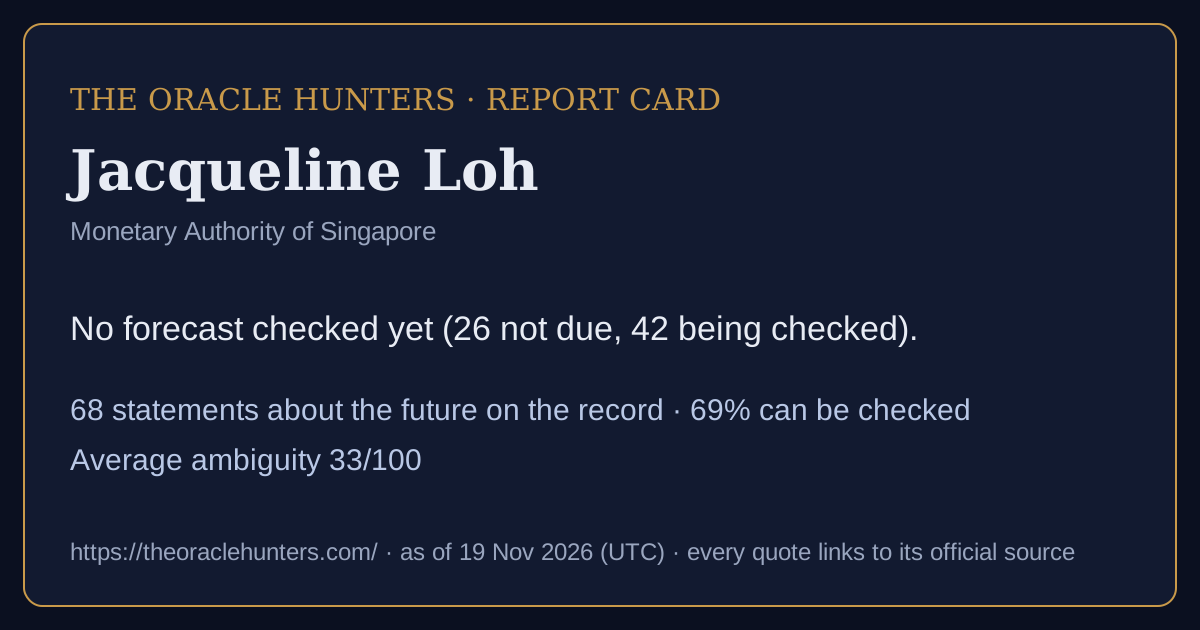
Jacqueline Loh
Monetary Authority of Singapore
Track record: No forecast checked yet (26 not due, 42 being checked).
68forecasts & commitments on the record
69%can be checked as stated
33average ambiguity (0-100)
0goalpost moves recorded
0confirmed U-turns
Timeline
came true partly did not not due / being checked / too vague
Calibration score: shown after 10 checked forecasts with a stated likelihood (now 0).
How they speak about the future: based on data 59, stated on authority 8, educated guess 1.
Kinds of claim: forecast 60, mixed claim 6, scenario (if… then) 1, commitment 1. · Download this report card as a picture
In the nine words
πρόγνωσιςInference from evidence57 · 84%μαντείαInspired knowledge8 · 12%προαναγγελίαPublic pre-announcement1 · 1%πρόνοιαPreparing for the future1 · 1%εἰκασίαConjecture1 · 1%
How to read this
Each box is one sentence a public figure or institution said about the future, word for word, with a link to the official text. Can be checked means it names what will happen, by when, and how likely - so it can be compared with official figures later. Too vague to check means it does not. Ambiguity (0-100) is how many different ways the sentence can be read. When the date passes, the forecast is compared with official data and marked came true, partly or did not come true. Labels judge the sentence, never the person. Full guide and glossary.On the record (68)
In the next five years, the IMF projects 5.2% average annual growth for the region, compared to 3.2% for the rest of the world.
OECD expects it to hit US$5.6 trillion by 2035 .
The World Bank forecasts global growth at 4.0% this year; with growth in East Asia at 5.9%.
While large swathes of the world are gripped by renewed waves of COVID-19 infections today, effective vaccination programmes and unprecedented policy support are expected to support a strong recovery in the second half of 2021.
By 2025, Asia's share of global GDP is expected to reach 38%, up from 26% 20 years ago.
W e will announce m ore details before the end of this year.
- For borrowers, the averaging effect from compounded SORA will provide more stable rates, compared to single-day SOR readings, which is exposed to idiosyncratic market factors, such as quarter- or year-end volatility.
- Following the strong market response to MAS' inaugural S$500 million SORA FRN issuance, we will expand this programme, through increasing the issuance sizes and lengthening the range of tenors.
A bank that adopts a 'wait and see' attitude and leaves things till next year, is likely to find itself with too much on its plate before the end-2021 deadline.
- Samuel will be sharing more on the SC-STS transition roadmap later, and will also chart out what needs to be done in the remaining 15 months to end-2021.
- around 12,000 SOR contracts in SGD cash markets, amounting to S$95 billion, will mature after end-2021, and will need to transition. 8
For the full year, GDP growth is projected at -7% to -5%. 5
As the IBF Credit and training allowance support will expire on 31 Dec 2020, we are looking into extending these measures into next year, so as to provide longer term certainty and support for business and
The World Bank's pandemic bond facility has been triggered, and will provide US$195 million in emergency financing to 64 of the world's poorest countries to support their recovery. 3
- We will issue a consultation paper on MAS' Environmental Risk Management Guidelines for the banking, insurance, and asset management sectors later this year.
The IMF has projected that global GDP will contract by 3% this year , marking a significantly deeper downturn than the 0.1% contraction in 2009 during the Global Financial Crisis. 1
- The IMF's 2019 global growth forecast was lowered to 3.2%, as cited in the World Economic Outlook, July 2019.
China has estimated that it will require US$450-600 billion of investments annually to achieve its green policy goals under its 13th Five Year Plan while ASEAN will need an estimated US$200 billion in green investments annually through 2030 .
Assets under management in the Asia Pacific is expected to increase faster than any other region globally, almost doubling from 2017 to about US$30 trillion in 2025.
According to the IMF, the major ASEAN economies are expected to continue outperforming emerging markets and developing economies as a whole, with projected GDP growth of about 5.0% annually for 2019-2020 .
United Nations has estimated that economic losses due to catastrophe events in Asia Pacific are set to rise, and could exceed US$160 billion annually by 2030.
As UPI's first cross-border tie-up with another nation's mobile wallet - NETS' NETSPay platform - this will allow Chinese customers to pay at NETS merchants in Singapore while Singapore's NETSPay users can make mobile payments at over 8 million merchants in China.
- 25 If we can do well in these two key areas, it will position our FX market and participants to capture growth opportunities and serve the needs of the Asian markets.
- 18 SFEMC will also be establishing a public register in the second half of this year, for market participants in Singapore to post their Statements.
- In addition, the GFXC launched a Global Index of Public Registers (or the Global Index) in May this year, which links these public registers.
Disasters could cost A sia-Pacific region $160 billion per year by 2030, UN warns, UNESCA P, 2018 2
Economic losses in Asia Pacific is projected to exceed US$160 billion annually by 2030 .
Digital payments in Asia are forecasted to grow annually at 16.4% to reach over USD 2.5 trillion per year in 2022.
Google and T emasek estimated that e-commerce in ASEAN could amount to USD 88 billion in 2025 .
A lot of commerce and e-commerce is carried out across borders today: Cross border e-commerce alone is expected to expand strongly, by approximately 25% annually until 2020, nearly twice the growth rate of domestic ecommerce .
About 60% of ASEAN infrastructure projects have benefitted from project finance or advisory services of Singapore-based banks.
- Advanced Economies are expected to grow at an average of 1.8% over 2017-2022. 3
Bank of China Singapore branch recently issued RMB 4 billion (USD 600 million) of BRI bonds in May this year.
The IMF places Emerging Asia at the top of the global growth league table, with average growth rates of 6.3% p.a. from now to 2022 , outstripping expected outturns in the developed economies as well as all other developing regions.
The Asian Development Bank estimates that developing Asian countries will need to invest USD 1.7 trillion annually in infrastructure till 2030 to fulfil its medium- to long-term growth potential.
- Thus far, a number of the largest FX market participants have indicated that they will be signing the Statement by May 2018.
- The survey will take place annually and the first survey will be conducted in 4Q this year, to form the baseline for monitoring progress.
- The GFXC was launched in May this year, together with the publication of the Code.
Within the region, domestic demand has generally been resilient and overall growth this year will receive additional support from the stronger performances of export industries.
China's banking system could grow to become the largest in the world within 4 years by 2020 . 5
HNWI growth in Asia-Pacific has doubled over the decade and if the trend persists, Asia-Pacific will represent two-fifths of the world's HNWI wealth by 2025. 9 10
- Some analysts estimate that the size of the financial system in Asia could reach USD 200 trillion by 2030.
By 2030, Asia will represent almost two-thirds of the global middle-class population and almost 60% of middle-class consumption. 4
- OECD estimates that the size of the global middle class will increase to 4.9 billion by 2030.
By 2014, this had increased to 38.8%, much larger than the shares of the U.S. and the E.U. If current growth trends continue, Oxford Economics forecast that Asia's share will reach nearly 45% by 2025 . 3
Qualifying Asian issuances will be able to offset up to 50% of one-time issuance costs such as international legal fees, arranger fees and credit rating fees.
This reflects a more than three-fold increase to 3.6 billion persons in 2030, and will continue to drive the need for long-term investment for retirement. 11
Asia will need USD 8 trillion of infrastructure by 2020 , and within that, ASEAN will need USD 110 billion a year in infrastructure investment through 2025 .
Two years on, in 2016, the IMF has lowered its forecast for the current year further to 3.1%, reflecting a more subdued outlook for advanced economies, before recovering to 3.4% in 2017 .
T o make it more attractive for Asian issuers to raise international capital in Singapore and benefit from the ecosystem here, we will introduce an Asian Bond Grant scheme next year.
Showing the newest 50 - the ledger has all 68.
Also said - not checkable as stated (12 newest)
Remarks about the future with no date, figure or likelihood that could be checked. They are kept on the record and shown here, but not scored.
- We will work with a consortium of financial institutions, FinTech firms, and industry players with expertise in Green FinTech, and also look forward to partner with like-minded central banks who are committed to harnessing the power of innovation to support sustainable finance.
I congratulate the BIS on the success of this inaugural BIS Innovation Summit; which demonstrates the central banking community's strong commitment to innovation, so that we may better serve our stakeholders.
- This integrated solution, which has the potential to be scaled across supervisory authorities, will be a tangible example of a global public good that the BIS Innovation Hub can deliver for the benefit of the central banking and supervisory communities.
For example, Internet-of-Things (IoT) devices could be deployed on-site to directly capture and assess relevant real-time data, such as energy and water consumption, by borrowers, portfolio companies, and suppliers.
- It will also explore the application of AI and other technologies on third-party data sources, to quantify the ESG impact of potential investments and loan portfolios.
Firstly, why central banks should embrace innovation;
- Jobs will need to be redesigned and transformed to harness the potential of technology and financial institutions would need to support employees to adapt to new work requirements;
We have to expect that new job creation in the financial sector will slow, while retrenchments are likely to pick up.
- Therefore, jobs will need to be redesigned and transformed too, and employees will need to acquire new skills and adapt to new work requirements.
We may not emerge from COVID-19 soon, and should take this period of slower growth to help our people and businesses build longer-term capabilities.
- With more global and regional functions anchored here and as the sector transforms with digitalisation and new growth engines, FIs might need to bring in foreigners with the experience and skills that are not yet available locally.
- We will also be anchoring centres of excellence in Singapore, to undertake quality green finance research and talent development, with strong customisation and applications for Asia's transition needs.