Ivan Iskrov
Bulgarian National Bank
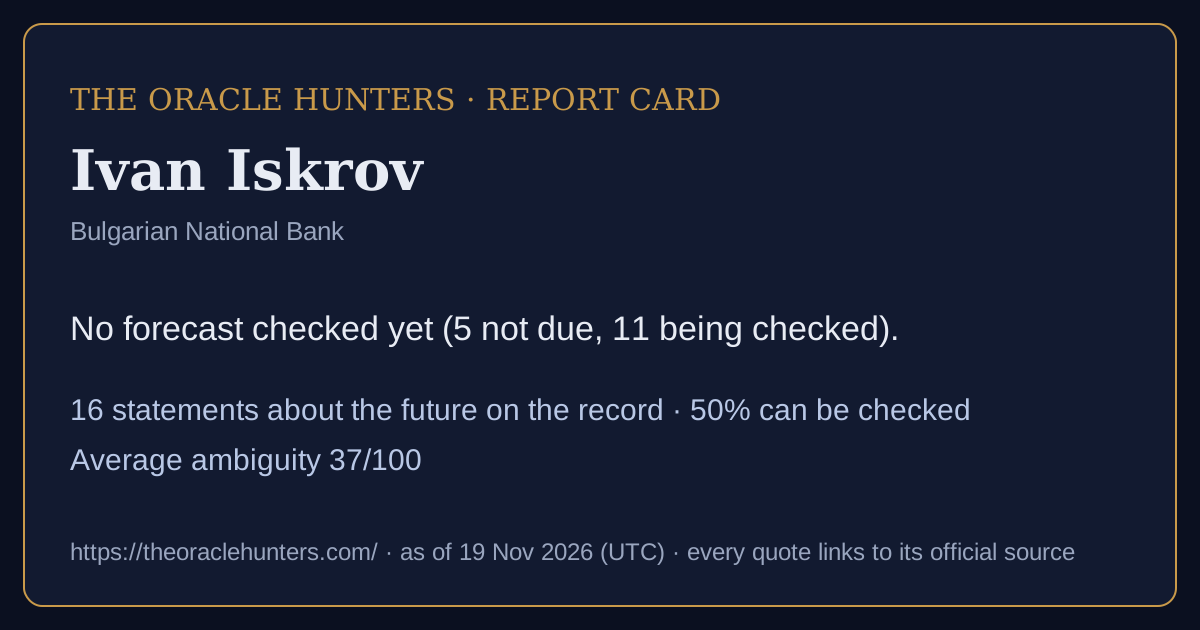
Track record: No forecast checked yet (5 not due, 11 being checked).
16forecasts & commitments on the record
50%can be checked as stated
37average ambiguity (0-100)
0goalpost moves recorded
0confirmed U-turns
Timeline
came true partly did not not due / being checked / too vague
Calibration score: shown after 10 checked forecasts with a stated likelihood (now 0).
How they speak about the future: based on data 14, stated on authority 2.
Kinds of claim: forecast 14, mixed claim 1, scenario (if… then) 1. · Download this report card as a picture
In the nine words
πρόγνωσιςInference from evidence13 · 81%μαντείαInspired knowledge2 · 12%πρόνοιαPreparing for the future1 · 6%
How to read this
Each box is one sentence a public figure or institution said about the future, word for word, with a link to the official text. Can be checked means it names what will happen, by when, and how likely - so it can be compared with official figures later. Too vague to check means it does not. Ambiguity (0-100) is how many different ways the sentence can be read. When the date passes, the forecast is compared with official data and marked came true, partly or did not come true. Labels judge the sentence, never the person. Full guide and glossary.On the record (16)
At the same time, let us use the recapitulation of this year as a starting point of reflection about the challenges that may lie ahead.
In 2015 it is expected that the EU-wide banking supervision rules will become more and more common in banking practices.
In 2015 the Bank Recovery and Resolution Directive in the EU will come into effect, aiming to introduce EU-wide rules and tools for the Member States to deal with banks in trouble and to take timely and adequate measures to rescue viable institutions.
Could it be, however, that in 2015 we would witness a radical change in the thinking and actions of the political representatives and media circles towards more prudence and better awareness of the key role the banking sector has for the financial stability, economic growth and welfare of society?
Because most likely in 2015 as well the banking community
We expect the sector to end 2014 at a positive financial result of circa BGN 700 million (i.e. above last year's result).
Our country can ill afford to do without the banks' considerable positive contribution to economic growth - which will be the effect, unfortunately, if the policymakers succumbed to certain populist sentiments that have been promoted recently by some figures who would use every occasion to come onto the media stage.
As a logical outcome, the stability of the banks in Bulgaria has won the confidence of domestic depositors - by the end of February the deposits of households increased year on year by 13.2%.
Based on the current projections for a recession in the euro area, we expect that the growth rate of the Bulgarian economy would slow down to about 0.7% in 2012, and this would have a direct impact on the potential of banks in Bulgaria to generate incomes from sources of their own.
This year, too, will be rich in new challenges.
We at the Central Bank are well aware that it could be possible for some of the local candidates for glory - the eternal candidates to come back on the big political scene - to actively try and 'sell fear' during the elections year 2011.
In the current year, while sustaining the effect of already implemented measures, we expect banking credit to grow with a rate below or near 20%.
To illustrate the large scale of this process, I will give Bulgaria as an example, where the capital inflow (in the form of direct investment and debt) was 1.5% of GDP in 1998, and in the recent two years it approximates 15% of GDP.
This year, inflation is expected to decline to 6.0%.
This year, the current account deficit is expected to drop below 11 % of GDP, mainly due to the slowed down growth of imports, and the recovery of exports growth, which has been evidenced since the last quarter of the previous year and the beginning of 2006.
As the change in indirect taxes and administered prices has a direct effect on domestic inflation, their catching-up adjustment should be effected before the years during which they will be used as basis for evaluation of compliance with the Maastricht criteria - i.e. before 2008.
Also said - not checkable as stated (12 newest)
Remarks about the future with no date, figure or likelihood that could be checked. They are kept on the record and shown here, but not scored.
The scale of reforms in the regulatory framework for the banking industry, after the collapse of Lehman Brothers and the outbreak of the euro area sovereign debt crisis, could be compared only with the major reforms undertaken in the aftermath of the Great Depression in the 1930s.
What caused the recent wave of banking reforms, what issues regulators still need to consider, and how are banks expected to respond on a global or national level?
Such questions will be discussed during the first panel of our conference by our renowned key speaker Professor Martin Hellwig, Director of the Max Planck Institute for Research on Collective Goods and Vice-chair of the ESRB Advisory Scientific Committee, and by his distinguished discussant Professor Marek Belka, President of the National Bank of Poland.
His presentation will be discussed by our highly respected colleague and long-time Governor of the Central Bank of Luxembourg, currently Member of the Executive Board of the ECB, Mr. Yves Mersch.
They will talk about the new challenges in the governance and accountability of central banks, the compatibility of traditional and recently assumed goals, as well as about newly emerging reputational, communication or related issues.
The discussions today will also be facilitated by our well-known colleagues Professor Boris Vujčić, Governor of the Croatian National Bank, and Mr. Kalin Hristov, Deputy Governor of the BNB.
But I am sure the contributions by my colleagues from the BNB will clearly illustrate during this conference that the currency board is something more than just a monetary policy regime.
The reason for this is the fact that there has always been, and there will always be, a strong interconnection between the state of the public finances and the quality of the banks' balance sheets.
As deputy governor Simeonov will detail later at this conference, the BNB has mastered and tested successfully a long list of both 'macro' and 'micro' bank supervision instruments.
The ongoing financial and sovereign debt crisis has sparked a need to reassess the existing economic governance structure and to come up with options for better policies.
Fiscal policy must play a vital buffer and corrective role in a small open economy.
Still, we should in no way take comfort in the external origin of the crisis because no matter what the origins of the crisis might be, we, here in Bulgaria, must deal with its consequences.