Ipumbu Shiimi
Bank of Namibia
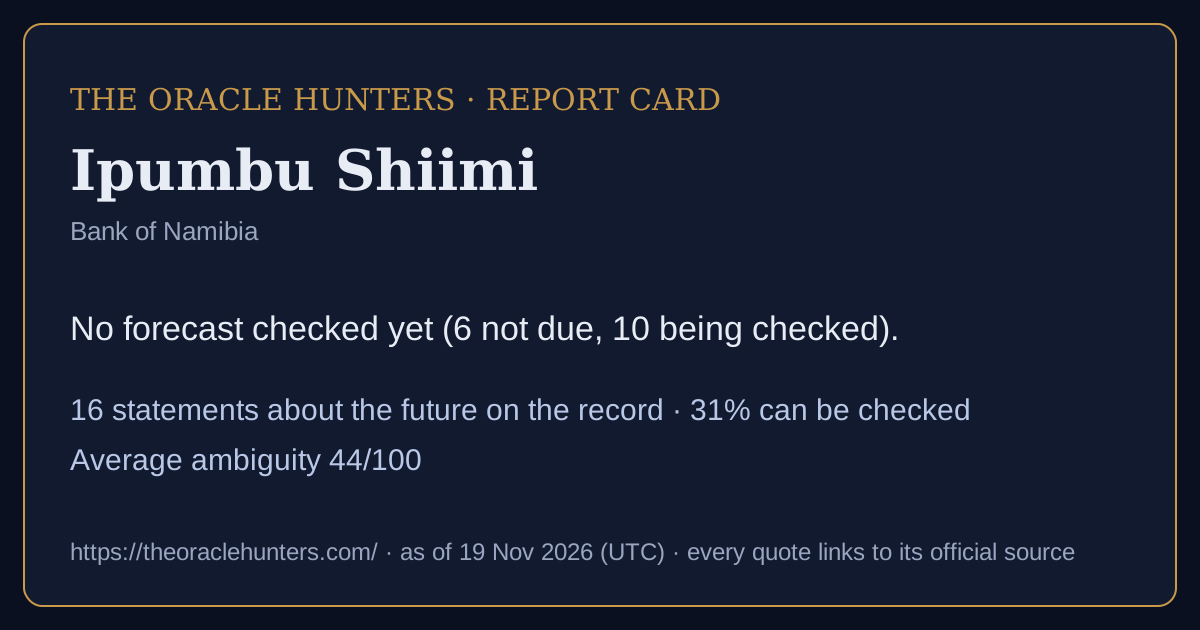
Track record: No forecast checked yet (6 not due, 10 being checked).
16forecasts & commitments on the record
31%can be checked as stated
44average ambiguity (0-100)
0goalpost moves recorded
0confirmed U-turns
Timeline
came true partly did not not due / being checked / too vague
Calibration score: shown after 10 checked forecasts with a stated likelihood (now 0).
How they speak about the future: based on data 15, educated guess 1.
Kinds of claim: forecast 14, scenario (if… then) 1, mixed claim 1. · Download this report card as a picture
In the nine words
πρόγνωσιςInference from evidence14 · 88%εἰκασίαConjecture1 · 6%πρόνοιαPreparing for the future1 · 6%
How to read this
Each box is one sentence a public figure or institution said about the future, word for word, with a link to the official text. Can be checked means it names what will happen, by when, and how likely - so it can be compared with official figures later. Too vague to check means it does not. Ambiguity (0-100) is how many different ways the sentence can be read. When the date passes, the forecast is compared with official data and marked came true, partly or did not come true. Labels judge the sentence, never the person. Full guide and glossary.On the record (16)
Going forward, the Bank of Namibia forecast the economy to grow by 0,6%, slightly better than last year's contraction.
By 2022, Namibia expects to have a diversified and competitive tourism sector and increase the number of tourists' arrivals from 1.4 million in 2015 to 1.8 million.
The FLI is currently planning a follow-up survey this year which will show us how much progress we have made since the last survey in 2013.
The aim of this strategy is to reform Namibia's financial sector to ensure that Namibia will have an effective, efficient, stable, competitive, resilient and inclusive financial sector by 2021.
We believe these regulations will be in force before the end of the year.
As you may recall, in 2011, the Bank with the banking industry launched the National Payment System (NPS) Vision 2015 document.
We will not stop here, Director of Ceremonies, but will continue to look at other bank fees and charges that warrant further attention in line with the Payment System Vision 2015, launched some time ago.
The question is; what will the impact be if it is not 30 per cent, but 80 per cent of the communal land?
This may potentially unlock a sizable investment equivalent to 7 per cent of GDP, almost equal to the current contribution of the mining sector to GDP.
In Namibia, these assets could amount to N$20 billion representing about 23 per cent of GDP.
The Namibian Financial Sector Strategy 2011-2021, which was endorsed by Cabinet will be launched before the end of December.
These standards will be fully complied with on the post machines side by 2012 and on the cards side by 2015.
Therefore the Bank looks forward to the continued co-operation of PAN, the Banking Association of Namibia and other stakeholders as we tackle the challenges that lie ahead in an effort to implement a world-class payment system, which will meet the needs of the domestic economy and comply with international best practices by 2015.
Over the next few years ending in 2015, the Bank will be targeting products, fees and charges that have hindered Namibia from moving towards a more financially inclusive economy: These are:
The NCCI Namibian Business Climate Survey of 2009 indicates that about 55 percent of informal business could not access credit, and 37.1 percent of those that had access to credit, obtained this from friends and relatives.
Instead, I chose to talk about financial inclusion as one of the key strategies that will help us to address our challenges and ultimately realise Vision 2030.
Also said - not checkable as stated (12 newest)
Remarks about the future with no date, figure or likelihood that could be checked. They are kept on the record and shown here, but not scored.
One of you will be studying agriculture (Food Science) a sector that is pivotal to growing the manufacturing capacity of the country and reduce its reliance on importing food, the importance of the sector cannot be over-emphasized.
We therefore need to work hard to achieve that growth.
The question then is: what should Namibia do to increase growth and create employment?
Or in other words, what sectors should we focus on to increase growth and employment?
Our expectations are that within the next two years the remaining banks should follow-suit to by either listing on the Namibia Stock Exchange or through private placements.
More importantly, the Financial Services Adjudicator Bill which will handle complaints against financial institutions has been developed and tabled in the National Assembly.
The Adjudicator will cater for consumer concerns related to both banks and non-bank financial institutions under one roof.
Bank of Namibia and NAMIFISA are also currently working on the Consumer Credit Bill which will regulate all consumer credit related issues and consolidate outdated laws regulating credit such as the Credit Agreements Act of 1980 and the Usury Act of 1968.
Equally, it is pleasing to learn that Letshego Namibia is considering to list of the NSX, a move which will open doors for the ownership of the group to many Namibians and at the same time improving the Namibian capital markets.
As you may recall, on 19 August 2013, I officiated at the Credit Information Sharing Workshop held in Windhoek organised by FinMark Trust.
The purpose of the Workshop was to explore potential approaches and actions that could improve the quality and flow of credit information in Namibia for the benefit of credit providers and, ultimately, their consumers.
As you may be aware, Namibia did not previously have legislation for regulating credit bureaus.