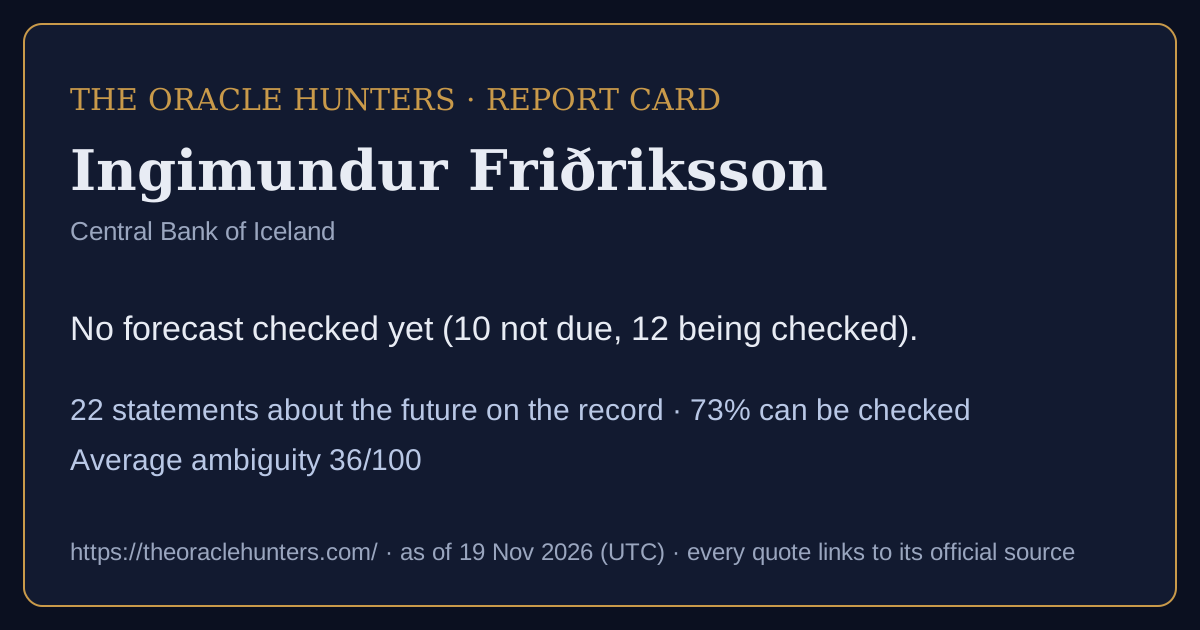
Ingimundur Friðriksson
Central Bank of Iceland
Track record: No forecast checked yet (10 not due, 12 being checked).
22forecasts & commitments on the record
73%can be checked as stated
36average ambiguity (0-100)
0goalpost moves recorded
0confirmed U-turns
Timeline
came true partly did not not due / being checked / too vague
Calibration score: shown after 10 checked forecasts with a stated likelihood (now 0).
How they speak about the future: based on data 15, stated on authority 4, educated guess 3.
Kinds of claim: forecast 16, mixed claim 3, scenario (if… then) 3. · Download this report card as a picture
In the nine words
πρόγνωσιςInference from evidence14 · 64%μαντείαInspired knowledge4 · 18%πρόνοιαPreparing for the future3 · 14%εἰκασίαConjecture1 · 5%
How to read this
Each box is one sentence a public figure or institution said about the future, word for word, with a link to the official text. Can be checked means it names what will happen, by when, and how likely - so it can be compared with official figures later. Too vague to check means it does not. Ambiguity (0-100) is how many different ways the sentence can be read. When the date passes, the forecast is compared with official data and marked came true, partly or did not come true. Labels judge the sentence, never the person. Full guide and glossary.On the record (22)
The economic adjustment ahead will be sharp, but if the global economy makes a gradual recovery, Iceland should be well equipped to return to sound economic growth at the end of that adjustment.
In addition to this, the report shed light on the banks' very large re-financing needs in the next few years: They would need to re-finance 35 billion euros in foreign bonds through 2012, including 17 billion in 2009 and 2010.
Finally, if the housing component were removed from the index now, inflation would probably measure higher than otherwise in the period ahead, assuming that house prices increase by less than the general price level, as has been forecast for some time.
This will narrow somewhat this year and is forecast to decline slowly but surely.
The forecast published in July implied that the policy rate would be lowered in the first half of 2008.
The current measurement is just over 4%, while underlying inflation is likely to be in the range 6-7%.
In its Monetary Bulletin published in July this year, the Central Bank forecast that inflation would be close to target in 2008 and it would be attained in full in 2009.
Despite lower inflation than in the Bank's July forecast, there was still no sign that the target would be attained within two years if the effect of indirect tax cuts on headline CPI in the first half of 2007 was ignored.
This was the eighteenth hike since May 2004; prior to that, the policy rate had been held at 5.3% for more than a year.
The scenario today is that commercial bank analysts expect the cycle of policy rate cuts to begin later this year than they were forecasting towards the end of 2006.
Cuts in indirect taxation will bring down headline inflation very rapidly over the next few months, although the reduction in underlying inflation will be slower.
If inflation looks likely to exceed the Bank's target limits in a long-term perspective, the Bank will raise its policy interest rate, or cut this rate if inflation is heading below the target limit.
Considering the new circumstances and the altered outlook due to the expected major development and resulting influx of foreign currency, barring unexpected changes the Central Bank will very likely continue its regular purchases of foreign currency on the domestic interbank market even after reaching the ISK 20 billion point.
In this connection it could be mentioned that, based on the predictions on performance made by financial enterprises, the contribution margin in fisheries companies will be fairly good this year, although not as good as in 2001 and 2002, which were quite exceptional.
When this decision was announced, it was stated that the Bank intended to purchase the equivalent of ISK 20 billion of currency by the end of 2003.
The Central Bank's foreign currency reserves are currently ISK 36 billion (USD 460 million) and it could be argued that they need to be considerably greater.
The Bank's latest forecast predicts that inflation will be slightly below this mark during the next two years, or just over 2%.
On the basis of the new inflation forecast and national economic forecast, the Central Bank announced a cut of 0.5 percentage points in the policy interest rate on February 10.
The effect will not begin to be felt to any extent until well into next year and the bulk of construction work will take place in 2005 and 2006.
On the basis of this and the new economic forecast, the Governors announced a cut of 0.5 percentage points in the Bank's policy rate last Monday.
In this context it is important to remember that relatively little development will take place in east Iceland this year and for most of next year.
The forecast assumes that inflation will be below the Bank's target over the next two years.
Also said - not checkable as stated (8 newest)
Remarks about the future with no date, figure or likelihood that could be checked. They are kept on the record and shown here, but not scored.
Ultimately, the Government decided that the Treasury should acquire a majority holding in Glitnir, but before that could be finalised, the bank collapsed.
In May 2008, the central bank entered into swap agreements with other Nordic central banks, in an effort to secure liquid foreign exchange should the need arise.
The Treasury was virtually debt-free on a net basis when the crisis struck but will now have to take on large debt, the exact amount of which cannot yet be estimated with any certainty because the government's total deposit insurance liability is still undetermined.
It contained the following statement: 'The Central Bank underlines that global market conditions can take a sudden turn for the worse and it is important to be on the alert and prepared for such a contingency.' The report goes on to say: 'The current episode of ample liquidity and lower interest rates which has been ideal for riskseeking investors may …
A landmark was reached this year when the Bank began publishing its staff's projection for the policy rate path that is compatible with attaining the inflation target within an acceptable timeframe.
In this context it must be remembered that without a tight monetary stance and high interest rates, the króna would probably have depreciated by more than it actually did, demand would have grown faster and inflation moved much higher.
Confidence in the exchange rate will be a crucial factor over the coming months.
One of the standard assumptions behind the forecast is an unchanged exchange rate from the forecasting day, and it should be borne in mind that it did not take into account the interest rate cut which was announced on February 10.