Ida Wolden Bache
Norges Bank
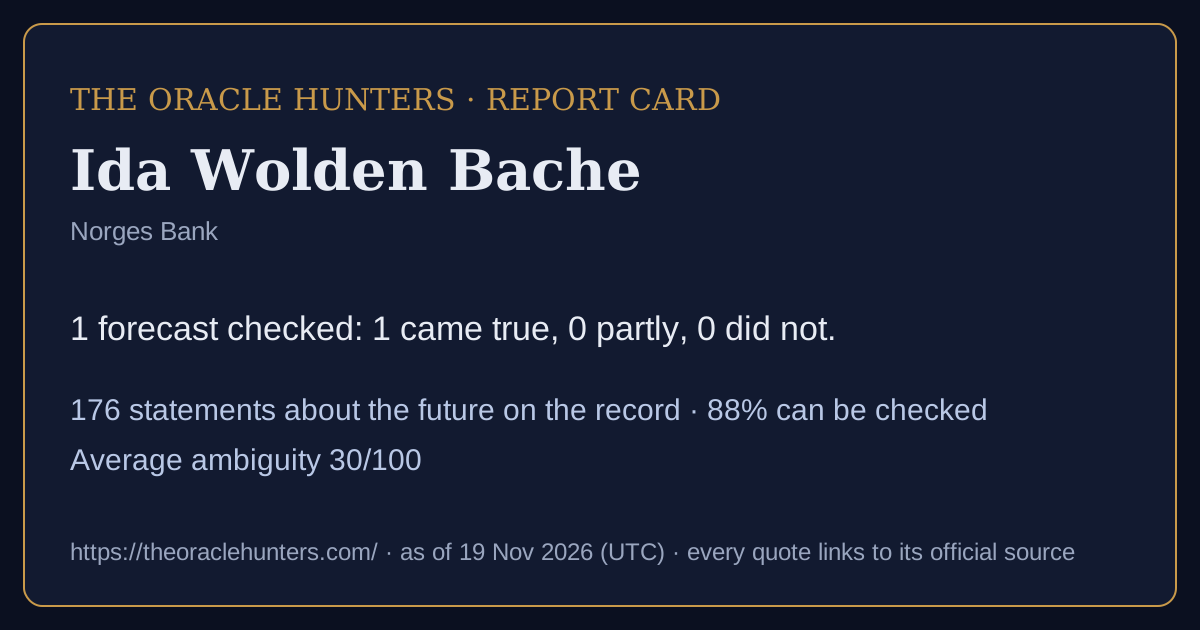
Track record: 1 forecast checked: 1 came true, 0 partly, 0 did not.
176forecasts & commitments on the record
88%can be checked as stated
30average ambiguity (0-100)
0goalpost moves recorded
0confirmed U-turns
Timeline
came true partly did not not due / being checked / too vague
Calibration score: shown after 10 checked forecasts with a stated likelihood (now 1).
How they speak about the future: based on data 90, stated on authority 47, educated guess 39.
Kinds of claim: forecast 117, scenario (if… then) 37, mixed claim 14, commitment 8. · Download this report card as a picture
In the nine words
πρόγνωσιςInference from evidence87 · 49%μαντείαInspired knowledge39 · 22%πρόνοιαPreparing for the future36 · 20%προαναγγελίαPublic pre-announcement8 · 5%εἰκασίαConjecture5 · 3%φρόνησιςPractical wisdom1 · 1%
How to read this
Each box is one sentence a public figure or institution said about the future, word for word, with a link to the official text. Can be checked means it names what will happen, by when, and how likely - so it can be compared with official figures later. Too vague to check means it does not. Ambiguity (0-100) is how many different ways the sentence can be read. When the date passes, the forecast is compared with official data and marked came true, partly or did not come true. Labels judge the sentence, never the person. Full guide and glossary.Checked
With the current path of the policy rate, inflation is projected to come down faster this year and to approach target in the course of the coming years.
Came true. Said: inflation would fall in 2024. Official figures for Norway: 5.5% in 2023, 3.2% in 2024 (World Bank open data). official data · checked 14 Nov 2026 · automatic check against official data (rules v3)
On the record (176)
Wage growth is expected to be lower this year than in 2025 and to slow further in the years ahead.
Inflation is projected to slow from next year and move down to 2 percent in 2029.
However, if expectations of higher earnings and wage growth were to boost investment and consumption without the supply side keeping pace, both wage and price inflation could pick up.
If AI boosts global productivity, growth opportunities will increase and the willingness to invest could pick up.
But if we assume that productivity will increase, will this result in higher or lower interest rates?
If inflation has been high for a long time, firms may assume that it will remain so and raise their own selling prices.
What remains unchanged is that we will set the policy rate with the aim of returning inflation to target within a reasonable time horizon.
Our June policy rate forecast indicated an increase in the policy rate from 4.25 percent to just above 4.5 percent by the end of the year.
Earlier this year, we received information indicating that inflation would be markedly higher ahead than we had envisaged before the turn of the year, and we raised the policy rate in May.
Wage growth will likely decline further in 2027, but wage growth expectations among firms and the social partners have risen slightly since March, when we last presented projections.
With the policy rate path we currently envisage, inflation is projected to return to 2 percent in 2029.
The policy rate forecast published today is a little higher than in March and is just above 4.5 percent at the end of the year.
Wage growth is expected to decline to 4.5 percent this year, close to the wage norm set in the manufacturing wage settlement.
If we compare a household with debt that is three times its annual income with a household with no debt, the highly indebted household will cut consumption by about 1.5 percentage point more after one year.
At Norges Bank's previous update of the normal interest rate, the nominal policy rate was for example forecast to lie between 2.25% and 3.5% somewhat further ahead, given an inflation rate of 2%.
If they have grown accustomed to prices rising rapidly, they may assume that prices will continue to do so and adjust their selling prices accordingly.
Norway published figures for consumer prices earlier this year that were higher than expected, market interest rates increased and the krone appreciated.
Financial market participants generally assume that we will react to prospects for higher inflation by tightening monetary policy.
Our latest policy rate forecast in March implied the potential need for further tightening of monetary policy later this year, but at present we do not foresee a pronounced increase in the policy rate.
The March projections indicate that wage growth will moderate further over the coming years, and inflation is projected to move down to 2.0 percent in 2029.
In the March projections, inflation declines to 2.0 percent in 2029.
The policy rate forecast presented in March indicated an increase in the policy rate to between 4¼ percent and 4½ percent by the end of the year.
Financial market participants generally take it for granted that we will react to prospects for higher inflation by tightening monetary policy.
As recently as in January, we expected the policy rate to be reduced this year.
The policy rate forecast presented today shows an increase in the policy rate to between 4¼ percent and 4½ percent by the end of this year.
Wage growth is also expected to be higher this year than projected in December, which is likely to restrain disinflation ahead.
The promise we can make is that we will ensure that inflation is brought back to 2 percent.
Inflation is projected to slow to close to 2.0 percent in 2029.
The moderate upturn in economic activity is projected to continue ahead, but growth will probably be somewhat lower than this year.
Wage growth will probably be high this year too, but lower than last year.
We will finish the job and ensure that inflation is brought all the way back to 2 percent.
A gradual decline in wage growth ahead will contribute to pushing down inflation to close to 2 percent in 2028.
The average residential mortgage rate is expected to decline to just above 4.5 percent in 2028.
The forecast we are presenting today is consistent with 1-2 rate cuts next year and a further reduction to somewhat above 3 percent towards the end of 2028.
This year, wage growth is expected to be lower, but still high compared with productivity growth.
Our most recent forecast, published in September, indicates one interest rate cut per year over the next three years.
If the policy rate is lowered too quickly, inflation could remain above target for too long.
The Ministry of Finance announced earlier this year that the mandate will be reviewed.
This will result in a decline in overall investment over the next three years.
where the world reaches net zero emissions by 2050, losses in output are relatively small, while in a scenario where little is done to stop climate change, economic losses may be substantial.
Some might ask whether it is obvious that the central bank should raise the policy rate at all if inflation rises due to a weather-related event.
This means that GHG emissions will become more expensive in the period to 2030 and to 2040,
According to a survey conducted by Norges Bank in August this year, approximately 40 percent of firms are planning to invest in order to reduce their emissions in the coming years. Many firms are also investing to direct production towards green markets and products.
If the outlook indicates that inflation will return to target faster or labour market conditions weaken, the policy rate may be lowered faster.
If the outlook indicates that inflation will remain elevated for longer than projected, a higher policy rate than currently envisaged may be required.
Norges Bank's Regional Network contacts expect sustained growth to the end of the year.
In the projections, the average interest rate on residential mortgage loans declines to a little more than 4.5 percent in 2028, which is markedly higher than the level in the decade before the pandemic.
With a gradual slowing of wage growth ahead, inflation is projected to move down and stand at close to 2 percent in 2028.
The economic outlook is uncertain, but if the economy evolves broadly as currently envisaged, the policy rate will be reduced further in the course of this year.
The June forecast indicates a decline in the policy rate to about 3 percent in 2028.
Showing the newest 50 - the ledger has all 176.
Also said - not checkable as stated (12 newest)
Remarks about the future with no date, figure or likelihood that could be checked. They are kept on the record and shown here, but not scored.
It will likely be necessary to keep the policy rate elevated for a time, and we are prepared to raise the policy rate if needed to bring inflation down to target within a reasonable time horizon.
Our assessment was that it would likely be necessary to keep the policy rate elevated for a time.
High labour cost growth in recent years will likely contribute to keeping inflation elevated ahead.
A stronger krone will in isolation dampen inflation.
Since summer, several central banks have raised their policy rates, and more rate hikes are expected going forward.
The future path of the policy rate will depend on how the economy evolves.
In any case, we will set the policy rate with the aim of returning inflation to target.
It will likely be necessary to keep the policy rate elevated for a time, and the Committee is prepared to raise the policy rate further if needed to bring inflation down to target within a reasonable time horizon.
In June, when we last presented projections, the Committee judged that it would likely be necessary to raise the policy rate at one of the forthcoming meetings.
Over the summer, underlying inflation moderated and was lower than expected.
#### It may stillbecome necessaryto raise the policy rate
Inflation is too high, and the rapid rise in business costs in recent years will contribute to keeping inflation elevated ahead.