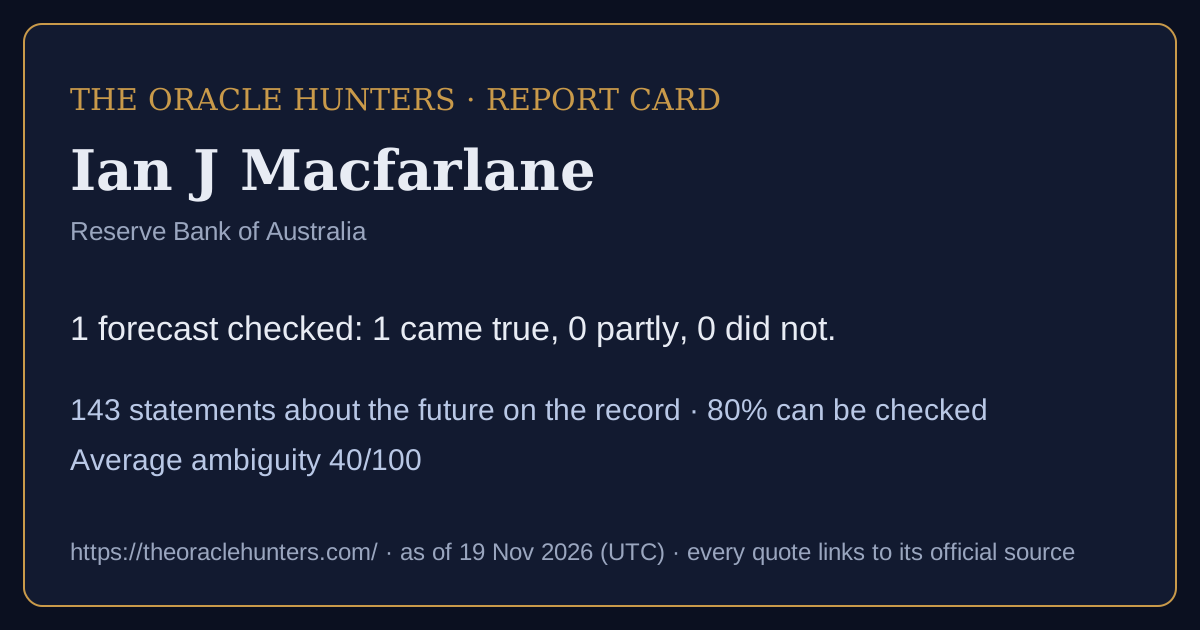
Ian J Macfarlane
Reserve Bank of Australia
Track record: 1 forecast checked: 1 came true, 0 partly, 0 did not.
143forecasts & commitments on the record
80%can be checked as stated
40average ambiguity (0-100)
0goalpost moves recorded
0confirmed U-turns
Timeline
came true partly did not not due / being checked / too vague
Calibration score: shown after 10 checked forecasts with a stated likelihood (now 1).
How they speak about the future: based on data 108, educated guess 19, stated on authority 16.
Kinds of claim: forecast 94, mixed claim 27, scenario (if… then) 17, commitment 5. · Download this report card as a picture
In the nine words
πρόγνωσιςInference from evidence102 · 71%πρόνοιαPreparing for the future17 · 12%μαντείαInspired knowledge12 · 8%εἰκασίαConjecture6 · 4%προαναγγελίαPublic pre-announcement5 · 3%πρόβλεψιςSeeing the signs1 · 1%
How to read this
Each box is one sentence a public figure or institution said about the future, word for word, with a link to the official text. Can be checked means it names what will happen, by when, and how likely - so it can be compared with official figures later. Too vague to check means it does not. Ambiguity (0-100) is how many different ways the sentence can be read. When the date passes, the forecast is compared with official data and marked came true, partly or did not come true. Labels judge the sentence, never the person. Full guide and glossary.Checked
Over the course of 2004, we expect GDP to grow by 4 per cent.
Came true. Said: economic growth around 4% in 2004. Official figure for Australia: 4.2% (World Bank open data). On target. Off by 0.2 points. official data · checked 14 Nov 2026 · automatic check against official data (rules v3)
On the record (143)
The Bank's mandate is to keep inflation averaging 2 to 3 per cent over the medium term.
the current level of oil prices, this forecast implies that headline CPI inflation would remain close to 3 per cent in the short term.
Global GDP growth was 4 per cent per annum or higher in 2003 and 2004 and is expected to remain so in 2005 and 2006.
7 Bernanke (2005A) reported a Federal Reserve study which estimated that balancing the federal budget would reduce the current account deficit in the medium term by less than 1 per cent of GDP.
Most private forecasts for global economic growth for the rest of this year and the next show above-average rates, although not as strong as in 2004.
With two quarterly sets of more reassuring price data now behind us, we were able in our recently released August Statement on Monetary Policy to conclude that the CPI increase will peak at 3 per cent per annum in the second half of next year.
While the rising exchange rate has been an important factor over the past couple of years, if we look at it over the past five years or so, it did not rise as much as would have been expected on the basis of its past relationship with the terms of trade (Graph 3).
With domestic demand in Australia growing at over 5 per cent in 2002/03 and 2003/04, which is well above long-term potential, and with the economy approaching full capacity in a number of sectors, the extra domestic demand generated by the exceptional rises in the terms of trade could well have had serious inflationary consequences if it had continued.
Consensus forecasts for 2005 and 2006 are also for above-trend growth, although somewhat lower than last year.
The result has been that competition amongst the schemes has seen fees increase from under 1.3 per cent in 1994 to 1.65 per cent today - a perverse outcome to anyone with an economics background who expects competition to lower prices.
In the middle of last year we were forecasting 3¾ per cent growth for the year to the December quarter 2004; now we think that when we receive the December quarter national accounts next month, they will show a growth rate of not much more than 2 per cent.
Growth in borrowing seems to have now settled for the time being at a rate of about 13 per cent per annum, and house prices may have risen in the December quarter of 2004.
I think we will have to get used to seeing GDP growth rates starting with the numbers 2 or 3 rather than 3 or 4 for a time.
Looking ahead, we forecast gradual rises in underlying inflation, with it reaching 2½ per cent by end 2005 and 3 per cent by end 2006.
inflation in the non-traded sector was over 4 per cent, and that if this continued it might imply a medium-term outlook for inflation somewhat above 3 per cent.
By end 2005, both headline and underlying measures are likely to have moved up to about 2½ per cent.
On inflation, we had forecast 2¼ per cent for the CPI increase over calendar 2003 and it came in a bit higher at 2.4 per cent, but has since receded to 2 per cent in the four quarters to March 2004.
On the external side, consensus forecasts for the growth of the world economy in 2004 put it well above 4 per cent, with a similar figure for 2005.
For calendar 2004, headline inflation will be heavily influenced by movements in oil prices, so it is best to look at underlying inflation.
Our forecast for growth through calendar 2004 is now 3¾ per cent.
Some may be inclined to think that a decline of this magnitude - 20 per cent - represents a sharp fall in the provision of housing finance.
It now seems likely that the peak in credit demand was reached around October 2003 when monthly loan approvals for housing (owner-occupation plus investment) reached over $15 billion per month, an increase of 40 per cent over the year earlier.
We will naturally be keeping a close eye on these developments to see that the return to a more sustainable rate of credit growth continues.
But $12 billion per month is still a rapid rate of lending and, if continued, would be consistent with the stock of housing credit growing at a twelve-month-ended rate of about 18 per cent by end 2004.
When the increases in the prices of steaming and coking coal and iron ore flow through into the index, we will soon see a further substantial rise (the blue dot in Graph 8).
If there had been a domestic need to tighten earlier this year, as there well could have been, there would have been an extremely difficult decision to make.
On inflation, we said last time that we expected the CPI to increase by 2½ per cent over calendar 2003.
It would not surprise us if the four-quarter-ended growth rate of GDP reached 4½ per cent in mid 2004 due to the effects of the sharp rise in farm GDP, before returning to 4 per cent by end year.
Another approach sometimes put to us is to say that we should raise interest rates if, and only if, our forecast for inflation is above 3 per cent, and lower them if, and only if, it is below 2 per cent.
As we stated in our quarterly statement, this expectation implies that the profile of inflation will exhibit a shallow U-shape - falling from its present 2½ per cent to below 2 per cent in mid 2004, but then rising back to 2 per cent by end 2004, 2½ per cent by mid 2005, and continuing under upward pressure thereafter.
Over the course of 2004, we expect the CPI to increase by 2 per cent, but in mid 2004 it could well be below that because the maximum effects of the higher Australian dollar could be being felt then.
Over the course of 2004, we expect GDP to grow by 4 per cent.
Came true. Said: economic growth around 4% in 2004. Official figure for Australia: 4.2% (World Bank open data). On target. Off by 0.2 points. official data · checked 14 Nov 2026 · automatic check against official data (rules v3)
If India emerges as a second Asian engine of growth, Australia will face new opportunities and challenges.
As recently as 1980, only 25 per cent of the exports of developing countries were manufactures; now the figure is well over 80 per cent - for Asian countries, the figure is likely to be over 90 per cent.
In contrast, the US budgetary position has moved from a surplus of 2 per cent of GDP in 2000 to an expected deficit of 4 per cent of GDP in 2003.
The outcome for growth through 2002/03 looks like it will be close to the 3 per cent forecast, or only a little below it.
When we met in December last year, I said that we expected GDP to grow by 3 per cent through the year to June 2003, that is through the present financial year.
But the oil price pressures have already reversed, and when we looked at the likely outcome in the remainder of 2003 and into 2004 in the May Statement on Monetary Policy , we reduced our inflation forecast from 2¾ per cent to 2½ per cent, largely because of the higher exchange rate for the Australian dollar.
When we moved the forecast horizon along six months, that is to the end of 2003, we expected the growth rate to rise to 3¾ per cent.
The inflation forecast I gave last time was for the rise in the CPI to exceed 3 per cent in the near term and then to ease to about 2¾ per cent in the 12 months to end 2003.
Instead of 3¾ per cent through calendar 2003, growth might now be more like 3 per cent.
Obviously, if households have more debt, a rise in interest rates will affect them more than if they had less, and so income after mortgage payments would fall more, and so would consumption.
Even if we judge that the incidence of this extreme reaction will still be relatively low, are there other forms of behaviour which are likely to have changed as a result of the higher debt-servicing ratio and higher gearing among indebted households?
In principle, this could happen if the shock in question was a deep enough recession accompanied by a large enough rise in unemployment.
Taking these facts into account, and allowing for the fact that households with debt have, on average, incomes about 30 per cent higher than the average for all households, interest and principal repayments probably account for something like 20 per cent of disposable income among those households who have debt .
This might be an over-simplification but, if it is, it is not a large one. 6 I know APRA have been looking at this situation closely and have been subjecting banks to stress tests based on quite onerous scenarios - for example, a 25 per cent fall in house prices.
The labour market's ability to manage wage formation will be tested as early as next year, when actual growth is supposed to be in line with potential growth.
If we use Statistics Sweden's population forecast as a starting point, we can see that the population will increase up to 2009 by an average of 0.5 per cent a year, which is slightly lower than the increase during the 1990s.
If the forecasts indicate that inflation will be higher than the target level one to two years ahead, monetary policy must normally be tightened and the interest rate raised.
Wage costs are expected to increase this year by just over 4.5 per cent, which is higher than the Swedish economy can manage in a longer perspective.
Showing the newest 50 - the ledger has all 143.
Also said - not checkable as stated (12 newest)
Remarks about the future with no date, figure or likelihood that could be checked. They are kept on the record and shown here, but not scored.
We need to be confident, however, that it will return to the 2 to 3 per cent range.
This will be my last appearance, and I have to say I will miss this regular half-yearly event - perhaps I should come and sit in the bleachers at future meetings.
It means, for example, that we have low unemployment and that our incomes are higher than they might otherwise be.
The only way monetary policy could have prevented this is if it had kept the economy 'semi-comatose'.
Viewing all of the available evidence that has accrued over the six months since we last appeared before this Committee, the Board came to the view that inflation was likely to exceed earlier forecasts and that corrective action was therefore needed.
So, in the absence of a significant lift in trend productivity growth, we should expect to see annual GDP growth rates mainly in the 2s and 3s, rather than in the 3s and 4s as was typical for most of the expansion.
With strong investment growth and an expected improvement in exports, our forecast for the economy overall is that annual GDP growth will pick up modestly during 2006 to about 3¼ per cent.
While strong business investment obviously contributes to capacity expansion, the sorts of outcomes envisaged for GDP growth would imply that the economy will continue to operate close to full capacity.
cannot be expected to target a particular composition of growth or current account deficit.
It is relatively unusual for countries in this group to experience what might be termed a 'home-grown' recession, that is, a recession not shared by the major industrial countries.
The only qualifications I have to make to my earlier generalisation is to concede that rates may have been slightly lower during the second world war in some countries such as the United States and United Kingdom when quantity rationing was the norm, but they have not been lower in peace time.
There have been a number of reasons for these favourable outcomes around the world, including the developed world's lower oil dependency compared with earlier years, but I will concentrate on a few that I think are important.