Iain Duncan Smith
Department for Work and Pensions · GBR
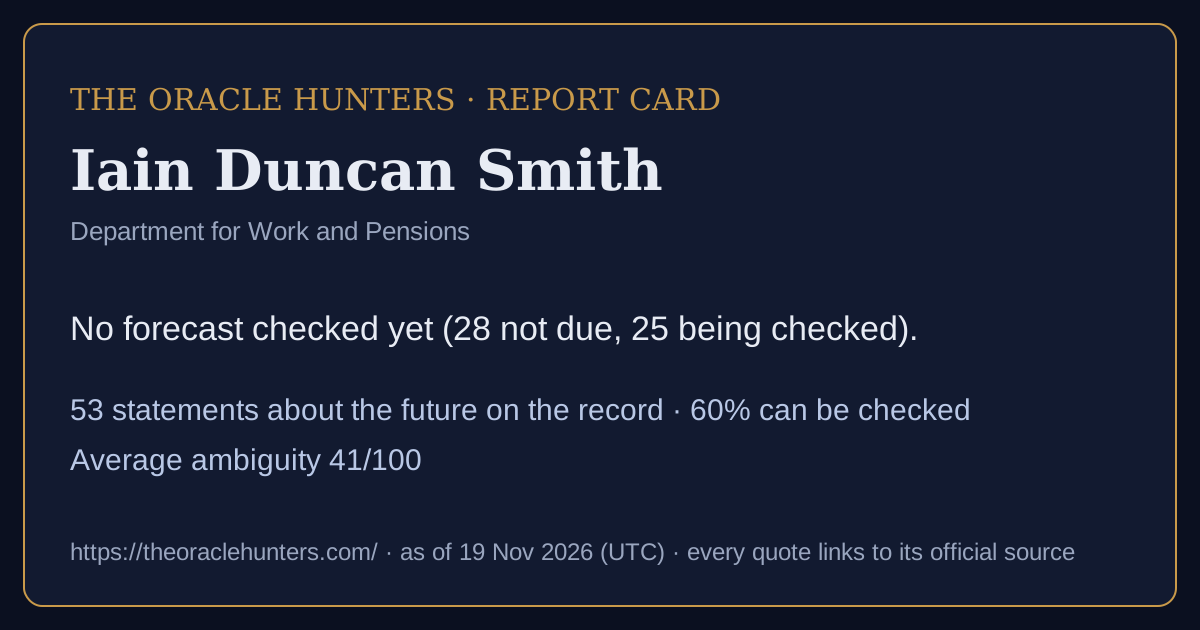
Track record: No forecast checked yet (28 not due, 25 being checked).
53forecasts & commitments on the record
60%can be checked as stated
41average ambiguity (0-100)
0goalpost moves recorded
0confirmed U-turns
Timeline
came true partly did not not due / being checked / too vague
Calibration score: shown after 10 checked forecasts with a stated likelihood (now 0).
How they speak about the future: based on data 40, educated guess 7, stated on authority 6.
Kinds of claim: forecast 34, scenario (if… then) 10, mixed claim 8, commitment 1. · Download this report card as a picture
In the nine words
πρόγνωσιςInference from evidence35 · 66%πρόνοιαPreparing for the future10 · 19%μαντείαInspired knowledge5 · 9%πρόβλεψιςSeeing the signs1 · 2%εἰκασίαConjecture1 · 2%προαναγγελίαPublic pre-announcement1 · 2%
How to read this
Each box is one sentence a public figure or institution said about the future, word for word, with a link to the official text. Can be checked means it names what will happen, by when, and how likely - so it can be compared with official figures later. Too vague to check means it does not. Ambiguity (0-100) is how many different ways the sentence can be read. When the date passes, the forecast is compared with official data and marked came true, partly or did not come true. Labels judge the sentence, never the person. Full guide and glossary.On the record (53)
We have also introduced the world’s first tax relief on social investment – which could generate up to nearly £500 million over the next 5 years.
Unless you opt out – which only 10% of people are doing, far fewer than we expected – then you will automatically save into a private pension, with government and your boss required by law to pay in as well.
Research shows the tax relief could generate £480 million in investment over the next 5 years…
Britain will only be great again if all in our society are part of our economic recovery and growth.
Working closely with the Chancellor, as part of cutting the deficit – by a third already, by half next year – we have set the welfare state on a sustainable footing for the future.
Expected to report next year, the aim is to ensure our action is effective, evidence-based, and better coordinated across the many relevant bodies with an interest in supporting strong and loving families.
Assuming there were to be no further increase in family breakdown – which we know from current trends is unlikely – the government’s family stability indicator tells us there would need to be an 80,000 reduction in the number of birth parents separating to realise a 1% drop in the indicator.
… and in the tax system, where the Chancellor confirmed in his Autumn Statement just yesterday that we will introduce a transferable tax allowance for married couples from April 2015 – meaning around 4 million married couples and civil partners who pay the basic rate of tax, will see their tax bills cut by up to £200 a year.
To do this, they will need a robust evidence base - and over the next year, we will be doing more to develop and share best practice around what works.
Launched today, it will run until 15 February 2013.
As we saw earlier this year - when the child poverty level dropped by 2% - a fall in the median income may lift a family out of poverty on paper.
With a new Masters degree in public policy starting at the University next year, I hope that vigorous policy thinking in Cambridge will filter through to Westminster…
From 2013, it will replace the main out of work benefits and tax credits with single, simple payment withdrawn at a clear and consistent rate.
We have already taken action to reduce welfare bills by £18 billion by the end of this Parliament, and with continuing economic uncertainty we will have to find further savings.
In Scotland over a quarter of the population will be over 65 by 2033, and this proportion is rising further, increasing cost pressures in pensions, health and social care.
The staged Agile approach means the transition from current benefits and tax credits is expected to be completed by the end of 2017…
… and the Universal Credit Pathfinder which will be launched in Greater Manchester in April 2013.
If people do not have “the work habit” - in other words they are not used to the workplace, or convinced that working is right for them - the risk is that they will soon fall out of employment again.
Well from next year this will no longer be the case.
Our budget deficit was larger than every economy in Europe with the single exception of Ireland and compared to US gross debt in 2010 of 99% of GDP, expected to grow by 12% of GDP over the same period.
Universal Credit is a new system we are introducing from next year, which will replace all work-related benefits and tax credits with a single, simple, payment.
In this year, we have reduced the economic inactivity level to its lowest since 1992, and we will get welfare inactivity down even further, as our other reforms start to bite.
If people take steps with us to find and stay in employment, they will see the rewards.
The Institute for Fiscal Studies estimated in 2009 that the 2020 child poverty targets could be hit through an extra £19 billion in welfare transfers.
If reoffending falls by 7.5% or more, then the investors will receive a return - paid for by Government out of the reduced costs.
If people do not have ‘the work habit’ - in other words they are not used to the workplace, or convinced that working is right for them - the risk is that they will soon fall out of employment again.
… we have committed to doubling the number of family nurse places by 2015, so that young mothers will receive support and advice in their child’s early years.
If reoffending falls by 7.5% then the investors will receive a 7.5% return - paid for by government out of the reduced costs.
If they do not have “the work habit” - in other words they are not used to the workplace, or convinced that working is right for them, the risk is that they will soon fall out of employment again.
Age-related spending currently accounts for some 12 per cent of GDP, and is projected to grow by around 5 per cent of GDP by 2060.**
So we were clear that if we were not going to fall back into a debt crisis of a different kind - with the resultant effects on growth - we would need to get the house back in order.
Would any of us here work at 96% tax rates, especially if we could earn a living without any effort at all?
We’re making a £73 million fund available that will support suitable Credit Unions to expand and become financially sustainable within four or five years, helping up to one million more people access clearer and fairer Credit.
The Universal Credit will fundamentally simplify the system and make sure that work always pays, eradicating some of the obscene withdrawal rates we’ve seen in the past and replacing them with a single, clear taper set at around 65%.
The Universal Credit will be tapered away at a clear and consistent rate - around 65% before tax - making it easier for people to see how their earnings will change as they move into work.
Without reform expenditure is expected to rise to £24bn by 2014/15.
From October 2013 all new claims for out-of-work support will be treated as claims for Universal Credit.
We expect to start introducing the Universal Credit from 2013, testing the system in the Spring before beginning roll-out in October.
And the Office for Budget Responsibility recently forecast that employment in the whole economy will rise by 1.1m between 2010 and 2015.
And from April 2014 to October 2017 we will work through existing cases.
Some 2.5 million households will get higher entitlements as a result of the move to Universal Credit.
The costs to society as a whole through social breakdown, addiction, crime, lost productivity and tax revenues are very difficult to quantify - but research suggests they could be up to £100 billion.
If we can extend the effective working life of the country by just one year, it is forecast to increase GDP by 1% - that is around £13 billion.
To ensure that we are being fair to the taxpayer, the Work Programme will be run on a payment-by-results basis when it rolls out in the first half of next year.
In real terms, the cost of working age HB has jumped by £5 billion in 5 years and is projected to reach £21 billion in 2014/15.
cutting the second highest level of debt in Europe - projected to be £149 billion this year - over the course of this Parliament with a clear, 5-year plan
If we can extend the effective working life of the country by just one year, it is forecast to increase GDP by 1% - that is around £13bn.
Some 7 million people are not saving enough to meet their own retirement aspirations - they will fall back onto the shoulders of the next generation in the form of higher taxes.
From April next year, the “triple guarantee” means that the basic pension will rise by the higher of earnings, prices or 2.5%.
And if neither is going up fast, it will go up at least 2.5%.
Showing the newest 50 - the ledger has all 53.
Also said - not checkable as stated (12 newest)
Remarks about the future with no date, figure or likelihood that could be checked. They are kept on the record and shown here, but not scored.
more likely to call on the health service
they will receive a work-focussed health assessment to overcome any obstacles to a return to work – and review what work they can do and what support they need to do it
Under Universal Credit, people can expect early and continued support about what work they can do and what support they need to do it, until they leave the benefits system.
The sickness benefit culture in this country, I believe, is in dire need of reform – so that will be my focus in the coming months.
As a result, work coaches will spend time working with claimants focussing them on what they need to do and how the system can help them progress.
When we achieve that, we will finally have a welfare system fit for the 21st century – a welfare system that focuses on those most in need, and helps ensure that, people who can, become independent from the state and live better, more fulfilled lives.
Thus it is vital that we bring social investment into the mainstream – making it the norm for corporate social responsibility in the private sector, for asset managers, investment banks, and many more, getting sustainable funding flowing to where it will have the most impact.
So far from thinking that budget pressures and rising costs are insurmountable, just think what that money could mean on the ground – how many people it could help, how many lives it could transform.
If we can get this right, I believe the effect social investment could have is dramatic – not just in fiscal terms, but in terms of our society as well.
For in straightened times, and faced with tight budgets, all of us need to find new ways of tackling social problems, answering a call to action in the years to come.
As part of this he rightly confirmed that we will continue to give pensioners the support they deserve by protecting pensioner benefits.
This is crucial, and we should not underestimate the difference it will make to encourage saving.