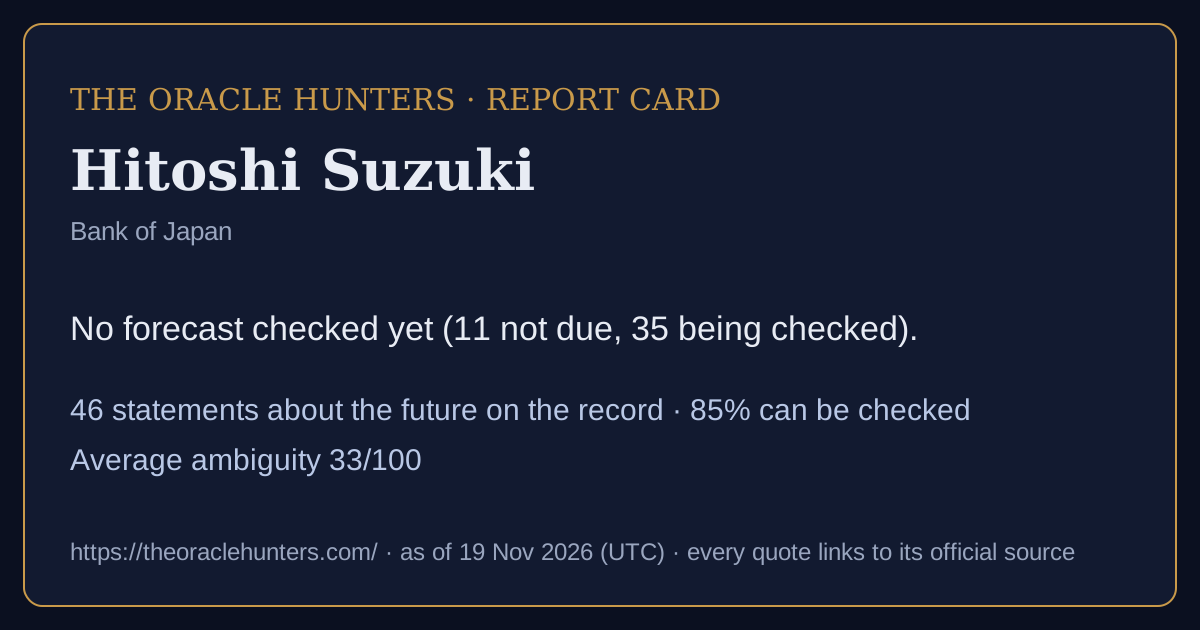
Hitoshi Suzuki
Bank of Japan
Track record: No forecast checked yet (11 not due, 35 being checked).
46forecasts & commitments on the record
85%can be checked as stated
33average ambiguity (0-100)
0goalpost moves recorded
0confirmed U-turns
Timeline
came true partly did not not due / being checked / too vague
Calibration score: shown after 10 checked forecasts with a stated likelihood (now 0).
How they speak about the future: based on data 43, educated guess 2, stated on authority 1.
Kinds of claim: forecast 42, mixed claim 2, scenario (if… then) 2. · Download this report card as a picture
In the nine words
πρόγνωσιςInference from evidence42 · 91%πρόνοιαPreparing for the future2 · 4%φρόνησιςPractical wisdom1 · 2%μαντείαInspired knowledge1 · 2%
How to read this
Each box is one sentence a public figure or institution said about the future, word for word, with a link to the official text. Can be checked means it names what will happen, by when, and how likely - so it can be compared with official figures later. Too vague to check means it does not. Ambiguity (0-100) is how many different ways the sentence can be read. When the date passes, the forecast is compared with official data and marked came true, partly or did not come true. Labels judge the sentence, never the person. Full guide and glossary.On the record (46)
In doing so, it will continue to aim at achieving the price stability target of 2 percent, as long as it is necessary for maintaining that target in a stable manner (Chart 12).
The United Kingdom, for example, has announced that it will raise the corporate tax in 2023 for the first time in about 50 years to secure fiscal resources for taking measures in response to COVID-19.
In the October Outlook Report, the medians of the Policy Board members' forecasts for the year-on-year rate of change in the core CPI are 0.0 percent, 0.9 percent, and 1.0 percent for fiscal 2021, 2022, and 2023, respectively (Chart 8).
Given these factors, in the Bank's October 2021 Outlook for Economic Activity and Prices (Outlook Report), the medians of the Policy Board members' forecasts for the yearon-year growth rate of real GDP are 3.4 percent, 2.9 percent, and 1.3 percent for fiscal 2021, 2022, and 2023, respectively (Chart 8).
From the middle of the projection period that covers through fiscal 2023, Japan's economy is projected to continue growing, albeit slower, at a pace above its potential growth rate, as a virtuous cycle from income to spending intensifies in the overall economy, including the household sector.
However, it is likely that the inflation rate will increase gradually toward fiscal 2023, as I mentioned earlier, but not reach the 2 percent target by then.
If interest rates fluctuate to some extent again and such investors stay in the market, this will help maintain the price stabilization function in the market during periods of high volatility.
The Bank will persistently continue with further effective and sustainable monetary easing to achieve the price stability target of 2 percent.
In the Bank of Japan's March 2021 Tankan (Short-Term Economic Survey of Enterprises in Japan), the plan for fiscal 2021 shows that business fixed investment is likely to increase by 2.4 percent on a year-on-year basis, indicating relatively high growth compared with the past March Tankan surveys. 1
In the April Outlook Report, the forecasts of the majority of Policy Board members for the year-on-year rate of change in the core CPI are in the range of 0.0 to 0.2 percent, 0.5 to 0.9 percent, and 0.7 to 1.0 percent for fiscal 2021, 2022, and 2023, respectively (Chart 8).
Given these factors, in the Bank's April 2021 Outlook for Economic Activity and Prices (Outlook Report), the forecasts of the majority of Policy Board members for the real GDP growth rate are in the range of 3.6 to 4.4 percent, 2.1 to 2.5 percent, and 1.2 to 1.5 percent for fiscal 2021, 2022, and 2023, respectively (Chart 8).
The Bank will continue expanding the monetary base until the year-on-year rate of increase in the observed CPI (all items less fresh food) exceeds the price stability target of 2 percent and stays above the target in a stable manner.
However, if these institutions' financial soundness deteriorates further due to a fall in lending rates and an increase in credit costs, the smooth functioning of financial intermediation could be impaired, posing a risk that downward pressure will be exerted on the real economy.
Specifically, the Bank applies a negative interest rate of minus 0.1 percent to a portion of financial institutions' current account balances at the Bank, and purchases JGBs so that 10-year JGB yields will remain at around 0 percent (Chart 10).
Unfortunately, given the deterioration in corporate profits brought about by the impact of COVID-19, it seems unlikely that the pace of increase in wages will boost its momentum in fiscal 2021.
In the October Outlook Report, the forecasts of the majority of Policy Board members for the year-on-year rate of change in the core CPI are in the range of minus 0.7 to minus 0.5 percent, 0.2 to 0.6 percent, and 0.4 to 0.7 percent for fiscal 2020, 2021, and 2022, respectively (Chart 8).
Given these factors, in the Bank's October 2020 Outlook for Economic Activity and Prices (Outlook Report), the forecasts of the majority of Policy Board members for the real GDP growth rate are in the range of minus 5.6 to minus 5.3 percent, 3.0 to 3.8 percent, and 1.5 to 1.8 percent for fiscal 2020, 2021, and 2022, respectively (Chart 8).
On the other hand, although more than seven and a half years have passed since the Bank introduced QQE, the projected rate of increase in the core CPI for fiscal 2022 is still only about 0.7 percent, which is far below the target.
Specifically, the Bank applies a negative interest rate of minus 0.1 percent to a portion of current account balances held at the Bank by financial institutions, and purchases JGBs so that 10-year JGB yields will remain at around zero percent (Chart 8).
According to the Bank's July 2020 Outlook for Economic Activity and Prices (Outlook Report), the forecasts of the majority of the Policy Board members for the real GDP growth rate are in the range of minus 5.7 to minus 4.5 percent, 3.0 to 4.0 percent, and 1.3 to 1.6 percent for fiscal 2020, 2021, and 2022, respectively (Chart 6).
With the phased resumption of economic activity, Japan's economy is likely to improve gradually from the second half of this year through the materialization of pent-up demand, together with the support of accommodative financial conditions and the government's economic measures.
From a somewhat long-term perspective, the inflation rate is likely to accelerate further through the second half of fiscal 2022 with a continued improvement in the output gap and a rise in medium- to long-term inflation expectations -- the perception of firms and households regarding future prices.
In the July 2020 Outlook Report, the forecasts of the majority of the Policy Board members for the year-on-year rate of change in the core CPI are in the range of minus 0.6 to minus 0.4 percent, 0.2 to 0.5 percent, and 0.5 to 0.8 percent for fiscal 2020, 2021, and 2022, respectively (Chart 6).
Thereafter, as the impact of COVID-19 wanes globally and overseas economies return to a steady growth path, the economy is likely to mark relatively high growth for fiscal 2021, and then continue to grow firmly for fiscal 2022.
Japan's economy is therefore expected to continue on an expanding trend in fiscal 2020.
The economy is projected to be underpinned mainly by the continued increasing trend in exports, with the growth rates of overseas economies rising, and an expansion in public expenditure accompanying the hosting of the Olympic Games to be held in Tokyo in 2020.
Following a likely decline in the second half of fiscal 2019 due to the effects of the consumption tax hike, private consumption and housing investment are expected to head gradually toward a recovery in fiscal 2020.
Japan's economy is likely to continue on an expanding trend throughout the projection period -- that is, through fiscal 2021.
For example, according to the July 2019 World Economic Outlook Update released by the IMF, global growth is forecast at levels exceeding 3.0 percent for 2019 and 2020, although the projections for both years were revised downward from those made in April 2019 (Chart 1).
An estimate by the International Monetary Fund (IMF) suggests that, if the U.S.-China trade friction intensifies, the growth rate of the Chinese economy for 2020 could slow by around 1 percent.
According to the Bank's January 2019 Outlook for Economic Activity and Prices (Outlook Report), the medians of the Policy Board members' forecasts for the real GDP growth rate are 0.9 percent for both fiscal 2018 and fiscal 2019, and 1.0 percent for fiscal 2020 (Chart 6).
Therefore, Japan's economy is expected to continue on an expanding trend in fiscal 2020.
In fiscal 2020, private consumption and housing investment, which are likely to decline in the second half of fiscal 2019 due to the effects of the consumption tax hike, are expected to gradually head toward a recovery.
With regard to the outlook, Japan's economy is likely to continue on an expanding trend throughout the projection period -- that is, through fiscal 2020.
According to the January 2019 World Economic Outlook Update released by the International Monetary Fund (IMF), the global economy is projected to continue growing at around 3.5 percent in 2019 and 2020, although the projections for both years were revised downward from those made in October 2018 (Chart 1).
1 According to the Population Statistics released in 2019 by the National Institute of Population and Social Security Research, it is estimated that labor force participants in Japan will total 63.81 million in 2020, declining to 61.69 million in 2030.
These points suggest that, while not yet sufficiently firm, the momentum toward achieving the price stability target is itself being maintained, and the year-on-year rate of change in the core CPI is likely to increase gradually toward 2 percent, although it will take more time than expected.
According to the July 2018 World Economic Outlook (WEO) Update released by the International Monetary Fund (IMF), global growth is projected to be 3.9 percent in 2018, exceeding the result for 2017.
Specifically, the medians of the Policy Board members' forecasts for the year-on-year rate of change in the core CPI presented in the July 2018 Outlook Report are 1.1 percent for fiscal 2018, and, excluding the direct effects of the scheduled consumption tax hike, 1.5 percent and 1.6 percent for fiscal 2019 and fiscal 2020, respectively (Chart 6).
According to the Bank's July 2018 Outlook for Economic Activity and Prices (hereafter the Outlook Report), the medians of the Policy Board members' forecasts of the real GDP growth rate are 1.5 percent for fiscal 2018, and 0.8 percent for both fiscal 2019 and fiscal 2020 (Chart 6).
This is despite a likely deceleration in business fixed investment, mainly reflecting cyclical adjustments in capital stock and the peaking out of Olympic Games-related demand, and a likely temporary decline in private consumption after the scheduled consumption tax hike in October 2019.
Japan's economy is expected to maintain its expanding trend from fiscal 2019 through fiscal 2020, supported in part by the increase in exports.
According to the January 2018 World Economic Outlook (WEO) Update released by the International Monetary Fund (IMF), global growth is projected to be 3.9 percent in 2018, exceeding the estimate for 2017 of 3.7 percent (Chart 1).
Specifically, the medians of the Policy Board members' forecasts of the year-on-year rate of change in the CPI (all items less fresh food) presented in the January 2018 Outlook Report are 0.8 percent for fiscal 2017, 1.4 percent for fiscal 2018, and, excluding the direct effects of the scheduled consumption tax hike, 1.8 percent for fiscal 2019 (Chart 8).
Therefore, the year-on-year rate of increase in the CPI (all items less fresh food) is projected to continue on an uptrend and will likely reach around 2 percent around fiscal 2019.
According to the Bank's January 2018 Outlook for Economic Activity and Prices (hereafter the Outlook Report), the medians of the Policy Board members' forecasts of the real GDP growth rate are 1.9 percent for fiscal 2017, 1.4 percent for fiscal 2018, and 0.7 percent for fiscal 2019 (Chart 8).
Also said - not checkable as stated (2 newest)
Remarks about the future with no date, figure or likelihood that could be checked. They are kept on the record and shown here, but not scored.
However, due attention should be paid to factors that could exert downside risks to economic activity, such as (1) the U.S. economic policies and their impact on global financial markets, (2) developments in emerging and commodity-exporting economies, (3) negotiations on the United Kingdom's exit from the EU and their effects, and (4) geopolitical risks.
In terms of the outlook, the U.S. economy is expected to continue to see firm growth driven by domestic private demand.