Hermann Remsperger
Deutsche Bundesbank
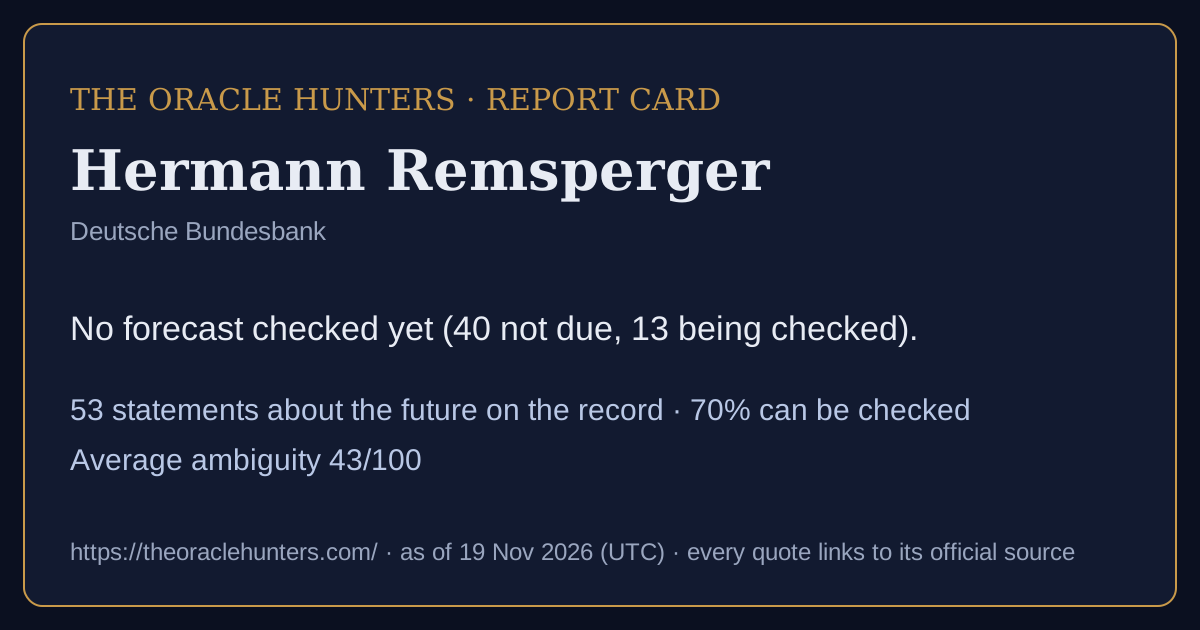
Track record: No forecast checked yet (40 not due, 13 being checked).
53forecasts & commitments on the record
70%can be checked as stated
43average ambiguity (0-100)
0goalpost moves recorded
0confirmed U-turns
Timeline
came true partly did not not due / being checked / too vague
Calibration score: shown after 10 checked forecasts with a stated likelihood (now 0).
How they speak about the future: based on data 36, educated guess 13, stated on authority 4.
Kinds of claim: forecast 34, scenario (if… then) 11, mixed claim 7, commitment 1. · Download this report card as a picture
In the nine words
πρόγνωσιςInference from evidence35 · 66%πρόνοιαPreparing for the future11 · 21%μαντείαInspired knowledge3 · 6%εἰκασίαConjecture3 · 6%προαναγγελίαPublic pre-announcement1 · 2%
How to read this
Each box is one sentence a public figure or institution said about the future, word for word, with a link to the official text. Can be checked means it names what will happen, by when, and how likely - so it can be compared with official figures later. Too vague to check means it does not. Ambiguity (0-100) is how many different ways the sentence can be read. When the date passes, the forecast is compared with official data and marked came true, partly or did not come true. Labels judge the sentence, never the person. Full guide and glossary.On the record (53)
The gearing of monetary policy to a quantitative objective and resolute interest rate responses pushed inflation in Germany down from a peak of nearly 8 % in the beginning of 1974 to 2 ½ % by the end of 1978.
For the current year, the IMF is forecasting a rise of 3.6% in consumer prices in advanced economies and an increase of as much as 9.4% in the emerging markets.
Following a roughly 5% increase in each of the past few years, the IMF now expects global economic growth to slow to close to 4% this year and to 3% in 2009.
If market participants draw the right conclusions with a view to higher safety standards, adequate incentive structures and perhaps a preference for financial instruments with less opaque financial structures, securitisation will continue to play an important role.
In this context, let me mention a conference we organised jointly with the Federal Ministry of Finance in Frankfurt in May this year.
We expect to see their recommendations by the end of this year.
Financial markets will become broader and deeper if market players look beyond national borders more and more and find a larger selection of financial instruments, greater turnover and higher liquidity.
These two days we have heard valuable contributions on 'How best to promote growth, employment and competitiveness in the European Union?' , and we will hear more about this tomorrow.
To close my remarks, let me stress that I think that if there is anything we can be certain about, then it is the fact that uncertainty will remain a key characteristic of monetary policy making.
If they are tackled resolutely, Germany will be in a position to overcome its weak growth.
The debt ratio increased to 60.8% and will grow further in the current year.
Based on this scenario, the elderly dependency ratio - the ratio of over 64 year olds to 15 to 64 years olds - having risen from 21.9% in 1970 to 24.2% in 2000, will shoot up to 45.5% in 2030.
Although the Federal Government has put together a package of consolidation measures, these will be offset by shortfalls arising from the planned advancement of the third stage of the income tax reform from 2005 to 2004.
A strict interpretation of the Pact therefore means that German fiscal policy must endeavour, also in line with the earlier provisions of the European Commission and the Ecofin Council, to comply with the 3% ceiling for the deficit ratio in the coming year.
It will further increase this year and could even exceed 4%.
In the last two years, gross investment in venture projects amounted to only €2.4 billion or 0.12% of GDP.
Since the autumn of last year the federal government has been assuming that the deficit ratio will again be over 3% for the current year.
If these days were to be used for production purposes on the customary scale, GDP could grow by between 1½% and 2% although at present the lower bound of the range seems more likely.
The OECD forecast estimates that in 2004 world trade will increase by just under 8% compared with 4% in 2003.
According to the IMF forecast, the growth of global GDP in 2004, estimated more than 4%, will be stronger than at any time since the boom year of 2000.
As these cost-cutting measures would not have exerted their full effect until later years, larger deficits than the government had originally planned can be expected from 2005.
An important statistical effect that should be noted in this context is that, as patients' own contributions to healthcare costs are being increased, the HICP will show an increase in inflation even if the market prices of the goods concerned remain unchanged.
And secondly, it seems obvious that the pressure on monetary policy could become very severe, if other policy areas do not sufficiently support growth and employment.
As regards the upper limit of price stability, I would first of all like to recall that the Governing Council of the ECB defined price stability as a medium-term increase in inflation for the euro area of below 2%.
As you know, the deficit ratio in Germany clearly exceeded the 3% limit last year and is expected to do so again in the current year.
If you take the idea of separating responsibilities to the extreme, the central bank should simply cut interest rates and forget about the impact on the financial system, the protection of which would be the regulator's job.
If labour is not involved to a greater extent in the production process, it will be difficult in Germany to achieve a sustained high level of growth again.
In the years after that, it is envisaged that the volume will go up well above 1% of GDP.
In the current year, Germany will considerably exceed both the 3% limit for the deficit ratio and the 60% debt ratio.
In all probability, the German inflation rate will remain at a low level next year too.
When exports gain momentum and the negative confidence effects on investment and consumption peter out, the upturn from the second half of 2003 onwards will be somewhat stronger and more broadly based.
The top income tax rate will come down to 42% by 2005.
Since the deficit in Germany, at 2.8% of GDP, already came quite close to the 3% ceiling last year - mainly on account of the tax reform - the risk that it might now exceed that limit in the current year has become greater.
Furthermore, there are some doubts as to whether German fiscal policy will be able to deliver on the self-commitment - reaffirmed in spring - to achieve a budget position close to balance by 2004 unless there are further cuts in public payments.
The welfare state system will have to be adapted to cope with these challenges if problems for future economic growth are to be avoided.
This is, however, to overlook the fact that, if at all, this could happen in the short term; over the longer term a stable monetary environment is absolutely essential to price stability, a healthy investment climate and sustainable growth.
It has already been foreseen that the first of the accession countries will participate in the European Parliament elections in 2004.
The tax-exempt status of corporate capital gains from the sale of participating interests, which will take effect from 2002, will have a positive impact. 2 Corporate bonds are attractive to yield-oriented investors and can help brand-name enterprises raise large amounts of funds.
Other things being equal, if the working population grows more slowly or declines, this will eventually dampen potential output.
At the same time, strict compliance with them takes due account of the fear that structural differences in inflation rates in the euro area might increase if emerging economies were to join the monetary union too early.
Because of the likely overestimation of the "true" rate of inflation by the measured rate, and the rigidities on the German labour market, Sinn and Reutter regard that value of 1% as too low.
According to those calculations, the longer-term inflation rate in Germany will run almost 1 percentage point below the EMU-wide inflation rate.
imports from non-euro- area countries varies between less than 10 % of GDP in Italy, France and Spain, via nearly 12 % in Germany, to almost 40 % in Ireland. 3 Divergent economic policy responses to the oil-price rises in individual countries may - in themselves - have actually enhanced the inflation differentials.
The impact of the introduction of the euro and recent changes in the financial industry on the credit channel of monetary policy transmission is ambiguous. 55 The increase in competition among financial institutions might tighten the supply of credit if monetary policy shifts to a restrictive stance.
Although owing to the elimination of currency risk - interest rate spreads have become considerably narrower across the 11 participating countries, there are still differences amounting up to over 20 basis points for equally rated borrowers. 12 This may be due to a liquidity premium on account of the lower frequency and the lower volume in trading such bonds.
If EMU paves the way for economic and institutional reforms that will ultimately lead to higher growth in Europe, then EMU is clearly in the political interest of the United States.
Transfers of funds from euro area monetary financial institutions to the banking systems of third countries (and vice versa) and - from 2002 - the circulation of euro banknotes outside the euro area might prove to be potential sources of distortions.
Official projections assume that this would result in the contribution rate having to rise to 24% by 2030.
The government's planned tax reform will result in a substantial tax relief for enterprises in net terms as well, especially as a result of the sharp reduction in the corporate tax rate to a uniform level of 25%.
5 In 1998 the Federal budget alone closed with a surplus of 1.6% of GDP; an even better result is expected for 1999.
Showing the newest 50 - the ledger has all 53.
Also said - not checkable as stated (12 newest)
Remarks about the future with no date, figure or likelihood that could be checked. They are kept on the record and shown here, but not scored.
At this point, it might be useful to mention the so-called impossible trinity: Countries that peg their exchange rates to an anchor currency either have to control capital movements or cope with the interest rate policy of the anchor currency.
We shall then move on to our second stopping place.
The global surge in inflation until the middle of this year should teach us to regard the globalisation dividend of low inflation rates as not being permanent.
The crucial point on which everything hinges should be the IOSCO code of conduct since anything else might result in competitive disadvantages in Europe.
A fundamental decision in favour of sovereign regulation in banking supervisions by no means settles the question of whether such regulation necessarily has to set detailed and prescriptive rules.
For example, Pillar 1 of Basel II contains clear provisions on how much capital has to be maintained for what credit risks.
Furthermore, it should be borne in mind that Basel II relies on ratings for classifying bank loans.
Deposit protection has to be consistent with the specific features of the national banking systems.
If we are thinking about changes, I believe we should strengthen those institutional structures that did their job well during the financial market turbulence.
This may be at odds with most recent events in financial markets which suggest that the spotlight should be turned on the group of advanced economies.
I shall answer it by looking at the three main building blocks of the 'impossible trinity' hypothesis - exchange rate regimes, financial integration and monetary policy.
This divergence may make it increasingly difficult for emerging markets to smoothly combine low inflation and a high degree of exchange rate stability.