Henry Ohlsson
Sveriges Riksbank
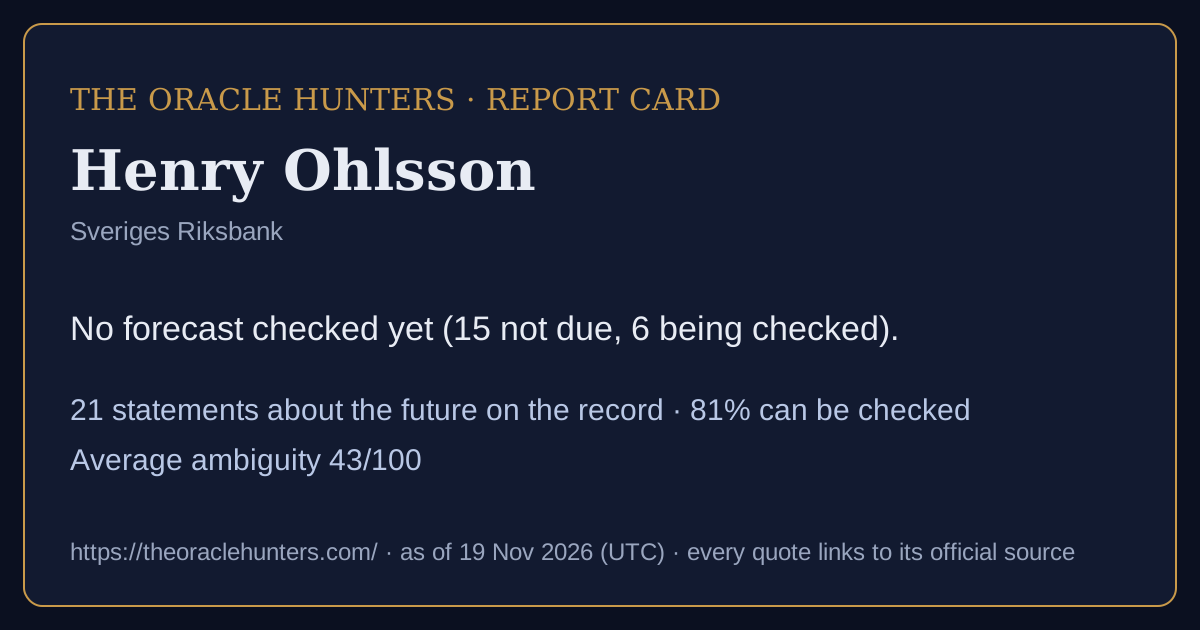
Track record: No forecast checked yet (15 not due, 6 being checked).
21forecasts & commitments on the record
81%can be checked as stated
43average ambiguity (0-100)
0goalpost moves recorded
0confirmed U-turns
Timeline
came true partly did not not due / being checked / too vague
Calibration score: shown after 10 checked forecasts with a stated likelihood (now 0).
How they speak about the future: based on data 16, educated guess 5.
Kinds of claim: forecast 12, scenario (if… then) 6, mixed claim 2, commitment 1. · Download this report card as a picture
In the nine words
πρόγνωσιςInference from evidence14 · 67%πρόνοιαPreparing for the future6 · 29%προαναγγελίαPublic pre-announcement1 · 5%
How to read this
Each box is one sentence a public figure or institution said about the future, word for word, with a link to the official text. Can be checked means it names what will happen, by when, and how likely - so it can be compared with official figures later. Too vague to check means it does not. Ambiguity (0-100) is how many different ways the sentence can be read. When the date passes, the forecast is compared with official data and marked came true, partly or did not come true. Labels judge the sentence, never the person. Full guide and glossary.On the record (21)
If a war is financed by increasing taxes or decreasing other expenditure, public purchasing power will be reduced.
If, as has often been the case throughout history, the army supports itself by looting, it may be able to survive for a while, but for the civilian population, prices will rise because supply decreases.
The survey published on 8 March included the following statement: 'The fallout from the Russian invasion of Ukraine will be stagflationary in that it will noticeably reduce global growth and raise global inflation over the next year'.
In other words, the effect will be stagflationary, that is, we will have a combination of lower growth and upward pressure on inflation. 23 Earlier examples of negative supply shocks are the oil crises in the 1970s.
That monetary expansion on the average could be expected to produce an inflation of something like 6 per cent a year, not of 12 per cent.
If we now view job openings as a measure of labour demand, we could see the relationship between job openings and wage increases as a kind of inverse Phillips curve.
Personally, I believe that both inflation and long-term inflation expectations will remain close to 2 per cent going forward, even if monetary policy is made slightly less expansionary.
The basis of the strategy is that the Riksbank shall strive towards an annual change of 2 per cent in the consumer price index with a fixed interest rate (CPIF).
If, for instance, mortgages are mainly at fixed interest rates, the effect of interest-rate cuts will be less than if the loans are primarily at variable rates.
Swedish competitiveness could be weakened, for instance, if inflation and wage increases in Sweden were higher than those abroad.
It could also be problematic to introduce a new, higher inflation target in Sweden in isolation, if other important central banks around the world stood firm by a target of 2 per cent.
Let us therefore say that future global real interest rates will be in the order of 1.5-2.5 per cent.
At the end of 2018/beginning of 2019 the forecast is that the repo rate will have risen to 0.5 per cent.
If the inflation target and inflation expectations were instead 4 per cent, the real interest rate could be cut in the short term to -4 per cent.
The Riksbank's forecast is that the repo rate will remain at the current level of -0.5 per cent until some time around the end of June/beginning of July 2017.
The repo rate is expected to remain at this level at least until the second half of 2016.
This does not mean that the Riksbank can ensure that inflation will always be 2 per cent.
Many economic agents now assume that inflation will be around 2 per cent in the coming period.
Most central banks probably considered, quite simply, that an inflation rate of 2 per cent was a reasonable level to strive for - sufficiently low for people not to worry about when making financial decisions, but not too low.
Several hundred collective wage agreements will expire in the first part of 2016.
Several hundred collective wage agreements will expire in the first part of 2016.
Also said - not checkable as stated (12 newest)
Remarks about the future with no date, figure or likelihood that could be checked. They are kept on the record and shown here, but not scored.
However, as developments now show, we must assume that inflation will sometimes be above the target as well.
Should it now be the case that we are entering a longer period of persistently higher inflationary pressures - which we do not know yet, of course - then my assessment is that the framework of wage-formation we have today will act as a built-in and useful brake in the system.
A government inquiry has recently started to look at whether Sweden shall once again compile wealth statistics on the individual level. 5 The Riksbank has been stressing for a long time the importance of reintroducing these statistics as soon as possible.
When inflation in Sweden is expected to be below target, the Riksbank conducts expansionary monetary policy.
At the same time, output and employment will also rise.
These challenges have by no means disappeared, we will continue to deal with them.
I will in this speech highlight three challenges that monetary policy has faced during the spring.
The conclusion in a current working report written by two world-leading researchers in this field is that the principles recommended by international organisations lead to underestimation of the rate of inflation and overestimation of the real increase in consumption. 5 However, this is probably no major problem for Sweden, as the percentage of prices imputed is relatively low.
The April Monetary Policy Report therefore did not present any forecast.
Monetary policy must also be forward looking.
A second conclusion is that this shortage of an unequivocal measures means that problems may arise for monetary policy decision-makers.
For instance, the price of oil may rise as oil reserves diminish.