Henry Bellingham
Foreign & Commonwealth Office · GBR
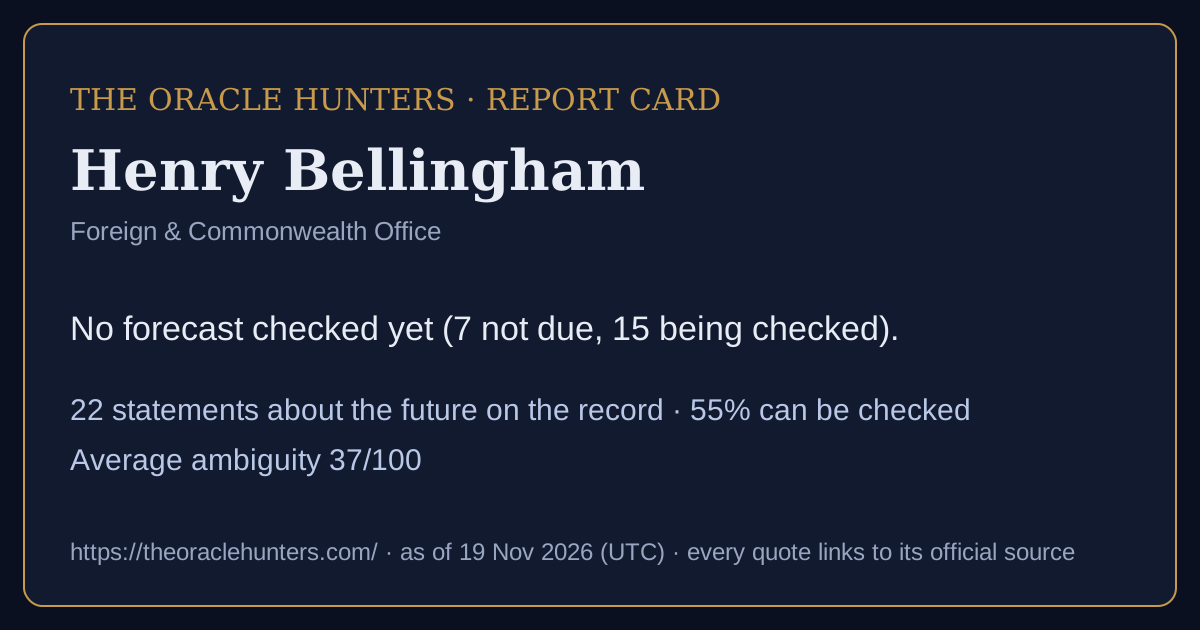
Track record: No forecast checked yet (7 not due, 15 being checked).
22forecasts & commitments on the record
55%can be checked as stated
37average ambiguity (0-100)
0goalpost moves recorded
0confirmed U-turns
Timeline
came true partly did not not due / being checked / too vague
Calibration score: shown after 10 checked forecasts with a stated likelihood (now 0).
How they speak about the future: based on data 13, stated on authority 8, educated guess 1.
Kinds of claim: forecast 16, commitment 4, mixed claim 2. · Download this report card as a picture
In the nine words
πρόγνωσιςInference from evidence12 · 55%μαντείαInspired knowledge6 · 27%προαναγγελίαPublic pre-announcement4 · 18%
How to read this
Each box is one sentence a public figure or institution said about the future, word for word, with a link to the official text. Can be checked means it names what will happen, by when, and how likely - so it can be compared with official figures later. Too vague to check means it does not. Ambiguity (0-100) is how many different ways the sentence can be read. When the date passes, the forecast is compared with official data and marked came true, partly or did not come true. Labels judge the sentence, never the person. Full guide and glossary.On the record (22)
By 2015 it will be providing £300 million per year in Development assistance.
The UK contributes almost 10% of the Court’s budget - which this year will amount to over €10m of a budget of €111m.
The UN predicts that without this humanitarian aid 750,000 people could die before the end of the year.
Especially important is the building of prisons, and the agreement to post-trial handovers from the Seychelles, probably starting at the end of the year.
The Development Secretary Andrew Mitchell will be speaking here next month, and I am sure he will have more to say on how the Commonwealth can further the international development agenda.
In Australia earlier this year we saw floods and a cyclone that devastated communities, farms and mines; indeed coal production from the region may not return to normal until next year.
But we can make low carbon, climate resilient growth a security multiplier: by using resources more efficiently we will ease resource stresses and reduce our vulnerability to food and oil price shocks.
But we will not get agreement on a global, binding deal at the negotiations this year.
In Tanzania in May this year I was given a book put together by local photojournalists, whose pictures illustrated powerfully the changes to people’s lives that climate change had wrought: elderly women in Namakongoro Village in Lindi, for example, having to descend a precarious 30m home-made bamboo ladder to fetch water from caves because the waterholes have dried up.
Australia hosting the Commonwealth Heads of Government meeting (CHOGM) in October this year will be one of the most significant gatherings in recent years.
The Prime Minister and President Zuma wrote in a joint articlex last year that removing barriers to trade in the region could produce an extra $62bn dollars of GDP growth per year.
And we will push G20 countries to extend 100 per cent Duty Free Quota Free access to less-developed countries.
The CDC’s new business plan published in May makes clear that the £2bn of new investment from 2011-2015 will be focused only on sub-Saharan Africa and South Asia.
For example, the CDC, the UK Government’s development finance arm will be investing £1.2bn in Africa through to 2015.
We believe the ultimate goal is the creation of a legally binding global agreement on climate change and we remain committed to seeking multilateral solutions.
Ghana is one of the UK’s 14 priority markets in Africa and it is easy to see why: the country has already reached middle income status, has weathered the global economic downturn far better than Europe and the US, and has a forecast GDP growth rate of 7%; 15% if we include oil revenues.
But at the current rate of over one country a month I am on track to visit all 53 states in Africa by our next general election in May 2015!
This is a country whose economy is projected to grow 8.8% next year, according to World Bank figures.
Should the EU move to 30%, the UK will reduce its emissions by over 40%.
The UK will commit £1.5 billion in assistance between now and 2012 to help other countries to reduce emissions, in a way that does not threaten their growth, and to combat the negative effects of climate change.
The focus that the football brings to Africa this year, and the demonstration of team work and national pride that the competition will showcase, is a welcome backdrop against which to celebrate today the achievement of African countries individually and collectively.
We will encourage the EU and other developed countries to lower trade barriers to poor countries; and we will target aid to promote trade - particularly intra-regional trade - so that growth in Africa is more sustained, and is of benefit to all.
Also said - not checkable as stated (12 newest)
Remarks about the future with no date, figure or likelihood that could be checked. They are kept on the record and shown here, but not scored.
It is only through hard work, including through partnerships between our countries, that we will succeed.
May I also thank the Bank of Industry in Nigeria for hosting this important event and in such superb surroundings.
A World Bank study forecast that seven of the World’s fastest growing economies will be from Sub-Saharan Africa.
I came back hoping that we in Britain could build even stronger partnerships with Nigerian businesses, harnessing the energy and dynamism that characterises Nigeria today.
A well crafted Petroleum Industry Bill could set a legal framework that ensures investor confidence in the oil and gas sector.
Its inception, therefore, was a recognition that justice can reach beyond the confines of national boundaries, that impunity could and must be challenged and that all are accountable for their actions regardless of where they come from.
This is why the UK will continue to urge all countries to cooperate.
We hope others will do the same, and commend those State Parties who have made clear that they would arrest ICC indictees should they visit, Malawi being the most recent example.
The UK is proud to have been at the forefront of this revolution, and we will work relentlessly to strengthen it further.
Nor should we forget that in every African situation where the Court has been involved, either the country in question, or where relevant, all African states on the UN Security Council, have supported the involvement of the ICC.
“The Antarctic Treaty System continues to be one of the most successful international agreements in the world and the UK will continue to play a leading role.”
Working with international colleagues, I know that British scientists are making a huge contribution to increasing our knowledge of the continent, the planet and the future challenges we will face.