Heng Swee Keat
Monetary Authority of Singapore
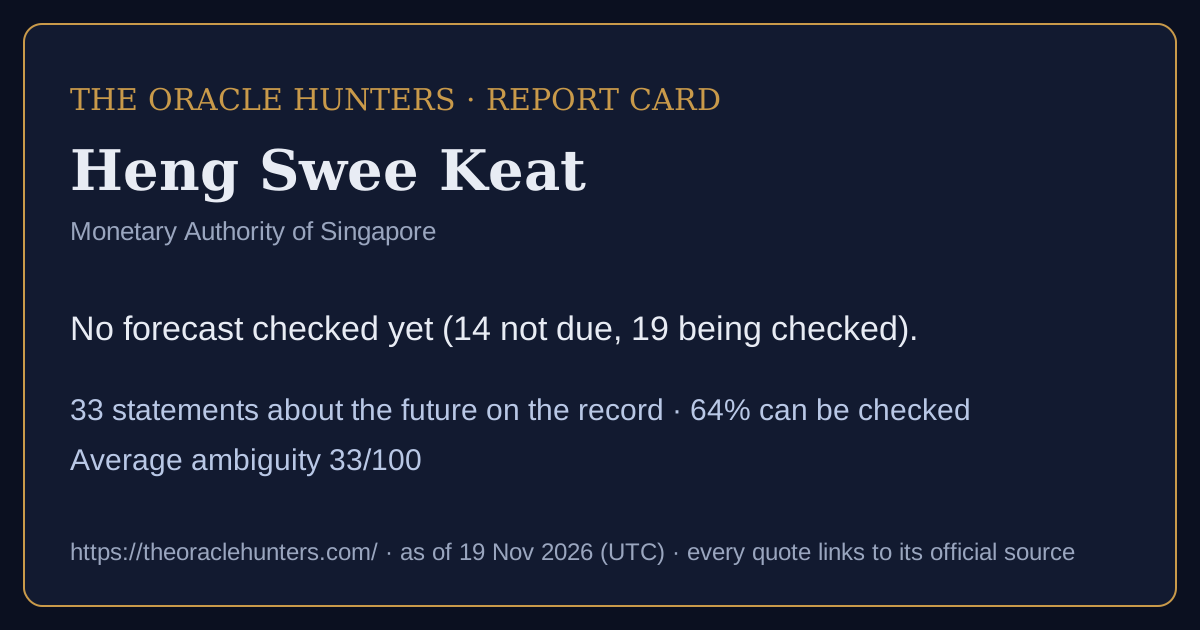
Track record: No forecast checked yet (14 not due, 19 being checked).
33forecasts & commitments on the record
64%can be checked as stated
33average ambiguity (0-100)
0goalpost moves recorded
0confirmed U-turns
Timeline
came true partly did not not due / being checked / too vague
Calibration score: shown after 10 checked forecasts with a stated likelihood (now 0).
How they speak about the future: based on data 19, stated on authority 13, educated guess 1.
Kinds of claim: forecast 23, commitment 6, mixed claim 3, scenario (if… then) 1. · Download this report card as a picture
In the nine words
πρόγνωσιςInference from evidence19 · 58%μαντείαInspired knowledge7 · 21%προαναγγελίαPublic pre-announcement6 · 18%πρόνοιαPreparing for the future1 · 3%
How to read this
Each box is one sentence a public figure or institution said about the future, word for word, with a link to the official text. Can be checked means it names what will happen, by when, and how likely - so it can be compared with official figures later. Too vague to check means it does not. Ambiguity (0-100) is how many different ways the sentence can be read. When the date passes, the forecast is compared with official data and marked came true, partly or did not come true. Labels judge the sentence, never the person. Full guide and glossary.On the record (33)
This year, the Singapore economy is expected to expand at a more moderate pace of 4-6%, driven by the services sector which is expected to benefit from robust regional demand.
MAS will mandate all local banks and significant insurers, following their Annual General Meetings this year, to have a dedicated Risk Management Committee, and for members of this Committee to have the appropriate balance of skills and expertise to discharge their responsibilities.
Starting this year, we will also be requiring mandatory training for all members of the Boards of local banks.
By bringing together senior officials from central banks and supervisory agencies from over 100 countries, this year's meeting will provide the platform for us to move ahead on the core of the regulatory changes, and to chart the direction for the remaining areas of work.
For the year as a whole, headline CPI inflation is projected to average between 2.5% and 3.5%.
Riding on Asia's growth, we will also continue to build on our strong fundamentals to provide for sustainable growth in the financial sector.
First, we will increase the availability of liquid securities to banks by issuing shortterm MAS bills as part of money market operations.
Growth is likely to have peaked at the middle of this year, and will moderate to a more sustainable rate, as external demand slows after the post-crisis bounce from stimulus measures and inventory effects wane worldwide.
The strong pace of growth seen in the first half of this year is not expected to be sustained.
There are three areas which MAS has been working on and which we will continue to focus on in the coming year: first, sustaining macroeconomic stability in the postcrisis period; second, strengthening the financial system; and third, maintaining the growth of Singapore's financial services sector.
But if we assess that we could also do a better job to take errant drivers to task early, we would have to also focus on strengthening the effectiveness of enforcement.
The Singapore economy has rebounded strongly and is expected to grow by 7-9% this year.
We will continue to work with fellow regulators and the private sector to fine-tune our regulatory approach and to develop the infrastructure and talent to facilitate the growth of Islamic Finance in Singapore.
MAS will announce members of the Corporate Governance Council, and its terms of reference, early next year.
For the whole of 2009, CPI inflation is now expected to come in between -0.5% and 0.5%.
For the economy as a whole, MTI has revised the official growth forecast for 2009 to between -6% and -4%.
We are targeting to conduct our review and consult the industry and public on the proposed changes over the next six to nine months, and will seek to implement the revisions to the deposit insurance scheme in 2010.
Its 2009 world GDP growth forecast was lowered slightly to -1.4% from -1.3% previously.
1 In July 2009, IMF upgraded its 2010 world GDP growth forecast from 1.9% to 2.5%.
We are committed to working with fellow regulators, and to developing the infrastructure and talent to support the growth of Islamic Finance in Singapore.
A recent survey by the ADB Institute found that a higher than expected 22% of responding firms use preferences accorded by free trade agreement (FTA) and more are planning to do so. 3 China, Japan and Korea have implemented their FTAs with ASEAN.
2 The World Bank projected Developing East Asia (including China) to grow by 5.3% in 2009;
Estimates of global Islamic Finance assets today range from US$700 billion to US$ 1 trillion and one consultancy firm estimates this could potentially grow to US$1.6 trillion by 2012. 4
To support professionals who wish to deepen their expertise, I am pleased to announce that beginning from this year we will sponsor students for the eligible Islamic Finance Masters programmes.
Under this Initiative, the Government will absorb 75% of the risk for insurance covering working capital and trade-financing loan facilities.
A number of financial institutions have already expressed interest and we expect the first issue to take place at the start of next year.
Between Asia and the GCC, for instance, total trade grew by 17% annually since 2000 to exceed US$328 billion in 2006. 8 Total cross-border capital flows between Asia and the GCC are also predicted to increase from US$15 billion at end 2006 to US$300 billion by 2020. 9 Even if only half of these projections are realised, growth is still …
Activities in Islamic Finance are growing with the entry of new players, and MAS is honoured to host the 6th Islamic Financial Services Board Summit in May next year.
We are thus revising our CPI inflation forecast for this year to 6-7%, compared to the earlier estimate of 5-6%.
Overall, global growth is expected to fall to 2.9% this year from 3.8% in 2007.
Finally, we are honored to be given the opportunity to host IFSB's 6th annual Summit next year, which will be a landmark event for Singapore and our Islamic finance industry.
The leaders of ASEAN have agreed to establish the ASEAN Economic Community by 2015, so that ASEAN will become a single production base with freer flow of goods, services and investments.
We expect to announce the results of our review soon, which will provide greater clarity on how we will be strengthening the REITs regime to promote better governance of REITS and further facilitate the growth of the industry.
Also said - not checkable as stated (12 newest)
Remarks about the future with no date, figure or likelihood that could be checked. They are kept on the record and shown here, but not scored.
The IMF and global bodies like the G20 will have to continue to focus and provide direction on these structural issues.
We will have to remain vigilant and nimble.
I hope that we will continue to make our small contribution to the global discussion on these challenges.
We will play our part in strengthening the global financial infrastructure to facilitate the efficient channelling of savings for sustainable development in the region and beyond.
To sustain global growth, some changes in the global saving-investment pattern will be necessary.
In particular, as Asian economies undergo rapid transition, policymakers will have to evolve their financial systems to meet the rapidly changing needs of their economies.
Indeed, post-crisis, central banks and regulators are focused on financial stability and the need to be proactive with regards to the risk of asset bubbles.
At the management level, MAS expects risk management units have to be sufficiently empowered and adequately plugged in to the risk-taking activities of the firm.
About 10 years ago, investors were concerned that the strong budget surplus of the US Federal Government might lead to a severe reduction in the supply of US Treasuries.
In the coming years, we will be focusing on some new tools such as countercyclical capital.
Different countries have different institutional arrangements, so each country will need to decide on the optimal arrangements.
While the financial system has to be responsive to the needs of the economy, a politicised supervisory process will almost certainly bring adverse consequences down the road.