Harvesh Seegolam
Bank of Mauritius
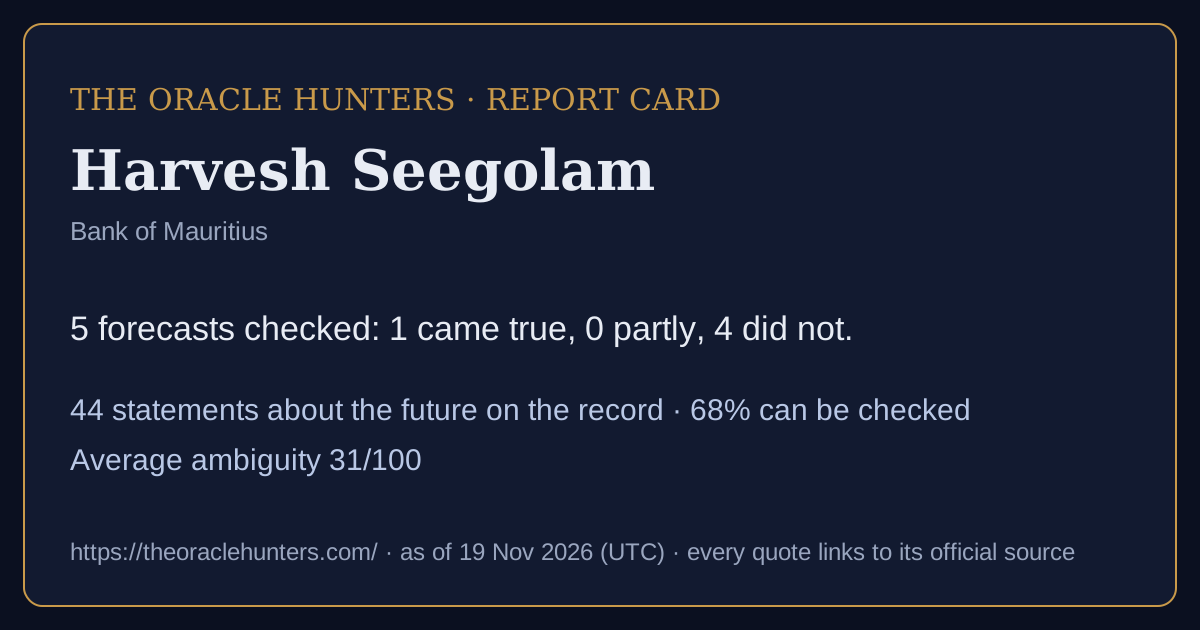
Track record: 5 forecasts checked: 1 came true, 0 partly, 4 did not.
44forecasts & commitments on the record
68%can be checked as stated
31average ambiguity (0-100)
0goalpost moves recorded
0confirmed U-turns
Timeline
came true partly did not not due / being checked / too vague
Calibration score: shown after 10 checked forecasts with a stated likelihood (now 4).
How they speak about the future: based on data 37, stated on authority 7.
Kinds of claim: forecast 41, mixed claim 2, commitment 1. · Download this report card as a picture
In the nine words
πρόγνωσιςInference from evidence37 · 84%μαντείαInspired knowledge6 · 14%προαναγγελίαPublic pre-announcement1 · 2%
How to read this
Each box is one sentence a public figure or institution said about the future, word for word, with a link to the official text. Can be checked means it names what will happen, by when, and how likely - so it can be compared with official figures later. Too vague to check means it does not. Ambiguity (0-100) is how many different ways the sentence can be read. When the date passes, the forecast is compared with official data and marked came true, partly or did not come true. Labels judge the sentence, never the person. Full guide and glossary.Checked
The economy is forecast to grow by around 5 per cent in 2023.
Came true. Said: economic growth around 5% in 2023. Official figure for Mauritius: 4.7% (World Bank open data). On target. Off by 0.3 points. official data · checked 14 Nov 2026 · automatic check against official data (rules v3)
It is expected that headline inflation will come down to 5-6 percent in 2023, from 10.6 per cent in 2022.
Did not come true. Said: inflation between 5% and 6% in 2023. Official figure for Mauritius: 7.1% (World Bank open data). Missed. Off by 1.1 points. official data · checked 14 Nov 2026 · automatic check against official data (rules v3)
For 2021, real GDP is projected to grow at about 7.5 per cent.
Did not come true. Said: economic growth around 7.5% in 2021. Official figure for Mauritius: 3.3% (World Bank open data). Missed. Off by 4.2 points. official data · checked 14 Nov 2026 · automatic check against official data (rules v3)
Barring exogenous shocks, the Bank is expecting headline inflation at about 2.5 per cent in 2020 and at about 2.0 per cent in 2021.
Did not come true. Said: inflation around 2% in 2021. Official figure for Mauritius: 4.0% (World Bank open data). Missed. Off by 2.0 points. official data · checked 14 Nov 2026 · automatic check against official data (rules v3)
However, real GDP growth is projected at about 7 per cent in 2021.
Did not come true. Said: economic growth around 7% in 2021. Official figure for Mauritius: 3.3% (World Bank open data). Missed. Off by 3.7 points. official data · checked 14 Nov 2026 · automatic check against official data (rules v3)
On the record (44)
These dynamics provide concrete evidence that inflation will stay within the target range of 2 to 5 per cent, and converge towards the Bank's midpoint target for inflation, namely 3.5 per cent.
The current account deficit is projected to improve from 4.5 per cent of GDP in 2023 to 4.3 per cent of GDP in 2024, on account of healthy tourism earnings and higher interest income.
In the absence of any shock, headline inflation is projected to be around 4.0 per cent at by the end of 2024 - settling within the inflation target range.
The US Fed will be convening two more meetings till the end of this year, and the market expects two further policy rate declines of 25 basis points each.
The IMF, in its July 2024 WEO Update, forecast global inflation to fall from 6.7 per cent in 2023 to 5.9 per cent in 2024 and further to 4.4 per cent in 2025.
In its July 2024 World Economic Outlook (WEO) Update, the IMF projected global growth to remain stable at 3.2 per cent in 2024 and 3.3 per cent in 2025.
I am pleased to report that the work of the Climate Change Centre over the past three years is on the right track as demonstrated through a 64 percent increase in bank exposures towards sustainable projects, and a 53 percent increase in loan applications for sustainable project financing over the period June 2022 to June 2023 as per the survey …
This year shall be remembered for many reasons.
Across-the-board buoyancy in main economic sectors of activity is expected to sustain the domestic growth momentum this year as well.
The IMF, in its January 2024 World Economic Outlook Update, projects global growth at 3.1 per cent in 2024 and slightly higher at 3.2 per cent in 2025.
Inflationary impulses have subsided in 2023 and are projected to ease further this year.
Inflation is projected to maintain its downward trend this year and be within the Bank's target range of 2% - 5% for inflation.
The IMF forecast global inflation to drop to 5.8 per cent in 2024 and further to 4.4 per cent in 2025 on the back of lower food prices, softening labour market conditions and lower core inflation.
As at 30 June 2023, the banking sector's total exposure in MUR to sustainable projects was estimated at Rs 6.9bn, compared to Rs4.2bn a year earlier.
These MNCs are expected to exclude 35 per cent of their current suppliers as they transition away from carbon.
A study by Standard Chartered Bank in June 2021 concluded that by 2025, 78 per cent of multinational corporations (MNCs) will remove suppliers that endanger their carbon transition plan.
Next month, the Bank of Mauritius will be issuing a document for public consultation on CBDC.
I am pleased to share with the audience that from the 22 nd to the 24 th of November this year, the Bank of Mauritius will host the Annual General Meetings of FinCoNet.
The current account deficit is projected to be slightly lower at 14.0 per cent of GDP in 2022 compared to the previous estimate of 14.7 per cent, mainly reflecting a much better-than-expected performance of the services account in 2022Q3.
The performance across most economic sectors is expected to be sustained in the last quarter of this year.
The OECD, in its November 2022 Economic Outlook Report, has forecast global growth at 3.1 per cent for 2022.
The economy is forecast to grow by around 5 per cent in 2023.
Came true. Said: economic growth around 5% in 2023. Official figure for Mauritius: 4.7% (World Bank open data). On target. Off by 0.3 points. official data · checked 14 Nov 2026 · automatic check against official data (rules v3)
The EDB has forecast FDI for this year to be above Rs20 billion.
It is expected that headline inflation will come down to 5-6 percent in 2023, from 10.6 per cent in 2022.
Did not come true. Said: inflation between 5% and 6% in 2023. Official figure for Mauritius: 7.1% (World Bank open data). Missed. Off by 1.1 points. official data · checked 14 Nov 2026 · automatic check against official data (rules v3)
In this regard, in March 2023, we will be hosting GSBF members including Central Banks and Prudential Authorities to discuss on the role and challenges of banking supervisors on AML/CFT matters.
Before this year is out, the Bank will replace its current monetary policy framework dating back to 2006 - with a new forward-looking, flexible inflation-targeting framework adapted to the realities of today for the Mauritian economy.
I am pleased to announce that the Bank of Mauritius will participate to this year's edition of the Global Money Week, an initiative spearheaded by the OECD/INFE, and which will take place from the 21st to the 27th of March next.
The first report of the Committee is expected in Quarter 1 2021.
Consequently, Bank staff has revised its projection for real GDP growth for 2020, from -12.5 per cent to -13.0 per cent.
Bank loans to the private sector continue to rise, growing year-on-year by 5.1 per cent in July 2020, from 4.1 per cent in May 2020, the highest pace recorded since May 2019.
The Bank has estimated that the country could lose, on a net basis, about Rs58 billion in terms of foreign exchange earnings in 2020, mainly arising from revenue losses from tourism and exports of goods and services.
The world economy is projected to recover in 2021, with an estimated growth of 5.0 per cent.
For 2021, real GDP is projected to grow at about 7.5 per cent.
Did not come true. Said: economic growth around 7.5% in 2021. Official figure for Mauritius: 3.3% (World Bank open data). Missed. Off by 4.2 points. official data · checked 14 Nov 2026 · automatic check against official data (rules v3)
The UK economy is projected by the Bank of England to shrink by 25 per cent, on a year-on-year basis.
The Bank remains alert and I assure you that we will continue to do whatever it takes for as long as conditions warrant to maintain price stability, orderly and balanced economic development as well as financial stability.
Barring exogenous shocks, the Bank is expecting headline inflation at about 2.5 per cent in 2020 and at about 2.0 per cent in 2021.
Did not come true. Said: inflation around 2% in 2021. Official figure for Mauritius: 4.0% (World Bank open data). Missed. Off by 2.0 points. official data · checked 14 Nov 2026 · automatic check against official data (rules v3)
In its June 2020 WEO Update, the IMF has assumed that major central banks will maintain an accommodative monetary policy stance up to the end of 2021.
However, real GDP growth is projected at about 7 per cent in 2021.
Did not come true. Said: economic growth around 7% in 2021. Official figure for Mauritius: 3.3% (World Bank open data). Missed. Off by 3.7 points. official data · checked 14 Nov 2026 · automatic check against official data (rules v3)
Savings on debt servicing reaped by households and corporate entities are estimated at around Rs1.4 billion and Rs2.2 billion, respectively, up to end-May 2020, that is an estimated total of Rs3.6 billion.
This year, as long as the tourism industry remains inoperative, there will be significant shortfalls in foreign exchange receipt.
The significant drop in export earnings will amplify the current account deficit, projected at about 12% of GDP in 2020.
This year, the overall balance of payments is forecast to record a deficit.
I must also point out that the Bank will finance this contribution by issuing its own instruments for the amount of Rs60 billion.
The contraction in output this year will be severe and we have estimated that the economy could contract between 7.5% and 15%.
Also said - not checkable as stated (12 newest)
Remarks about the future with no date, figure or likelihood that could be checked. They are kept on the record and shown here, but not scored.
Allow me to illustrate with the case of Mauritius: to meet its climate obligations by 2030 under the 2015 Paris Agreement alone, Mauritius requires funding estimated at USD 6.5 billion, 35 per cent of which would be funded by the Government and domestic private sector while the remaining 65percent or USD 4.3 billion would have to be financed externally by …
International banks must also develop relevant instruments and vehicles that will attract private investors.
We have the responsibility towards the future generations who will judge us by the quality of legacy we shall bequeath to them.
In Mauritius, we equally witnessed a major GDP contraction of around 15 per cent in 2020, one of the highest in the world I must say.
Project bankability is especially challenging for SIDS due to limited technical expertise and access to natural resources which may explain why less than one-third of the available climate funds has been disbursed so far to developing countries and SIDS.
We must reduce our environmental footprint or else risk another global crisis that could sprawl beyond control.
You will need to redefine your processes and business strategy for a smooth transition.
A robust disclosure framework will need to take centre stage to calm down the nerves of potential investors regarding the possibility of greenwashing.
The issue about debt dynamics is that it should not be accumulated till the point when it becomes unsustainable, i.e., starts spiralling out of control and, therefore, will require painstaking macroeconomic adjustments in the future.
In the journey that we are charting for Mauritius as an IFC of choice in sustainable finance, banks - locally and regionally - will have a critical role to play.
To do justice to the debate, however, we need to re-cast debt using an appropriate and well-balanced context.
Many of us are familiar with the famous law of motion equation of debt dynamics which posit that to grow out of debt sustainably, it is imperative to lay the foundation for strong macroeconomic performance.