Hans Tietmeyer
Central bank (via BIS)
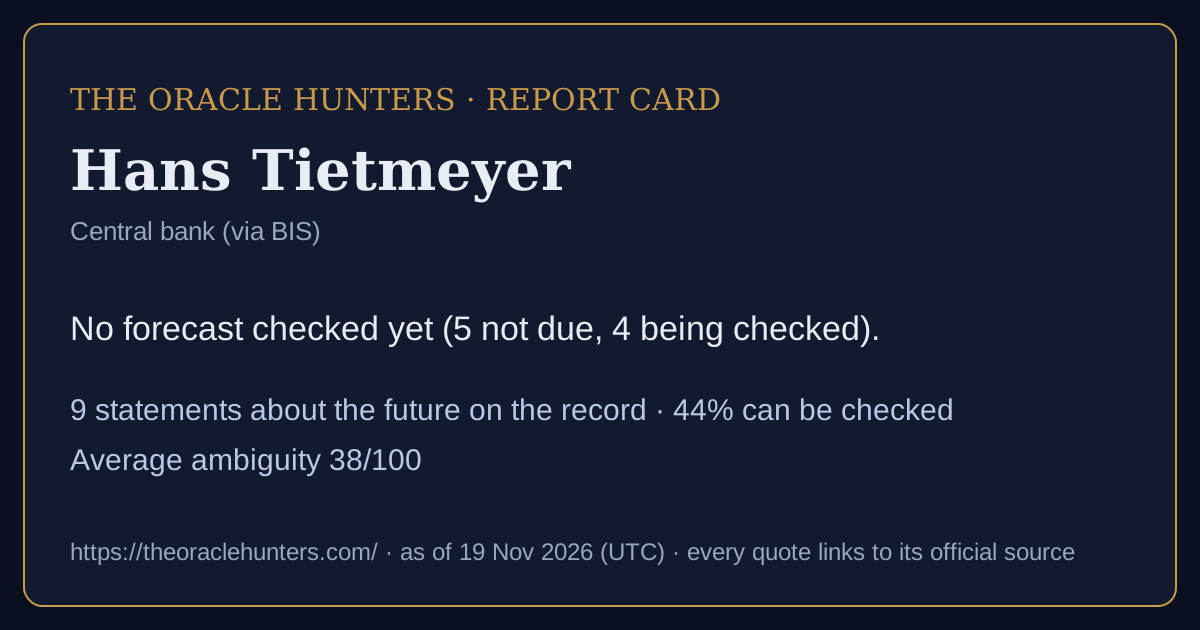
Track record: No forecast checked yet (5 not due, 4 being checked).
9forecasts & commitments on the record
44%can be checked as stated
38average ambiguity (0-100)
0goalpost moves recorded
0confirmed U-turns
Timeline
came true partly did not not due / being checked / too vague
Calibration score: shown after 10 checked forecasts with a stated likelihood (now 0).
How they speak about the future: based on data 6, educated guess 2, stated on authority 1.
Kinds of claim: forecast 7, scenario (if… then) 1, mixed claim 1. · Download this report card as a picture
In the nine words
πρόγνωσιςInference from evidence6 · 67%εἰκασίαConjecture1 · 11%μαντείαInspired knowledge1 · 11%πρόνοιαPreparing for the future1 · 11%
How to read this
Each box is one sentence a public figure or institution said about the future, word for word, with a link to the official text. Can be checked means it names what will happen, by when, and how likely - so it can be compared with official figures later. Too vague to check means it does not. Ambiguity (0-100) is how many different ways the sentence can be read. When the date passes, the forecast is compared with official data and marked came true, partly or did not come true. Labels judge the sentence, never the person. Full guide and glossary.On the record (9)
Indeed, the medium-term price outlook appeared so favourable to the Governing Counci we were actually able to lower central bank rates by a further 50 basis points in Apr
These elements comprise: the quantitative definition of price st the primary objective of the single monetary policy: 'Price stability shall be defined year increase in the Harmonised Index of Consumer Prices for the euro area of below 2 % this price stability is to be maintained over the medium term.
Secondly, upon the entry into monetary union at the end of the year, if not uniform money market rates will pertain.
At the end of the year, as you all know, the Central Bank Council of the Deutsche Bundesbank will surrender its monetary policy decision making powers to the ECB Governing Council, in accordance with the Maastricht Treaty.
And then I will not mind Financial Times wrote just a few days ago - D-Mark banknotes end up after 2002 as mul the famous hock wine, which is and will continue to be produced not far from Frankfurt.
Since the euro banknotes and coins will not be available until the end of 2001 and the beginning of 2002, the national currencies will continue to play a dominant role in the interim for wage and salary earners, consumers, retailers and probably among medium-sized businesses, too.
In all probability, the supranational monetary policy of the ECB will, in the event of a conflict, find it difficult enough as it is to withstand the political pressure of fiscal, economic and pay-rate policies which remain national in Europe.
In 1996, the average rate of inflation in the EU countries was no more than 2.5 %, for example, and is likely to be even less in 1997.
In Denmark, the general government's net borrowing will be reduced to almost a balanced budget in 1997, while the unemployment rate is expected to decline to almost 9 % of the working population, compared with the all-time high of more than 12 % in 1994.'
Also said - not checkable as stated (12 newest)
Remarks about the future with no date, figure or likelihood that could be checked. They are kept on the record and shown here, but not scored.
That does not mean that the international community should or could neglect such crisis.
The Forum should obviously not attempt the IMF's systematic surveillance of individual countries, although cases may arise where financial vulnerabilities in individual counties merit the Forum's attention.
As a financial center, Frankfurt has to be more than a center of commercial and central banking.
But if lender of last resort in a broader sense means that draining liquidity and offering generous or even unlimited credit lines should be regarded as main response and that the international community should place its highest priority on such measures, I would be strongly opposed.
These may not have been the final pearl of wisdom in the strict economic sense, but that should not make us overlook what fundamental pillars the convergence criteria represent in terms of the logic of a politically decentralised currency union.
(To be honest, I hope that is something we shall never learn.) However, we can tell from the recent national financial crises in other regions that systemic risk can easily arise.
We shall study developments carefully.
But in making a reasonable assessment of the opportunities and risks inherent in the project of monetary union, we shall maintain a longer-term perspective.
It may also be the case that the debate in Germany did not always take the best possible course, especially when somewhat too much emphasis was being placed on the decimal place in the budgetary policy for the test year, for example.
If the budgets of individual participating countries - especially the large ones - have excessive recourse to the capital markets, this will obviously be a burden on the other countries.
In future, even more than before, each country participating in monetary union will have to be a cushion differing movements in the business cycle and in growth and employment by the strength their own efforts and will have to be able to make appropriate adjustments.
It is likely that each country will have to own solution.