Guy Debelle
Reserve Bank of Australia
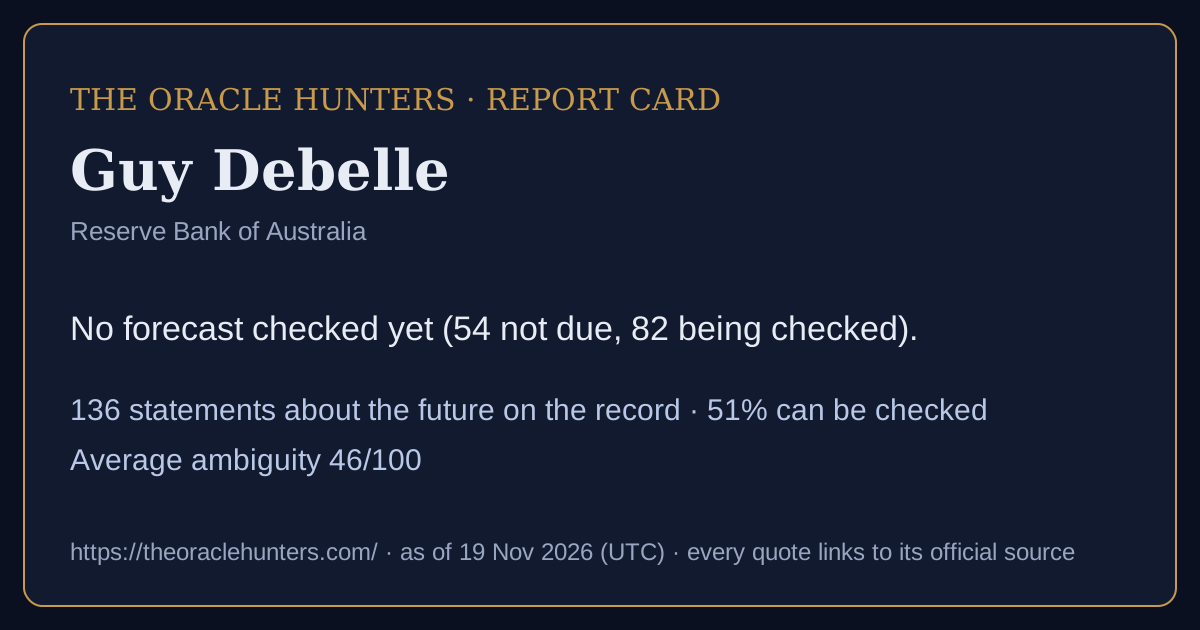
Track record: No forecast checked yet (54 not due, 82 being checked).
136forecasts & commitments on the record
51%can be checked as stated
46average ambiguity (0-100)
0goalpost moves recorded
0confirmed U-turns
Timeline
came true partly did not not due / being checked / too vague
Calibration score: shown after 10 checked forecasts with a stated likelihood (now 0).
How they speak about the future: based on data 95, stated on authority 29, educated guess 12.
Kinds of claim: forecast 110, mixed claim 13, scenario (if… then) 11, commitment 2. · Download this report card as a picture
In the nine words
πρόγνωσιςInference from evidence95 · 70%μαντείαInspired knowledge26 · 19%πρόνοιαPreparing for the future10 · 7%προαναγγελίαPublic pre-announcement2 · 1%φρόνησιςPractical wisdom1 · 1%εἰκασίαConjecture1 · 1%πρόβλεψιςSeeing the signs1 · 1%
How to read this
Each box is one sentence a public figure or institution said about the future, word for word, with a link to the official text. Can be checked means it names what will happen, by when, and how likely - so it can be compared with official figures later. Too vague to check means it does not. Ambiguity (0-100) is how many different ways the sentence can be read. When the date passes, the forecast is compared with official data and marked came true, partly or did not come true. Labels judge the sentence, never the person. Full guide and glossary.On the record (136)
- a Term Funding Facility (TFF) for the banking system under which funds equivalent to 3 per cent of lending could be borrowed from the RBA for 3 years at 25 basis points (against eligible collateral) up until end September 2020.
- forward guidance that the Board will not increase the cash rate target until progress is being made towards full employment and it is confident that inflation will be sustainably within the 2-3 per cent target band
We will need a tighter labour market to lead to higher wage rises.
For that to occur, we will need to see further significant gains in employment and a lower unemployment rate.
It will continue to provide low-cost funding to the banking system and keep downward pressure on borrowing rates for businesses and households throughout the next 3 years until the funds are repaid.
The size and duration of the TFF was extended in September 2020, when an additional 2 per cent could be accessed until end June 2021 (the deadline for drawing down additional allowances related to business lending was also extended to this date).
The Board has stated that it will not increase the cash rate until actual inflation is sustainably within the target range of 2-3 per cent.
cash rate and are around 4 basis points for the foreseeable future, reflecting the market's expectations that the ES rate and the cash rate will not be increased over that horizon, consistent with the Bank's forward guidance.
A materially lower unemployment rate is clearly desirable in itself, but will also be necessary before we will see sustainably higher wages growth and inflation.
This is true in Australia, where the federal government's budget deficit in 2020/21 is expected to be 11 per cent of GDP, having been near balance at the beginning of this year (Graph 1).
year and (in the central scenario) to decline gradually to be 7 per cent by the end of 2022.
In the August Statement on Monetary Policy , the forecast was for the unemployment rate to rise to 10 per cent at the end of the
The Board has consistently stated that it will not increase the cash rate target until progress is being made towards full employment and it is confident that inflation will be sustainably within the 2-3 per cent target band.
In a few weeks' time, it will switch to being the April 2024 maturity.
It will result in a further material expansion of the RBA's balance sheet for the next three years.
The unemployment rate in August was 6.8 per cent, which was better than expected.
This is consistent with the Board's guidance that the cash rate target will not be raised until progress is being made towards full employment and it is confident that inflation will be sustainably within the 2-3 per cent target band.
Particularly obvious is the settlement of $19 billion of the December 2030 bond on 21 May, which was the largest bond syndicated in Australian history and resulted in a large rise in Government deposits (Graph 11).
We expect increased drawings in the coming months as banks use the TFF funds to replace maturing wholesale funding.
The market expectation is that the cash rate will remain around its current level of 13-14 basis points for at least the next year (Graph 3).
- The expectations theory of the term structure implies that the three-year Government bond yield should be approximately equal to the expected path of the cash rate over the next three years, with some (potentially small) compensation for uncertainty over that three-year horizon.
The estimate is approximate, but at this stage we think the decline in services exports in the March quarter will amount to at least 10 per cent, roughly evenly split between lower tourism and education exports.
We had estimated that the bushfires will subtract around 0.2 percentage points from growth across the December and March quarters, but besides that, economic growth was set to continue to pick up supported by low interest rates, the lower exchange rate, a rise in mining investment, high levels of spending on infrastructure and an expected recovery in residential construction.
What we know from our liaison program is that the proportion of firms expecting stable wages growth in the year ahead is around 80 per cent and only around 10 per cent anticipate stronger wages growth.
The Bank has highlighted this previously, but I will update that analysis and illustrate the increased pervasiveness of wage outcomes between 2 and 3 per cent across the labour market.
Growth in disposable income slowed from 4 per cent at the end of 2017 to 2 per cent by the end of 2018.
As the residential construction sector downturn continues over the next year, the impact will be felt in these sectors too.
The effect of the downturn in housing construction on the broader economy, though, is likely to be somewhat larger than 1 percentage point given the linkages the sector has with other parts of the economy.
This will directly subtract around 1 percentage point from GDP growth from peak to trough, given that dwelling investment accounts for around 6 per cent of GDP.
Given the large size of the pipeline, we had expected construction activity to remain at a pretty high level for most of this year, but it turned down sooner and by more than we had expected.
We are forecasting a further 7 per cent decline in dwelling investment over the next year, and there is some risk the decline could be even larger.
In the March quarter this year, the deficit was 0.6 per cent of GDP, and it may well be smaller still in the June quarter just past.
If, on the other hand, domestic demand remains resilient, there could be enough demand that businesses decide an investment will be profitable regardless of the trade uncertainty.
This year, we will be giving respondents an opportunity to point to areas where they think greater guidance from the Code might be necessary.
The first review of the Code will take place during 2020.
To prevent LIBOR from abruptly ceasing to exist, the FCA has received assurances from the current banks on the LIBOR panel that they will continue to submit until the end of 2021.
Hopefully normal seasonal conditions will return in time for the winter crop this year.
Particular industries and particular communities that are especially exposed to the costs of changes in the climate will face lower costs if there is an early and orderly transition.
If instead we have a statement such as 'x has a one in three chance of happening in the next two years', we can work out that it is less likely to occur than something that has a 50/50 chance of happening.
Around one-quarter of all employees will have received a 3.5 per cent pay rise following the increase in national minimum and award wages on July 1.
I will invoke Chris Caton in noting that you should always avoid statements like: if the participation rate hadn't increased, the unemployment rate would have been lower.
limited by these caps, which means that child care prices could also fall in the March quarter next year.
Rather it has been kept going to date because of the actions of regulators, but that is not going to occur beyond 2021.
T o prevent LIBOR from abruptly ceasing to exist, the FCA has received assurances from the current banks on the LIBOR panel that they will continue to submit their estimates to sustain LIBOR until the end of 2021.
A large share of these contracts have short durations, often three months or less, so these will roll off well ahead of 2021, but they should not continue to be replaced with another short-dated contract referencing LIBOR.
There is a risk that it may take a lower unemployment rate than we currently expect to generate a sustained move higher than the 2 per cent focal point evident in many wage outcomes today. 9
Forecasts for global growth in 2018 and 2019 are below the outcome for 2017, notwithstanding some upward revisions to those forecasts (Graph 2).
The outlook for the economy in 2018 and 2019 is expected to be a little stronger than occurred in
In contrast, I would expect that the 20 per cent depreciation of the Australian dollar in 2014-2015 did have a material impact on decision-making at any business with an export or import-competing focus.
Table 1 shows the Bank's outlook for GDP growth, the unemployment rate and inflation until June 2020.
Showing the newest 50 - the ledger has all 136.
Also said - not checkable as stated (12 newest)
Remarks about the future with no date, figure or likelihood that could be checked. They are kept on the record and shown here, but not scored.
We have been discussing how EMEAP could best contribute to the G20 roadmap on enhancing cross-border payments.
This will reduce the reliance on existing cross-border banking arrangements.
- Project Nexus provides a blueprint for scalable connectivity of countries' domestic fast payment systems, which will make cross-border payments faster, cheaper, easier to access and more transparent.
Project Dunbar will develop prototypes of a common multilateral settlement platform that will enable international settlements with digital currencies issued by multiple central banks (as opposed to reliance on existing payment systems).
It will continue to serve its important role of setting the standard for good practice.
We did consider whether to state what some of those other purposes might be that you should not use last look for.
Decisions should be prompt and may well be within small fractions of a second in many cases, but cannot truly be immediate.
Market participants should be making clients aware of the basis on which trades might be rejected, and should be keeping records of the reasons behind electronic trade rejections.
While the intent of any liquidity provider conducting pre hedging should be to benefit the liquidity consumer in executing an anticipated order, there is no guarantee that it will always result in a trade, or a trade at a price that is beneficial to the liquidity consumer.
The Code's guidance on the information that providers of Algorithmic Trading or aggregation services should be disclosing has been expanded to include the disclosure of any conflicts of interest that could impact the handling of client orders (such as those arising from interaction with their own principal market-making desk).
At the same time, we will also publish the disclosure templates as they contain disclosures on last look.
Tonight I will remind you about the important role the Code plays in the foreign exchange (FX) market.