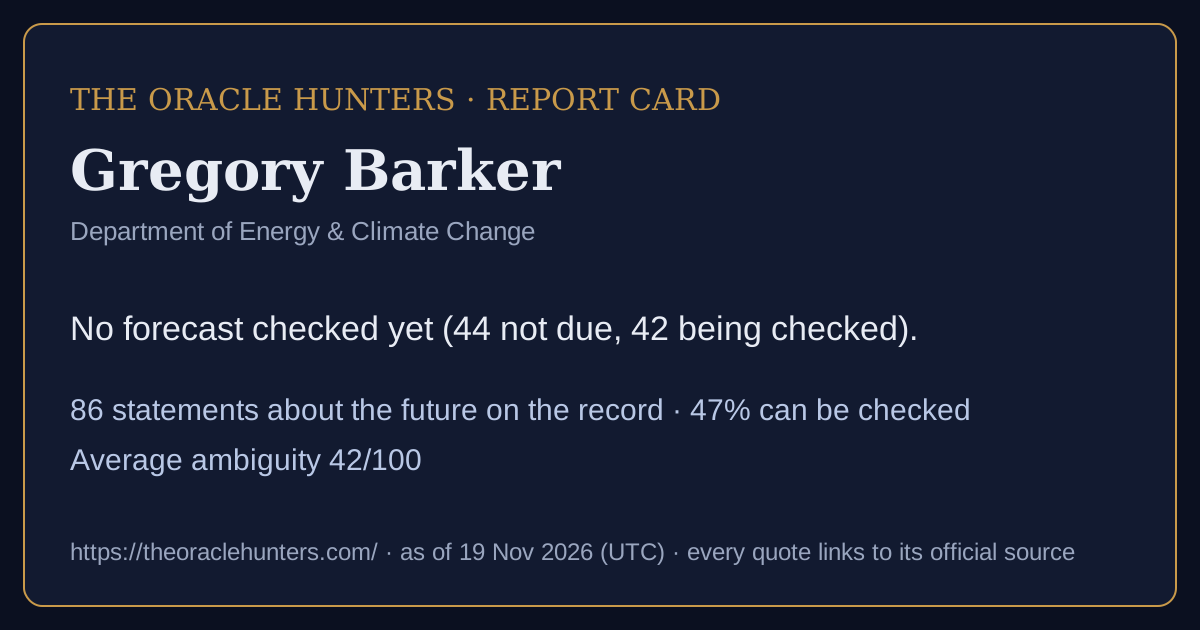
Gregory Barker
Department of Energy & Climate Change · GBR
Track record: No forecast checked yet (44 not due, 42 being checked).
86forecasts & commitments on the record
47%can be checked as stated
42average ambiguity (0-100)
0goalpost moves recorded
0confirmed U-turns
Timeline
came true partly did not not due / being checked / too vague
Calibration score: shown after 10 checked forecasts with a stated likelihood (now 0).
How they speak about the future: based on data 71, stated on authority 14, educated guess 1.
Kinds of claim: forecast 72, mixed claim 10, scenario (if… then) 2, commitment 2. · Download this report card as a picture
In the nine words
πρόγνωσιςInference from evidence70 · 81%μαντείαInspired knowledge12 · 14%προαναγγελίαPublic pre-announcement2 · 2%πρόνοιαPreparing for the future2 · 2%
How to read this
Each box is one sentence a public figure or institution said about the future, word for word, with a link to the official text. Can be checked means it names what will happen, by when, and how likely - so it can be compared with official figures later. Too vague to check means it does not. Ambiguity (0-100) is how many different ways the sentence can be read. When the date passes, the forecast is compared with official data and marked came true, partly or did not come true. Labels judge the sentence, never the person. Full guide and glossary.On the record (86)
On schools, we – together with the BPVA and Friends of the Earth – will launch a new campaign later this year to encourage students parents, teachers and Governors to install solar on school roofs.
We will build your suggestions into our programme of work to ensure an ambitious rate of growth in rooftop solar.
The GIB has committed £1.3bn to green energy projects and has mobilised a further £3.3bn of private sector money.
These will bring forward £12 billion of investment, support 8,500 jobs and generating enough electricity for over 3 million homes.
A reform that will deliver up to £100 billion of investment by 2020.
And a separate group of established technologies such as onshore wind and large-scale solar PV which will move to competition from the start of the CfD regime later this year
Construction will start later this year and will finish in 2016.
But by 2020 we could see 8 to 15GW of installed offshore wind capacity which could support up to 35,000 jobs
And a further 12 centres have recently been announced and will start taking students in October this year.
In this parliament, the members of the LCICG are expected to invest in excess of £1 billion in support for low carbon innovation.
By targeting our innovation support and fulfilling our innovation goals we could save the UK over £100 billion in energy costs to 2050.
Around 70% of our future economic growth is expected to come from innovation and the low carbon sector is set to make a major contribution to this.
As we prepare for the next spending round in 2015 we in government will need to make some tough choices.
Over £3.5m of grants have so far been placed with UK companies for energy from waste projects.
Lastly, five bioenergy projects have been supported by the Energy Entrepreneurs Fund a £35M fund aimed at helping small businesses demonstrate innovative low carbon technologies.
Government part-funded the Energy Technology Institute £13M waste to gasification demonstration project.
This funding support will run until March 2015 and I would encourage you take up the opportunities offered by the Delivery Unit through your Local Authority who is ideally placed to facilitate the development of heat networks by brokering agreements between heat providers, distributors and customers.
Those energy from waste technologies which are not eligible for CfDs may apply under the capacity market which we intend in 2014, for delivery of capacity in winter 2018-2019 (subject to state aid approval).
And the recent £22m funding commitment won by Biogen will allow them to roll 10 plants before 2017.
I encourage you all to see our website for details on how to apply for The Third phase of the Energy Entrepreneurs Fund which opened at end of January and offers up to £2m for projects.
Overall, energy storage innovation has the potential to save the energy system over £4bn by 2050, and innovation could support the growth of a UK energy storage industry and contribute an estimated £11.5bn to UK GDP by 2050.
It will set out core low carbon innovation priorities to 2020 as well as the key technologies that will benefit from public sector innovation worth £1billion to 2015.
So next year you can expect to hear more from me on my ambitious plans to ensure the government estate plays its part in the decentralised energy revolution.
Projects like the glasshouse heating scheme that Lincolnshire Herbs are investing over a million pounds in – when completed next year this will be one of the largest GSHP systems in the UK.
The CCC’s 4th Carbon Budget called for 6.8 million heat pumps by 2030 – this may be seen by some as a stretch – but I still expect heat pumps to play a major role in achieving heat’s contribution to the 2020 renewable energy target
The Renewable Heat Premium Payment has also supported over 17,000 renewable heat installations, with several thousands more expected this year in private and social housing up and down the country.
Announced that we will use the 2014 RHI review to examine the case for other renewable fuels such as sustainable, heating-only bioliquids, biopropane injection, gas driven heat pumps and reversible air-to-air heat pumps.
The £1.4m Wave Energy Converter project, using Scottish-based developer, Pelamis.
The total global market for ocean energy could be worth as much as £40bn per annum by 2050.
Through the Research Councils who have provided a £6m grant for the FloWave test tank, a national facility of international importance, which will soon open, here, at the University of Edinburgh.
They will decide the scope of a £1.5M joint call for research proposals between EPSRC and the Chinese Ministry of Science and Technology (MoST) to be launched in early 2014.
Work with us to link up with other initiatives we are determined to drive forward and share in their growth;
We could meet my 20GW ambition if we used jut 16% of UK commercial and industrial roof space.
The DECC central forecast expects some 10GW to be deployed by 2020.
Next month I will lead a dedicated solar trade mission to Saudi Arabia.
The LCICG are now building on the TINAs to develop a strategy, due to be published later this year which will lay out a shared vision of public investment principles approach and technology improvement priorities between now and 2020.
Together we will provide 1 billion pounds between 2011 and 2015 to directly support energy innovation.
Imagine how much more difficult this will be in 2030….
By 2030 India will be the largest middle class consumer market in the world.
And earlier this year they opened our first ever National Solar Centre, which will identify opportunities to help the solar industry deploy further, faster, and cheaper.
And later this year I will launch the UK’s first-ever Government led Solar Strategy.
Our Green Investment Bank – a world first – and one which I am glad to say Nick Stern was involved in the very early days when it was just a glimmer of an idea, Nick played a crucial part in helping frame that idea and ultimately help create that is now a key part of the architecture of the …
It predicted that China will install 100GW of renewable energy by 2015…
…the UK is taking a leadership position, the government is going to be at the forefront of an ambitious EU-wide target of 50% greenhouse gas emissions reductions by 2030 as part of a global deal…
…and 80% of Brazil’s power is expected to come from renewables by 2030.
Finally, I can disclose that from DECC’s £35m Energy Entrepreneurs Fund, we are funding 30 projects to support young innovative companies develop low carbon products.
It will put in place the necessary conditions to attract £110 billion investment in low carbon infrastructure to meet the unprecedented challenges we face.
DECC will give £2m funding for 16 organisations to help develop innovative storage solutions for energy.
This could save the UK over £160 billion in energy supply costs to 2050 and contribute billions to GDP over the same period multiplying the gains from our initial investment many times over.
And, despite recent public sector cuts the Government expects to invest in excess of £1billion between 2011-15 to directly support energy innovation
Showing the newest 50 - the ledger has all 86.
Also said - not checkable as stated (12 newest)
Remarks about the future with no date, figure or likelihood that could be checked. They are kept on the record and shown here, but not scored.
You may have heard that, when I reformed solar tariffs in 2011, I was accused by many of killing the sector stone dead.
If you own – and see every day – panels generating electricity, you are more likely to reduce unnecessary energy consumption.
No other country has taken this step, though many intend to – and, within the EU, all will have to.
I’d therefore like to focus my speech by looking ahead over the next few months and years.
But third, and importantly, this transition should be seen as an opportunity…
The need to handle these pressures leads me to my second point: the shift from the Renewables Obligation to Contracts for Difference.
Additionally, I should manage your expectations about the size of the budget.
Secondly, the energy market of tomorrow will – and must – look fundamentally different to yesterday.
And I hope you will see, as we finalise implementation of the reforms in the Energy Act, that we are determined to provide this.
Over time this will reduce the cost of capital for the sector and help renewable energy towards its target of competing on cost with energy from fossil fuels.
And if we are to realise our huge ambitions for renewables and offshore wind especially, we are going to need that certainty.
Earlier this month, we confirmed the two main technology groupings we will use when allocating contracts: