Greg Clark
Department for Business, Innovation & Skills · GBR
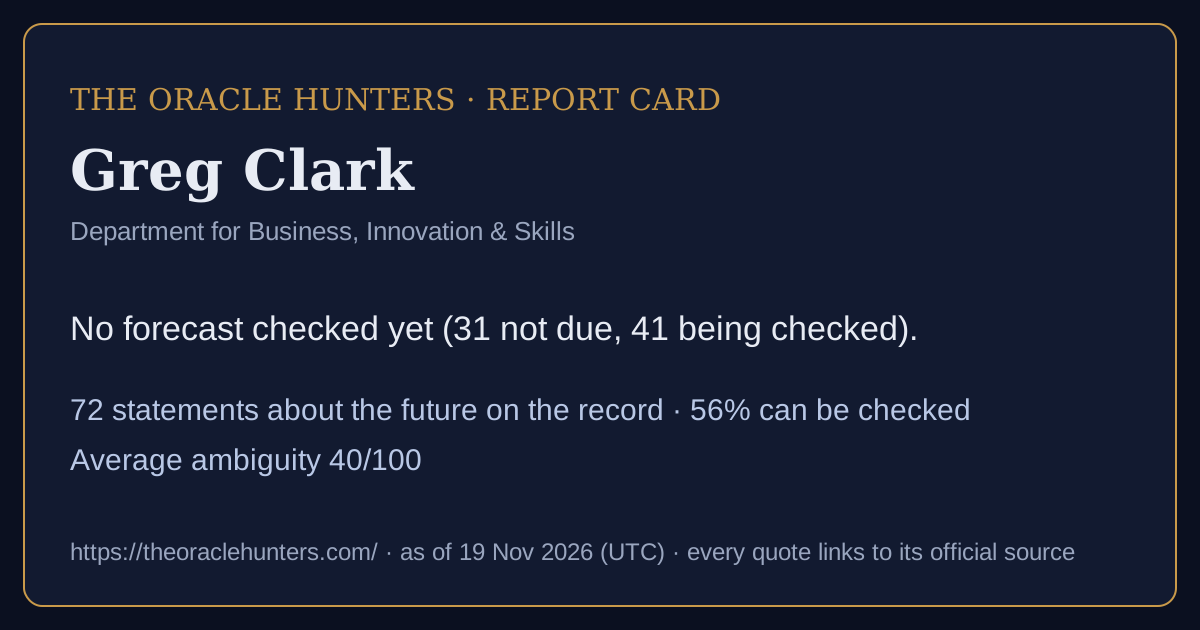
Track record: No forecast checked yet (31 not due, 41 being checked).
72forecasts & commitments on the record
56%can be checked as stated
40average ambiguity (0-100)
0goalpost moves recorded
0confirmed U-turns
Timeline
came true partly did not not due / being checked / too vague
Calibration score: shown after 10 checked forecasts with a stated likelihood (now 0).
How they speak about the future: based on data 52, stated on authority 17, educated guess 3.
Kinds of claim: forecast 44, mixed claim 15, commitment 9, scenario (if… then) 4. · Download this report card as a picture
In the nine words
πρόγνωσιςInference from evidence50 · 69%μαντείαInspired knowledge9 · 12%προαναγγελίαPublic pre-announcement9 · 12%πρόνοιαPreparing for the future4 · 6%
How to read this
Each box is one sentence a public figure or institution said about the future, word for word, with a link to the official text. Can be checked means it names what will happen, by when, and how likely - so it can be compared with official figures later. Too vague to check means it does not. Ambiguity (0-100) is how many different ways the sentence can be read. When the date passes, the forecast is compared with official data and marked came true, partly or did not come true. Labels judge the sentence, never the person. Full guide and glossary.On the record (72)
Before I go any further, I just want to comment on the announcement made by Honda this morning that their Swindon plant will close in 2021.
The very next month, in October we announced 120 million pounds to make sure that this diffusion of the technologies that we have in this country to supply chains in every part of industry should be able to be supported.
Will we have an economic means of mass energy storage in 2035?
We will shortly announce the parameters for the next Contracts for Difference (CfD) auction round that will be held by May next year, and, led by Claire Perry we also hope to move to the next stage with our ambitious Sector Deal in the coming weeks for offshore wind.
So today, I am delighted to announce, the winners of two £10 million innovation competitions which will support companies as they pioneer energy efficient technologies.
Of the more than $11 trillion of investment expected in global power in the next 3 decades, the vast majority – 86% – is expected to be in low carbon.
The Clean Growth Challenge is the means through which we shall do this, setting out the scale of the opportunity.
And by 2040, electric vehicles could make up over half of global car sales, compared to 1% today.
These new fellowships, awarded in the next three years, will have a lifetime value of nearly £900 million.
The money will help ensure the UK invests 2.4% of GDP in R&D by 2027.
With 40% of their exports going to the EU, they often need to deploy service engineers to member states within 24 hours for urgent site visits to service the manufacturer’s warranty, for example.
Currently superfast broadband is available to 91% of UK premises, and by 2025 15 million premises will have full-fibre
Not just about the next 3 years but on what our permanent relationship with the rest of the EU will be like.
And I’m delighted to announce today that the government will invest £90 million to make this challenge a reality.
So it’s fantastic that the Science Museum is planning a new £3 million exhibition to show the real face of modern British agriculture to the whole country and especially to the rising generation of people who may not have the knowledge or experience of agriculture, which should open later this year.
Employment in manufacturing is on the rise and from conversations I’ve had with many people in this room would rise further if only you could lay your hands on enough people with the skills you need.
And if, as I believe will be the case, this is formally agreed next month that continuity will be available for around 3 years from now.
We remain committed to nurturing the kind of low carbon economy that we set out in the Clean Growth Strategy.
Therefore we published draft legislation that will require Ofgem to design and set a price cap for all customers on standard variable tariffs and default tariffs that will be in place until 2020, with the option to extend it to 2023.
One estimate suggests that the UK’s low carbon economy could grow in the region of 11 per cent per year up to 2030…
For businesses, the largest pool of contributors to emissions, we will help them improve how they use their energy, aiming to improve their energy productivity by at least twenty per cent by 2030, saving businesses £6 billion a year…
Today we are publishing ‘Smart Systems and Flexibility’ – a plan to make the UK’s energy system smarter will help reduce energy bills, balance demand on the grid and realise up to £40 billion of benefits.
And through local industrial strategies, the government will help the business leaders, community representatives in each local economy to put a plan together to build on their strength and stimulate local growth.
Today, I am delighted to announce that the first £55 million phase of competition funding will begin early next month.
Later this year we will be unveiling a formal framework for the negotiation of sector deals.
If we do this right, a smart system could save consumers up to £40 billion in the coming decades.
It will save £11 off the average bill by 2020 rising to nearly £50 by 2030.
By 2020 every home and small business will have had the offer of a new smart meter.
We will have around 35% of our electricity from renewables by 2020.
There will be £6 million towards the development of advanced nuclear fuels which will provide greater levels of nuclear safety and importantly will help contribute to both conventional new build and possible small modular reactors.
This initial tranche will commit about £20 million to support innovation across 5 major areas during the next 2 years.
To support and incentivise locally-led investment in transport, housing, skills and other priorities, the next round of Growth Deals will make £4.3 billion of funding available from the Local Growth Fund.
In May next year we will see metropolitan mayors elected in at least nine parts of the country.
Local government will retain 100% of business rates from 2019 to 2020 and will be financially independent of central government.
In 2009, they registered 81,000 new homes; this year they expect to register 160,000.
Now, the great majority of local authorities do have a Local Plan – and we will ensure that the rest are in place by 2017.
By anyone’s reckoning, a 30% growth in 5 years in young people from the most disadvantaged backgrounds going to university, is remarkable progress.
That will not change, and our 10 year ‘Science and innovation strategy’ projects with confidence that demeanour over the next 2 Parliaments, not just the next year.
Science capital investment increased from £0.6 billion in 2012 to 2013 to £1.1 billion next year, and will rise as a minimum in line with inflation for the whole of the next Parliament.
Working hand in hand with academic partners and the private sector, we are committed to those targets set by the Space innovation and growth strategy.
The contract totals approximately €14 million, with delivery of the terminal to the European Space Agency expected by the end of 2016.
And I can only hope that when we look back in 2030, challenged by our own ambitions and inspired by the successes that I am sure we will be enjoying during those intervening years, that we can hand-on-heart say that we have done all that we could to create a good future for the UK space sector that will echo …
We have a firm ambition to establish a spaceport in the UK by 2018, and if we can capture even 10% of that market, we will be well on our way to reaching our target for the space sector as a whole.
We expected that this would translate in practice to something like 15,000 extra students this year.
And Howard Newby, another giant of the HE policy scene, will be retiring from the University of Liverpool next year.
Next year Eric Thomas will retire as VC of Bristol University after 14 years.
Their final report, due in February 2015, can play an important role in informing decisions at the next Spending Review, where you will want to ensure the story is one of a sector delivering the highest value for students and in research - and as Professor Diamond has said, “scaling the twin peaks of excellence and efficiency”.
If applications meet expectations, then the resources available for teaching will rise from £7.9 billion provided in 2011 to 2012 to around £10 billion in 2015 to 2016.
We will remove the arbitrary cap on student numbers completely in 2015 to 2016.
This will bring our overall investment in science to nearly £5.9 billion in 2015 to 2016 – an increase in overall spend compared to recent years.
Showing the newest 50 - the ledger has all 72.
Also said - not checkable as stated (12 newest)
Remarks about the future with no date, figure or likelihood that could be checked. They are kept on the record and shown here, but not scored.
Luring consumers onto cheap tariffs in the hope that many of them will fail to notice subsequent price rises should be seen as simply bad business.
Consumers may not feel the pinch when they click on that link for a cheaper credit card, but the card-issuer who has to recover the £100 that this click cost them on the search engine certainly does and will have to recover the cost from consumers somehow.
So we need to make sure that what may have characteristics in digital platforms that could run the risk of sapping innovation, squeezing businesses and raising the prices of goods anticipates some of the problems that may arise.
But before turning to each of these, allow me a brief, historical detour which I hope will show that government shaping of markets has always been with us, and needs to be approached without ideology - pro or contra – but in a pragmatic and empirical spirit.
And yet the CMA and Jason Furman, who led our review of competition between the Tech Giants, are right that the rules need to be considered and may need to change if competition is to perform its magic there too.
The CMA has just launched a much-needed market study into digital advertising and Professor Furman recommended that we establish a ‘Digital Markets Unit’ that will work to establish and enforce ex ante the principles by which we must shape these markets.
We will study the recommendations very carefully.
We know we must do more – and we will do more.
It is a comprehensive and ground-breaking report and we will commit to responding in a timeframe which
Everyone knows that when you appoint John Gummer to chair this important committee you are going to
It is a seminal work and draws on the very latest climate science and its impact will be felt for decades to come.
In the years ahead the battle to halt catastrophic climate change will be won or will be lost.