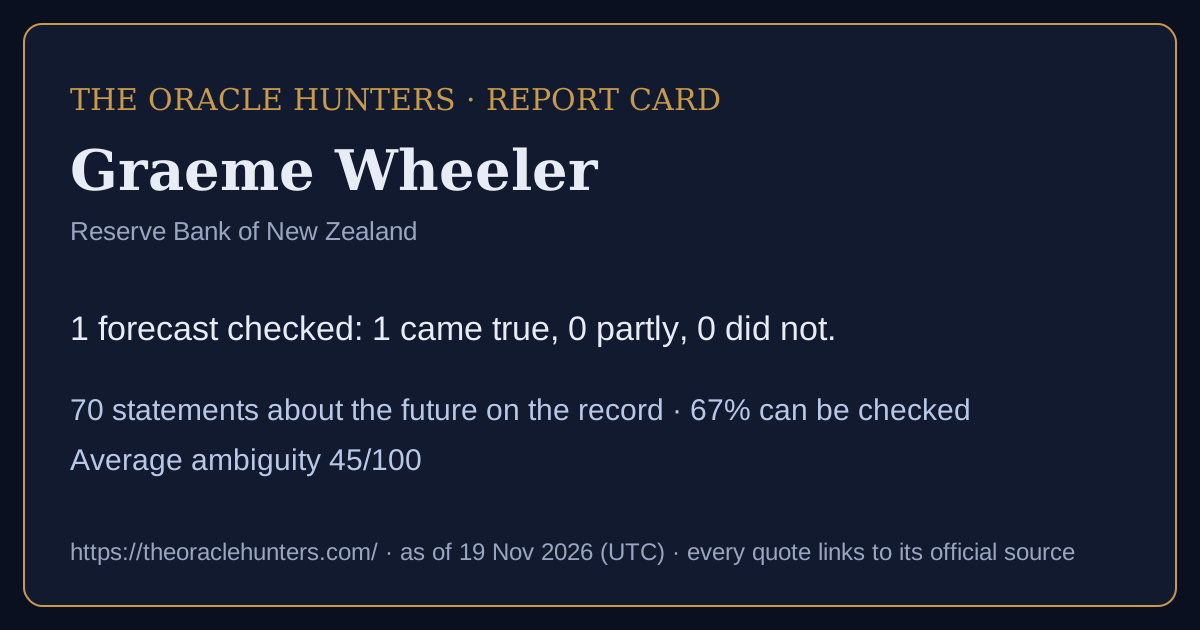
Graeme Wheeler
Reserve Bank of New Zealand
Track record: 1 forecast checked: 1 came true, 0 partly, 0 did not.
70forecasts & commitments on the record
67%can be checked as stated
45average ambiguity (0-100)
0goalpost moves recorded
0confirmed U-turns
Timeline
came true partly did not not due / being checked / too vague
Calibration score: shown after 10 checked forecasts with a stated likelihood (now 1).
How they speak about the future: based on data 56, educated guess 7, stated on authority 7.
Kinds of claim: forecast 55, scenario (if… then) 8, mixed claim 7. · Download this report card as a picture
In the nine words
πρόγνωσιςInference from evidence53 · 76%πρόνοιαPreparing for the future8 · 11%μαντείαInspired knowledge7 · 10%πρόβλεψιςSeeing the signs2 · 3%
How to read this
Each box is one sentence a public figure or institution said about the future, word for word, with a link to the official text. Can be checked means it names what will happen, by when, and how likely - so it can be compared with official figures later. Too vague to check means it does not. Ambiguity (0-100) is how many different ways the sentence can be read. When the date passes, the forecast is compared with official data and marked came true, partly or did not come true. Labels judge the sentence, never the person. Full guide and glossary.Checked
We expect economic growth in New Zealand's trading partners of around 3 ¾ percent this year - a little higher than last year and slightly above the average growth rate over the past 30 years.
Came true. Said: economic growth around 3.75% in 2015. Official figure for New Zealand: 3.7% (World Bank open data). On target. Off by 0.0 points. official data · checked 14 Nov 2026 · automatic check against official data (rules v3)
On the record (70)
By late 2014, the global economy was not strengthening as anticipated, oil prices had almost halved since June 2014 and whole milk powder prices were down by 40 percent.
If growth in the global economy slows because of debt-related or other issues, our economy will be affected.
With a debt to income ratio of 167 percent (up from the 2009 peak of 159 percent) households are already heavily exposed to the risk of rising interest rates or falling house prices.
Back home we've experienced the strongest migration surge since the 1800s, probably the longest period of negative tradables inflation since the Great Depression, a 75 percent decline in dairy prices before recovering, a major shift in resources to the non-tradables sector to support the Canterbury rebuild, and annual national house price inflation reached 21 percent.
With a third of new mortgage lending at that time taking place at LVRs of 80 percent or higher, the overall stock of high LVR mortgages was likely to approach 25 percent.
Our forecasts assume net immigration of 140,000 people over the next three years a further 3.5 percent boost to the working age population.
These projections represent the Bank's central view of the policy path needed to return inflation to the 2 percent mid-point of the target range specified in the Policy Targets Agreement (PTA).
This means that if the economy were to develop in line with the Bank's economic projections, the OCR would remain at its current level over the next two years.
Such an increase could have a major impact, especially on the countries introducing these restrictions: their GDP could fall by 2 to 3 percent; imports by 5 to 10 percent; and exports by 10 to 15 percent, with the US the worst affected.
The Official Cash Rate (OCR) projections in the November 2016 MPS contained a slight easing bias, building in a 20 percent probability of a further 25 basis-point interest rate cut.
The Reserve Bank's economic projections in the February 2017 Monetary Policy Statement, which are based on several assumptions, suggest that the economy could grow by around 3½ percent pa over the next two years.
However, while there are important issues around the build-up of debt, house price inflation, capital outflows, and the slow speed of reform in the SOE sector, the consensus international forecasts are that the Chinese economy will avoid any material slowdown and grow by around 6¼ percent pa over the next two years.
Some increase in construction cost inflation is likely as this is already running at 7.9 percent in Auckland and 6.3 percent nationally due to capacity bottlenecks within the sector.
Early indicators are that reconstruction work, including by government, could be in the order of $3 - $8 billion, or around 1-3 percent of GDP.
The low point for CPI inflation has probably passed and, supported by the improvement in global commodity prices in recent months, we expect the December quarter 2016 CPI data to confirm that annual CPI inflation is moving back within the 1 to 3 percent target band.
The factors behind the rise in US rates have increased market expectations that the Federal Reserve will raise policy rates at its meeting on 13-14 December 2016, and tighten more rapidly in 2017.
The main upside risk is that the US economy in 2017 grows more rapidly than the 2 2¼ percent growth currently projected by the IMF, OECD and BIS, due to substantial personal and corporate tax cuts and a large increase in infrastructure spending (with no major moves to raise trade barriers).
The output and inflation projections assume 35 basis points of further OCR cuts from the current level of 2.00%.
For example, the Federal Reserve, Bank of Japan, Bank of England and the Bank of Canada have adopted inflation goals framed around 2 percent annual inflation (the European Central Bank expresses the goal as 'achieving annual inflation rates of below, but close to, 2 percent over the medium term'.)
Our present judgement is that the current interest rate track, involving an expected 35 basis points of further interest rate cuts, balances a number of risks weighing on the economy while generating an increase in CPI inflation back towards the midpoint of the 1 to 3% target range.
- interest rates are at historic lows and countries with negative policy rates now account for 25 percent of global output. 4 The volume of quantitative easing by central banks is expected to reach record levels in 2016.
It includes further downgrades in 2016-2017 growth projections for all the major economies, and for many emerging and developing economies.
The forecasts contained in the August Monetary Policy Statement have the economy's output gap currently at zero and rising to around 1.2 percent of GDP in 2018.
- Survey measures of inflation expectations have fallen and are now consistent with inflation settling at 2 percent in the medium term.
- A well-defined policy target to keep future CPI inflation outcomes between 1 percent and 3 percent on average over the medium term , with a focus on keeping future average inflation near the 2 percent target mid-point.
Forecasts of global GDP growth in 2016 look a bit more promising with the IMF, World Bank, BIS, and OECD forecasting growth of between 2.9 and 3.4 percent.
- Non-tradables inflation is running at an annual rate of around 1.8 percent, but has been a little lower than forecast in recent years.
Annual GDP growth slowed to around 2½ percent in the first half of 2015, primarily due to the sharp decline in dairy prices, but the economy is projected to grow at around 3 percent over the next couple of years.
As discussed in our September Monetary Policy Statement, survey measures of inflation expectations have fallen and are now consistent with inflation settling at 2 percent in the medium term.
Including the reference to the midpoint in a medium-term context was aimed at lowering and stabilising inflation expectations close to 2 percent.
We also believe that further exchange rate depreciation is necessary given the weakness in export commodity prices and the projected deterioration in the country's net external liabilities over the next two years.
Some local commentators have predicted large declines in interest rates over coming months that could only be consistent with the economy moving into recession.
Also, over coming months, we are likely to see the Federal Reserve and the Bank of England begin the process of normalising their interest rates, and this may assist the currency lower.
The Bank expects annual CPI inflation to be close to the midpoint of the 1 to 3 percent target range by the first half of 2016.
However, the effect on farmers' spending in 2015 is likely to be much smaller than that: farmers normally smooth spending through swings in income, and there are signs that last season's record pay-out was used by many to bolster farm balance sheets.
The drop in global prices is expected to lower dairy farmers' incomes by NZD 6 billion compared with the 2013/14 season.
But the 58 percent decline in oil prices in US dollars and the 26 percent decline in a wide range of commodity prices since the end of June mean several countries will experience negative headline inflation over the coming year 1 .
If prices do not recover as expected, there is a risk that spending will slow more sharply in 2016 as additional pressure comes on balance sheets and land prices.
We expect economic growth in New Zealand's trading partners of around 3 ¾ percent this year - a little higher than last year and slightly above the average growth rate over the past 30 years.
Came true. Said: economic growth around 3.75% in 2015. Official figure for New Zealand: 3.7% (World Bank open data). On target. Off by 0.0 points. official data · checked 14 Nov 2026 · automatic check against official data (rules v3)
The fall in oil prices should provide an income boost to the economy in the order of 1 percent of GDP, and fiscal consolidation, equivalent to around 0.2 percent of GDP, is expected to take place during the 2015/16 financial year 3 .
In a similar vein, the Bank 'looked through' the October 2010 increase in the Goods and Services Tax rate (from 12.5% to 15%) because it believed it would have limited impact on medium-term inflation expectations.
Although the Federal Reserve has discontinued its bond purchase programme, global quantitative easing in 2015 is expected to be greater than at any time since 2011.
We will be reviewing these criteria and their implications for LVR restrictions in next month's Financial Stability Report.
Global dairy prices have fallen by 45 percent since February 2014 and Fonterra has cut its milk price from $8.40 per Kg of milk solids in the 2013/14 season to a forecast $5.30 per Kg of milk solids in the current season.
Under the current US outlook, the Federal Reserve is expected to start raising interest rates in the second or third quarters of next year.
China achieved average annual growth of 10 percent in the three decades to 2010, and although growth has slowed, the Government's target is for annual growth of 7-and-a-half percent over the medium term.
Our exchange rate could be expected to weaken if one or more of the following occurs: the US economy continues to improve; global dairy prices continue to come off their recent highs;
New Zealand's annual GDP is more than $220 billion so better quality or more timely decisions that result in a very slight improvement in economic performance could easily be worth millions of dollars per annum.
Such cost pressures could spill over into broader consumer price inflation, particularly if the construction sector reaches capacity constraints (employment in the sector is currently 9 percent below its 2006 peak).
Although there is considerable uncertainty as to the magnitude and phasing of the re-build, annual construction investment associated with the re-build is projected to peak in 2016 and 2017 at around $4 billion.
Showing the newest 50 - the ledger has all 70.
Also said - not checkable as stated (12 newest)
Remarks about the future with no date, figure or likelihood that could be checked. They are kept on the record and shown here, but not scored.
This more muted impact on spending is likely due to the higher proportion of younger cohorts in the migrant flows, and the fact that many migrants are returning from a weaker labour market in Australia and may be more cautious in their spending. 2 3
We will have a better feel for this when we see the February and March 2016 housing data.
The degree of monetary policy stimulus is assessed by comparing the current and projected policy interest rate (in our case the OCR) against the neutral interest rate. 12 A major challenge is that potential output, the output gap and the level of neutral interest rates are not observable; all have to be estimated through economic modelling.
While we could debate the desired temperament of central bankers, the world in which they have operated monetary policy over the past 8 years has also been dramatic and turbulent.
In discussing the world that central banker's face in small open economies, I will offer some thoughts on: the international economy; the constraints and uncertainties around monetary policy judgements; and the recent application of monetary policy in New Zealand.
On the policy side, there is uncertainty as to when and how fast the process of raising interest rates might take place, and its possible impact on international growth and asset prices - especially at a time when the Bank of Japan and European Central Bank are considering expanding their quantitative easing programs.
Non-tradables inflation has been about ½ of a percentage point weaker on an annual basis than the Bank's modelling estimates would suggest is normal for this phase of the economic cycle, even allowing for the stronger growth in economic capacity. 4 This underestimate of inflation has also occurred in other countries and could be due to several factors.
For example, inflation expectations may be weaker than survey data suggests, the tradables component of non-tradable products and services may be higher than previously thought, or online commerce may be increasing competition and squeezing margins in non-traded sectors, such as retail.
This means that macro-prudential policies may need to be called on to help prevent asset price booms and complement monetary policy.
On the design front, considerable effort went into defining price stability, agreeing a target range for inflation (as price level targeting was ruled out), and establishing caveats whereby it might be acceptable for inflation to be outside the target range for short periods 1 .
This means that if economic shocks or a monetary policy action result in inflation moving outside its target range, wage and price setters will expect it to return to its target band within an acceptable period.
One of the insights from the GFC was how rapidly instability could develop even though an economy might be growing close to its potential, and be experiencing sound fiscal policy and price stability.