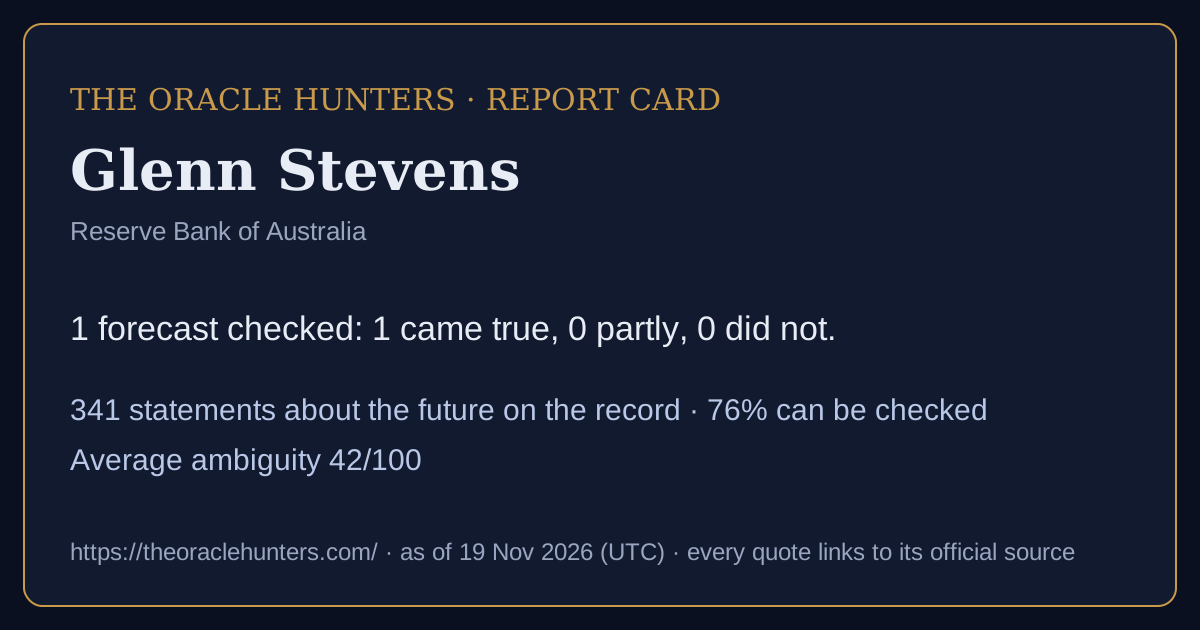
Glenn Stevens
Reserve Bank of Australia
Track record: 1 forecast checked: 1 came true, 0 partly, 0 did not.
341forecasts & commitments on the record
76%can be checked as stated
42average ambiguity (0-100)
0goalpost moves recorded
0confirmed U-turns
Timeline
came true partly did not not due / being checked / too vague
Calibration score: shown after 10 checked forecasts with a stated likelihood (now 1).
How they speak about the future: based on data 188, educated guess 84, stated on authority 69.
Kinds of claim: forecast 206, scenario (if… then) 79, mixed claim 47, commitment 9. · Download this report card as a picture
In the nine words
πρόγνωσιςInference from evidence172 · 50%πρόνοιαPreparing for the future77 · 23%μαντείαInspired knowledge60 · 18%εἰκασίαConjecture16 · 5%προαναγγελίαPublic pre-announcement9 · 3%φρόνησιςPractical wisdom4 · 1%πρόβλεψιςSeeing the signs3 · 1%
How to read this
Each box is one sentence a public figure or institution said about the future, word for word, with a link to the official text. Can be checked means it names what will happen, by when, and how likely - so it can be compared with official figures later. Too vague to check means it does not. Ambiguity (0-100) is how many different ways the sentence can be read. When the date passes, the forecast is compared with official data and marked came true, partly or did not come true. Labels judge the sentence, never the person. Full guide and glossary.Checked
Hence, as things currently look, inflation is more likely to rise during 2008 than to recede.
Came true. Said: inflation would rise in 2008. Official figures for Australia: 2.3% in 2007, 4.4% in 2008 (World Bank open data). official data · checked 14 Nov 2026 · automatic check against official data (rules v3)
On the record (341)
If one further thinks that, by about 200607, the level of output was probably above the trend level, then one could expect a further slight reduction in average growth over the ensuing period as the level of output came back towards the trend level.
This could probably account for growth slowing from 3.6 per cent to about the 3 to 3¼ per cent growth that most people assumed, up until recently at least, to be trend or 'potential' growth.
If it were really true that central bank policies were the only factor at work in very low long-term interest rates, while at the same time they were not helping growth, the critics might have a point.
If trend growth is lower and we can't or don't want to do anything about that, then expectations about future incomes, tax bases and so on will have to be reconfigured.
So in the end we will collectively have to face up to the question of whether trend growth is lower and, if so, what is to be done about that.
The second development is that the outlook for global growth is assessed as having weakened, with forecasters expecting less growth in the global economy this year and next year than they did six months ago.
Alternatively, if demand growth were to be in areas that require relatively little capital to support the labour employed, then the apparent weakness in capital spending outside mining could be of less concern anyway.
If, on the other hand, recent trends were to continue, the income gains coming from higher employment may start to feed into stronger demand growth, which would probably lead in due course to higher levels of investment.
With inflation unlikely to cause a problem by being too high over the next year or two, the statement after the recent meeting indicated that the Board retains the flexibility to ease further, should that be helpful.
As the WA projects come on line in the next few years, Australia's total LNG production capacity will reach over 80 million tonnes per year.
The unemployment rate is projected to remain around 6 per cent or a little above over the next year, before gradually declining.
I won't go into detail here, but, in brief, year-ended GDP growth is forecast to be in the range of 2 to 3 per cent in June 2016 and to pick up a bit during the following year.
Clearly there is a likelihood that the Federal Reserve will raise the fed funds rate next month or, if not then, pretty soon.
The UN projects India's working-age population to increase by 250 million by 2040, to 1.11 billion (compared with 866 million in China).
Those days, like in late August this year, when US and global markets are roiled by some event in China, will probably become more common.
1 If, for example, the 'central' forecast for underlying inflation two quarters ahead is 2 per cent, the statistical likelihood of an outcome of 2 per cent +/- 0.125 per cent, is about 25 per cent, if forecast errors are assumed to be drawn from the same distribution as in the past.
The points of debate might be around whether, and when, growth might speed up a bit or slow down; whether inflation would be broadly consistent with the 2-3 per cent target or a bit on the low side; and whether unemployment could start to drift down, or instead, might resume its drift up.
Over the next couple of years, as the drag from the decline in mining investment starts to lessen (mainly in 2016/17), and the effects of assumed low levels of interest rates and the exchange rate continue to accrue, growth is thought likely to pick up a bit.
By the time it is finished, this decline will probably total something like 5 per cent of GDP.
allocative efficiency, if we could secure it, would doubtless add to growth.
They also know, intuitively, that the kind of growth we want won't be delivered just by central bank adjustments to interest rates or short-term fiscal initiatives that bring forward demand from next year, only to have to give it back then.
But if there are assumptions about absolute growth rates embedded in business or fiscal strategies, or retirement income plans, they would need to be re-examined.
But unless we think our wants, including for publicly provided services, will grow more slowly, which I doubt, the very practical imperative will increasingly be to secure sources of growth.
Lastly on the international front, the likelihood still seems to be that US interest rates will begin to rise before the end of this year.
Moreover, a recent speech by Jamie McAndrews outlines a number of respects in which negative interest rates, if attempted on a widespread basis over a long period, could in fact be very disruptive, and in ways not likely to be expansionary for growth. 3
On the other hand, if there has been a persistent shift in attitudes to debt, spending and saving, then monetary policy's weaker ability to generate short-term growth might just be part of the 'new normal'.
This will lessen the negative feedback from debt to spending, which, in turn, stops aggregate spending falling as much as it otherwise might do (even though the net asset holders will at some point start to reduce their spending if interest income continues to fall).
Rapid declines in asset values might evoke a monetary policy response if they were thought likely to have a significant economic effect.
(The Bank of Japan's was already larger than that, as a result of the use of balance sheet measures over the preceding decade.) They have since increased to around 25-30 per cent of GDP, with the Bank of Japan on a path that will take it to around 90 per cent.
For example the decline in the exchange rate, even if not by as much as we might have expected, has had the effect of supporting growth and keeping inflation from falling as much as it might have done.
The full implementation of the socalled 'third arrow' of structural reform could be expected, if it occurs, to lift growth per head further over the long run.
Underlying inflation is within the 2-3 per cent range that had been forecast.
That will be a very gradual process, but at this stage, indications still seem to be that the US Federal Reserve will begin the process some time this year.
In fact, growth for our trading partners has remained at about 4 per cent and is expected to stay there over the next couple of years.
Back then, the two-year-ahead forecast was for annual GDP growth to be in a range of 2½ to 4 per cent by mid 2015.
If capital requirements become too onerous then the higher cost of borrowing could impinge on economic growth.
And Australia's privately funded retirement income system growing at the time of Wallis but by now amounting to about 100 per cent of GDP - could not be omitted from any comprehensive review of the system.
This is probably a moment to recall the commitments we all made in the G20 meetings in Australia last year, as we agreed on the goal of an additional rise in global GDP of 2 per cent over five years.
And inflation is forecast to be consistent with the 2-3 per cent target.
Indeed, the current projections have China contributing about the same growth in global output in 2015 and 2016 as it did in recent years.
The projections are for a slight pick-up in 2015 and around average growth in 2016.
It will be important this year, after one of the five years has passed, to see whether we are all making good on our various promises.
Housing starts will reach high levels this year and wealth effects do appear to be helping consumption, which is rising faster than income.
Looking back at the history of such episodes, of which there have been a few over the past century or more, if we come through this terms of trade event with neither a major outbreak of inflation in the upswing nor a major crash in the downswing, even if we have a period of sub-average growth in the process, we …
It is expected that the Federal Reserve will, some time this year, lift the federal funds rate accelerator off the floor.
All indications are that this downswing will accelerate this year.
Substantive things have been achieved by way of pro-growth commitments that, if carried through by the various jurisdictions over time, will make a material difference to wellbeing around the world.
As the expansionary effect of very high levels of mining investment is unwound, even if only partly, other sources of demand will need to play a stronger part in driving growth in the economy.
Two years ago we expected capital expenditure by resources firms to peak at about 8 per cent of GDP and then decline.
The market has, and continues to, respond to these pressures by looking for more efficient ways to process cheques, but they are clearly the highest cost payment instrument, as will be confirmed when the Bank releases its payments cost study later this year.
Showing the newest 50 - the ledger has all 341.
Also said - not checkable as stated (12 newest)
Remarks about the future with no date, figure or likelihood that could be checked. They are kept on the record and shown here, but not scored.
Many difficult choices will need to be made along the path of budgetary adjustment.
It remains the case that, over time, the gap in the recurrent budget has to be closed, because rising public debt that is not held against assets will start to be a material problem.
Before leaving indicators of overall performance, though, a fourth observation needs to be made, which will frame the forward-looking part of my remarks.
That will occur should there be a moment of crisis, but it would be better if it occurred before then.
The Financial Stability Board continues to work on these issues and over time presumably we will be able to refine our assessments.
That is not to say central bank policy should not have done all it could, only that we should be realistic about what it can achieve.
For central banks, this has meant trying to be clear about our objectives and our reaction functions - and what we will, or might, do in various states of the world.
Unfortunately, we will not be very good at forecasting these events.
We need providers of finance, be they banks, so-called 'shadow banks' or capital markets, that have ample capacity to bear losses when things go wrong - because sooner or later some things will.
So is the possibility that consumers both there and in Europe may, for particular reasons, be more inclined to save any windfall from lower oil prices than they used to be.
Having said all that, people might be being a little too pessimistic about the effects of the fall in oil prices.
The point here is not so much that growth is that weak: it is forecast to be higher than it was in the relatively mild global slowdown in the early 2000s, for example, and nothing like as weak as 2009.