Gillian Keegan
Department of Health and Social Care · GBR
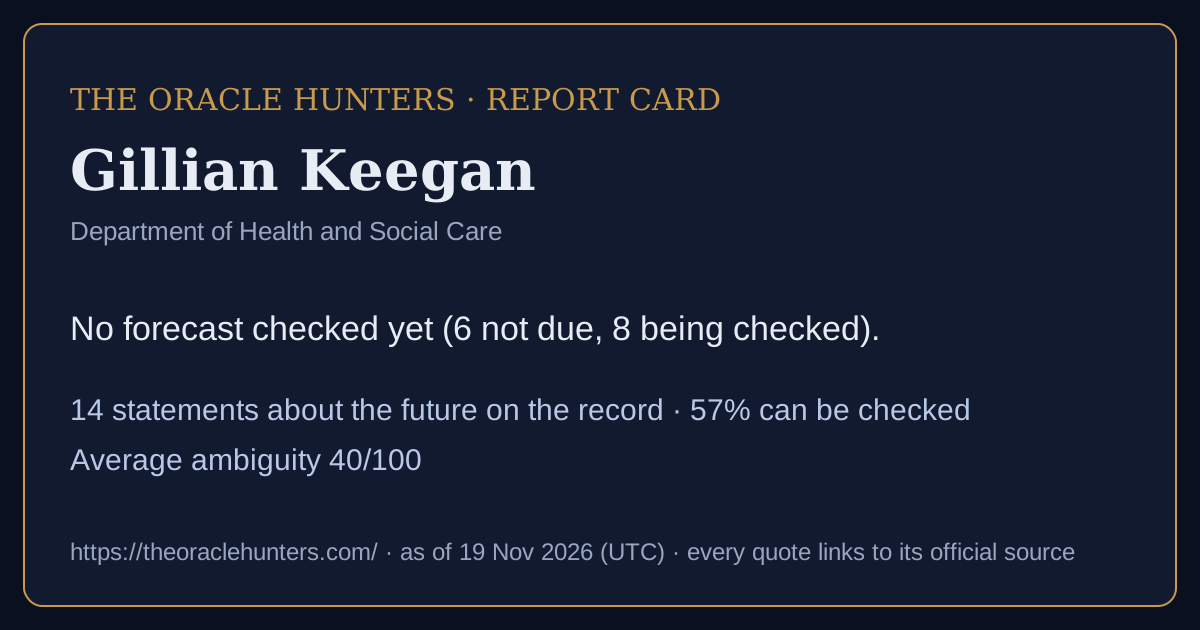
Track record: No forecast checked yet (6 not due, 8 being checked).
14forecasts & commitments on the record
57%can be checked as stated
40average ambiguity (0-100)
0goalpost moves recorded
0confirmed U-turns
Timeline
came true partly did not not due / being checked / too vague
Calibration score: shown after 10 checked forecasts with a stated likelihood (now 0).
How they speak about the future: based on data 13, stated on authority 1.
Kinds of claim: forecast 11, mixed claim 3. · Download this report card as a picture
In the nine words
How to read this
Each box is one sentence a public figure or institution said about the future, word for word, with a link to the official text. Can be checked means it names what will happen, by when, and how likely - so it can be compared with official figures later. Too vague to check means it does not. Ambiguity (0-100) is how many different ways the sentence can be read. When the date passes, the forecast is compared with official data and marked came true, partly or did not come true. Labels judge the sentence, never the person. Full guide and glossary.On the record (14)
Over the next two years we will recruit over 1000 volunteers as climate ambassadors, to support over 2,500 education settings.
By this time next year, 3,700 schools from priority areas, such as Blackpool and Ipswich, will benefit from a new wireless network.
We’re also scaling up the delivery of our Skills Bootcamps to help transform the adult skills landscape and we’ve set an ambitious target of reaching 64,000 learners in key growth areas, including digital and green skills, by March next year.
I’m pleased that next year, high needs funding will rise to £10.5 billion.
I know that funding won’t fix everything, but I’ve made sure that from next year overall school funding will be more than £59.6 billion, the highest per-pupil figure in real terms ever.
We have also announced £289m of investment to help you set up and deliver wraparound childcare, available from next year.
In February this year, we set out how we will provide this and ensure children are kept safe and stay happy.
This is why the Chancellor pledged the single biggest investment in childcare this country has ever seen, and why by 2028 we will have doubled spending on childcare with more than £8 billion every year on early years education.
Most importantly the taskforce will make it easier for students to choose computing and digital pathways at school, colleges, Institutes of Technology and universities and we have invested over £100 million in the National Centre for Computing Education.
If you think this sounds alarming, by 2030 this gap is expected to reach 85 million - bigger than Germany’s current population.
Last year the market for wearable tech was worth around $61billion and is expected to grow 15% a year between now and 2030.
This year the scheme is unlocking opportunities for more than 38,000 UK students and learners who will gain international experience, developing skills and expertise.
On the top of my in-tray when I got this job was a joint letter from the four major teaching unions – it asked for an extra £2 billion next year and the year after to support our schools with increased costs and to help fund this years pay awards.
According to the UN, climate change is expected to cause around 250,000 extra deaths a year between 2030 and 2050.
Also said - not checkable as stated (12 newest)
Remarks about the future with no date, figure or likelihood that could be checked. They are kept on the record and shown here, but not scored.
Artificial intelligence will likewise transform our lives.
AI is going to be another one of those changes, just like that.”
Our department for science and innovation is currently hosting a virtual AI summit with South Korea – because only by sharing national developments through international dialogue will we stay on top of developments in this field.
Even Bill Gates once said: “technology is just a tool, in terms of getting the kids working together and motivating them, the teacher is the most important” and of course giving them that confidence they will need to succeed in life.
He shares my view that whilst we need to mitigate those risks, we’re approaching a time when we will see a monumental shift in the way in which technology is used in education.
These conversations have highlighted some of the opportunities and the challenges that AI might bring.
As part of that ambition, we’ve introduced a new AI Safety Institute, which will ensure that the UK and the rest of the world are not caught off guard by rapid and unexpected advances in technology.
They will need to have the skills to deliver the net zero transition that we have legislated for.
I hope to be able to say more shortly on how we will explore the potential impact of generative artificial intelligence on education, including reducing time spent by teachers on administrative tasks.
That is why we have announced that we will introduce a new Advanced British Standard (ABS) for 16–19-year-olds.
We have to be bold and even more ambitious about what our young people need, what will help them succeed.
We will work with you, and with families, to develop and test these resources over the coming months.