Gill Marcus
South African Reserve Bank
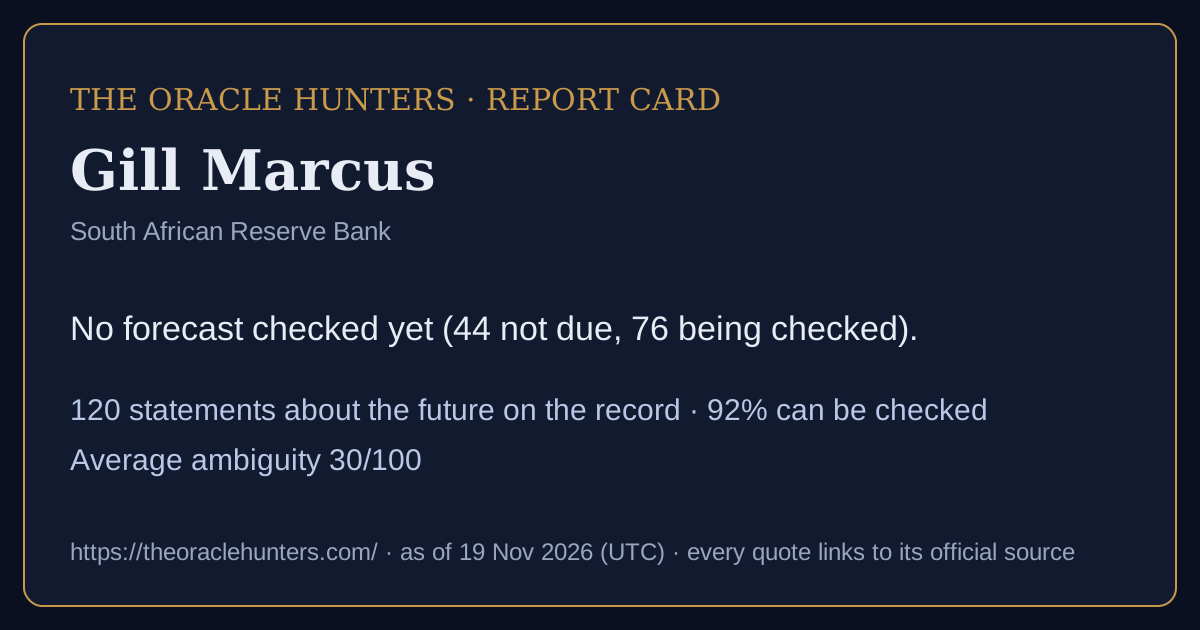
Track record: No forecast checked yet (44 not due, 76 being checked).
120forecasts & commitments on the record
92%can be checked as stated
30average ambiguity (0-100)
0goalpost moves recorded
0confirmed U-turns
Timeline
came true partly did not not due / being checked / too vague
Calibration score: shown after 10 checked forecasts with a stated likelihood (now 0).
How they speak about the future: based on data 90, stated on authority 15, educated guess 15.
Kinds of claim: forecast 99, scenario (if… then) 12, mixed claim 7, commitment 2. · Download this report card as a picture
In the nine words
πρόγνωσιςInference from evidence90 · 75%μαντείαInspired knowledge13 · 11%πρόνοιαPreparing for the future12 · 10%εἰκασίαConjecture3 · 2%προαναγγελίαPublic pre-announcement2 · 2%
How to read this
Each box is one sentence a public figure or institution said about the future, word for word, with a link to the official text. Can be checked means it names what will happen, by when, and how likely - so it can be compared with official figures later. Too vague to check means it does not. Ambiguity (0-100) is how many different ways the sentence can be read. When the date passes, the forecast is compared with official data and marked came true, partly or did not come true. Labels judge the sentence, never the person. Full guide and glossary.On the record (120)
It is highly likely that, after a long period of a synchronised downturn in the economic performance of advanced economies, next year will be characterised by an asynchronised recovery.
Going forward, it is possible that inflation will return to within the target range in the first quarter of 2015, but is likely to remain close to the top of the band.
It is quite likely that these two economies will begin tightening monetary policy in the first half of 2015 and while the rates normalisation process is likely to be gradual and prolonged, given continued fragility in the global economy, interest rates are likely to be on their way up.
- -senior debt instruments and wholesale deposits (excluding subordinated debt holders) will be transferred at 90% of face value following the restructuring (the absolute interest rate will be based on the revised face value)
With household consumption expenditure and private sector investment growth expected to slow further amid weak business confidence, the Bank has lowered its growth forecast for 2014 to 1,7 per cent.
Its growth is now expected to be below 7,5 per cent, lower than historically, and while risks are seen to be on the downside recent data suggest that these downside risks may have dissipated somewhat.
However, the Bank will continue to play its part in supporting the economy through these difficult times by maintaining its focus on price stability in support of sustainable economic growth.
Inflation is expected to return to within the target band during the second quarter of 2015.
It is also complicated by the fact that normalisation in the advanced economies is likely to be unsynchronised, with further loosening expected in Japan and the Eurozone, while the Bank of England has indicated that the first policy rate increase could already occur later this year, but at a moderate pace.
The forecast average inflation for 2015 and 2016 is 5,9 per cent and 5,6 per cent respectively, with inflation expected to average 5,5 per cent in the final quarter of 2016.
Nevertheless, unless these stoppages turn out to be far worse than anticipated, the Bank's base case remains one of positive growth for this year, although it may be difficult to achieve a better outcome than last year.
To give some perspective of how bad things will have to be in order to get to this point: if zero growth in each of the remaining three quarters of the year were to be recorded, the economy would still achieve a positive growth rate of 0,8 per cent for the year.
So while tapering is steadily continuing, and is expected to be completed later this year, there is a great deal of uncertainty about the outlook for short term interest rates.
The growth forecast of 3,1 per cent for 2015 is predicated on a more stable industrial relations environment and an improvement in the electricity supply situation, with new generating capacity coming on stream early in 2015.
The Bank's most recent growth forecast, as indicated in the May monetary policy statement of the MPC, is for growth for this year of 2,1 per cent, but with a downside risk.
While the accuracy of these measures can be debated, we only need to look at the recent growth rate of the economy, -0,6 per cent in the first quarter of this year and concerns for second quarter growth amid unresolved and intensifying labour disputes, to recognise that we have enormous challenges ahead of us.
In 2007, 38 per cent of South African manufactured exports went to Europe, with 25 per cent going to Africa.
While this is an improvement, it is still below potential, and likely to have a minimal positive impact on the unemployment rate, which currently stands at 24,1 per cent.
At the most recent meeting in March, the inflation forecast had improved slightly, particularly for 2015, and the MPC kept the repurchase rate unchanged.
Inflation was expected to average 6,0 per cent in the second quarter of 2015 and remain close to the top of the band for the remainder of the year.
According to the latest World Economic Outlook, economic growth in sub-Saharan Africa is expected to average 6,1 per cent in 2014 and 5,8 per cent in 2015.
The Bank's forecast for growth in 2014 and 2015 is 2,6 per cent and 3,1 per cent for these two years respectively.
So a forecast close to the upper end of the target range could result in a preemptive tightening if the economy is operating close to or above potential and the output gap is positive.
Although the Reserve Bank projects an improved growth rate of 2.8 percent growth for this year, it is still too low to make a meaningful dent in our unemployment rate.
Labour Organisation projects that unemployment levels are only likely to reach pre-crisis levels by 2017, a full ten years from the start of the crisis.
A consistent growth rate of 7 per cent will allow for a doubling of income every 10 years, whereas a growth rate of 3 per cent will take 24 years to double incomes.
The 2013 growth forecast for China was reduced from 7,8 per cent to 7,5 per cent;
While the news from the US appears relatively positive, the same cannot be said about the prospects for the Eurozone, where the outlook for growth is poor, despite the fact that the region as a whole emerged from recession in the second quarter of this year.
This is why we pay such close attention to developments in the US, including who will replace Ben Bernanke when his term expires at the end of January 2014.
The July World Economic Outlook (WEO) update of the IMF forecasts growth of -0,6 per cent in 2013 and 0,9 per cent in 2014, with the risks still seen to be on the downside.
The ILO estimates that the number of unemployed people in advanced economies is likely to remain above the precrisis level up to at least 2017, a full decade after the crisis first began.
Unless we neutralise this liquidity increase, it could have inflationary consequences.
The Bank's most recent forecast is for growth of 2,0 per cent in 2013, rising to 3,3 per cent next year.
Unfortunately, this year's shareholder road shows were not well attended and the Bank has decided that it will no longer hold the road shows in Durban and Cape Town unless circumstances dictate otherwise.
At the same time, driven mainly by a depreciating currency and rising wage and salary costs, the forecast inflation path has moved up, and a temporary breach of the target range is expected in the third quarter of this year, despite an absence of strong demand pressures.
If things do not get any worse it will probably still take a number of years before the world is back to more normal growth and output gaps are fully closed.
Furthermore, if there is a spike in inflation as a result of the depreciation, is it a one-off increase that will pass through the numbers by next year, or will it generate a depreciation-inflation spiral?
There has been increasing attention paid to many parts of the African continent, which is expected to maintain a growth rate in excess of 5 per cent for the next few years.
The recent OECD report suggests that the Eurozone will contract by 0,6 per cent this year, and only grow by 1,1 per cent next year.
The World Trade Organisation last week downgraded its forecast for growth in world trade in 2013 from 4,5 per cent to 3,3 per cent (well below the long run trade growth of 6 per cent), mainly a result of renewed risks coming from the Eurozone and the impact of rising protectionism.
These factors are expected to contribute to a temporary breach of the inflation target during this year.
According to Arvind Subramanian of the Peterson Institute of International Economics, this latter share is expected to increase to as much as 45 per cent by about 2030.
The National Treasury estimates that R827 billion will be spent on infrastructure over the next three years.
Electricity supply constraints are also an impediment to investment growth, and are likely to remain so until new capacity, currently under construction, comes on stream during 2014.
The Bank's latest forecast is for growth of 2,6 per cent in 2013 and 3,8 per cent in 2014.
The output gap remains negative, and with growth expected to remain below potential (3,5 per cent) this year, the gap is not expected to be closed within the Bank's forecast period ending 2014.
Nevertheless the government remains committed to achieving a fiscal consolidation path, and expects the deficit to GDP ratio to decline to 3,1 per cent by 2015/16 .
According to the latest World Economic Outlook, economic growth in subSaharan Africa is expected to average 5,8 per cent in 2013 and 5,7 per cent in 2014.
We are, however, still concerned about the impact of the proposed net stable funding ratio (NSFR) which is expected to be implemented in 2018.
In May of 2012 the registrar of banks announced the introduction of such a facility, which will be provided for an amount of up to 40 per cent on any particular bank's net cash outflows under stressed scenarios.
Showing the newest 50 - the ledger has all 120.
Also said - not checkable as stated (12 newest)
Remarks about the future with no date, figure or likelihood that could be checked. They are kept on the record and shown here, but not scored.
Whether or not policy should focus primarily on core inflation is an issue that will be addressed by Stan du Plessis, and I am sure it will generate some interesting debate.
The conventional response at the time, as typified in Chairman Greenspan's Jackson Hole address in 2003, was that central banks could not recognise asset price bubbles, and therefore should not lean against them, but should rather clean up after the bubbles had popped (Bill White's so-called 'lean or clean' debate).
This does not mean, however, that interest rates could or should not be used in combination with macroprudential tools should the need arise.
Although the focus of the conference is more about the future, the topic does imply some assessment of the framework, and I will attempt to provide brief reflections of the past 14 years of inflation targeting in South Africa.
A criticism sometimes leveled at inflation targeting is that the response to such supply side shocks could lead to pro-cyclicality of monetary policy.
Depending on the extent to which inflation expectations are anchored, we could also take a more flexible approach by, for example, extending the policy time horizon.
South Africa will continue to take steps to promote financial inclusion but we will not tolerate unhealthy lending practices or excessive risk-taking in the financial sector.
We will continue to deepen our engagements in order to be part of a global movement for shared prosperity.
While there is uncertainty about the pace at which discouraged jobseekers will return to work, there is optimism that wage and income growth will return in the course of the next year.
These will further strengthen the resilience of the banking system as a whole, and, importantly, they will provide African Bank with the best chance of a viable future.
These meetings commenced in May 2013, and the Governors received regular reports on measures taken by the Bank Supervision Department on the steps they required African Bank to take in addressing the concerns.
He will be responsible for African Bank with immediate effect, with the full authority the law confers on the curator.